
Taste Note - Amazon Leadership Best Sellers
Turn the Ship Around!: Moving Authority to Where the Information Already Lives
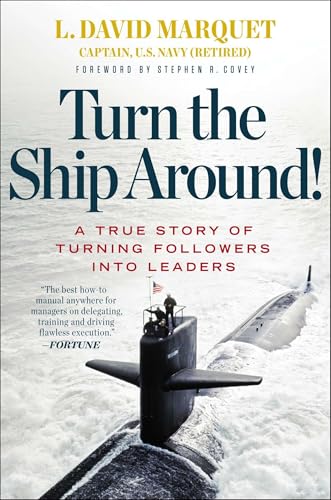
A Kurums Book Taste review of Turn the Ship Around! for HR and people leaders who need to build leadership at every level instead of waiting for orders to flow down.
Why this book fits Kurums
Most leadership programs teach people to become better order-givers. Marquet's account of commanding the nuclear submarine USS Santa Fe argues the opposite: the order-giving model itself is the bottleneck. When only the person at the top thinks, the whole organization is capped at that one person's attention, and the moment that person leaves, performance drops with them.
For the Kurums HR audience this book is unusually useful because it does not stay at the level of culture talk. It describes specific language changes, meeting habits and certification routines that shifted decisions downward in one of the most rule-bound, high-consequence workplaces there is. If you design manager development, succession plans or decision-rights frameworks, you get a tested blueprint rather than a theory.
What the book argues
Marquet opens with his own failure. Trained in detail on one class of submarine and then reassigned at short notice to a different one, he gave an order that was impossible on that boat, and the crew relayed it anyway. The lesson he draws is blunt: a crew trained to follow will execute a bad order, and a leader who relies on knowing every technical detail will eventually be wrong in front of people who knew better but stayed quiet.
From there he lays out the shift from a leader-follower model to a leader-leader model. The core move is to stop moving information up to authority and instead move authority down to where the information already sits. He supports it with three pillars: control, meaning decision rights actually handed to the people doing the work; competence, meaning the technical knowledge needed to use that control safely; and clarity, meaning a shared understanding of purpose so that decentralised decisions still point the same way.
The rest of the book is a sequence of mechanisms, each tied to a moment on board. Officers stop requesting permission and start announcing intent. Briefings that people sit through passively are replaced by certifications where the team must show it is ready. Mistakes are examined for their root process rather than punished as individual lapses. Marquet's claim is that these practices outlasted his tour because they were built into how the crew worked, not attached to his personality.
Key ideas, translated to your desk
Say "I intend to"
Ask people to state the action they plan to take and why, rather than ask permission. You approve or question the intent, and the thinking stays with them.
Control needs competence
Handing over decision rights without the skills to use them is abdication, not empowerment. Pair every delegation with the training and checks that make it safe.
Certify, don't brief
Replace one-way briefings with short sessions where the team demonstrates readiness. You learn whether the knowledge is really there before the work starts.
Use it at work
- Map ten recurring decisions in one team and move at least three of them down a level, with the information needed to make them.
- Coach managers to answer requests for permission with "What do you intend to do?" for one month.
- Turn your next project kickoff briefing into a readiness check where the team explains the plan back.
- Rewrite your leadership competency model so it rewards developing decision-makers, not just making good decisions.
Read it if
- You are designing a leadership program and want behaviours managers can practise on Monday.
- Your organization escalates small decisions because nobody below the top feels allowed to own them.
- You liked The Coaching Habit and want the organizational system that makes asking instead of telling stick.
You can skip it if
- You need research data on engagement; this is a first-person case account, not a study.
- Military settings put you off; the examples are naval throughout, and you have to do the translation yourself.
- Your teams already run on explicit decision rights and you mostly need help with hiring or pay.
This book appears in
Curated Tasting Menus that chain this title into a reading route.
Discover more from Kurums | Business Intelligence
Subscribe to get the latest posts sent to your email.