
Employer surveys project 2027 health benefit costs rising 8% to 11%. Here is how to read the numbers and where HR still has room to act.
Employer surveys from Marsh, the Business Group on Health, Aon and Brown & Brown project 2027 health benefit costs rising between about 8% and 11%, the steepest in two decades by Marsh's measure. Workers already pay 9% more for family coverage in 2026, according to KFF. Most employers plan to shift some cost, but the more durable options are funding alternatives for small firms, pharmacy contract terms, steering to high-value care and tighter vendor guarantees.
What the 2027 forecasts say
Every major employer survey published this year points the same way: 2027 health benefit costs will rise faster than in any recent year, and plan design changes will only take part of the edge off.
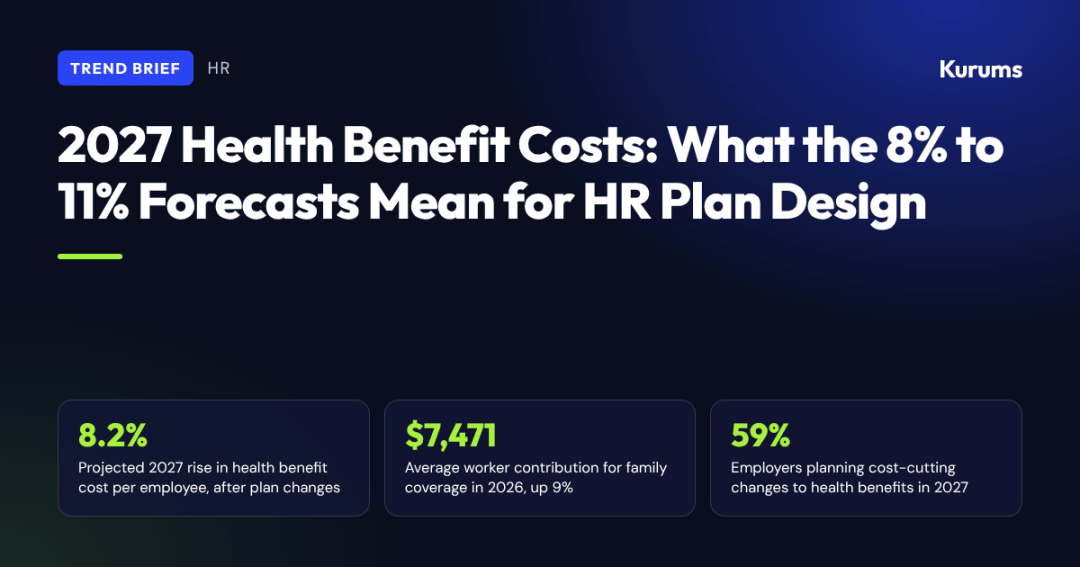
Marsh reported in preliminary results from its 2026 National Survey of Employer-Sponsored Health Plans, released September 2, 2026, that employers expect total health benefit cost per employee to rise 8.2% on average in 2027 after planned cost-reduction measures. Marsh called that the highest increase since 2003. Without changes, the more than 1,800 responding employers said the cost of their current plans would rise 11% on average. The comparable figure for the current year was 6.7%. These are preliminary numbers; Marsh said final results would follow later in the year.
The Business Group on Health, which surveys large employers, found a median projected increase of 9.2% for 2027, falling to about 8% after plan changes, according to Healthcare Dive’s report on the survey of 127 employers covering about 8.7 million people. Aon projects 9.5% before mitigation and average spending above $19,000 per employee, according to SHRM. Healthcare Dive also cites a WTW figure of 11.1%. Brown & Brown expects an average 10% rise in both 2026 and 2027 even after plan design changes, HRD America reported on November 25, based on that firm’s survey of 998 US employers.
Two cautions apply. First, these are projections, not renewals. Second, the Business Group on Health said employers underestimated actual medical spending for three straight years, each miss larger than the last. Its president and CEO, Ellen Kelsay, is quoted by Healthcare Dive as saying the pattern suggests current forecasts for 2026 and 2027 “may actually be too optimistic”.
What is driving the increase
The sources agree on most of the causes:
- High-cost claims. Marsh points to expensive new cancer and rare-disease therapies. In the Business Group on Health survey, 70% of employers named cancer as their top cost driver, up from 58% a year earlier.
- Pharmacy. The Business Group on Health puts pharmacy at about a quarter of total spending and projects it to rise 12% in 2026 and again in 2027. Marsh attributes about one percentage point of 2027 cost growth to rising GLP-1 use.
- Provider pricing and billing. Both surveys cite health system consolidation. Marsh also cites AI-enabled billing software that has increased the number and level of claims, and 64% of Business Group on Health respondents reported a cost impact from providers’ AI-driven revenue optimisation.
- Out-of-network disputes. Marsh cites larger than expected payments through the No Surprises Act dispute resolution process. The Business Group on Health cited vendor estimates that these claims add about two percentage points to medical trend.
What employees are already paying
The 2027 increase lands on a workforce that has just absorbed a large one. KFF’s 2026 Employer Health Benefits Survey, released October 22, 2026, found the average family premium reached $28,303, up 5% from 2025, while the average worker contribution for family coverage rose 9%, or $621, to $7,471. Over the same period wages rose 3.7% and inflation 2.7%, KFF said.
Firm size matters. KFF found covered workers at firms with fewer than 200 workers contribute $9,687 a year toward family coverage, $2,847 more than at larger firms, and face an average single deductible of $2,624 against $1,772 at large firms. Among firms with 200 or more workers, 44% increased the share of premium that workers pay and 21% increased deductibles or other cost sharing.
Search behaviour reflects the season more than a spike in alarm. On Google Trends, a relative index from 0 to 100 and not a measure of search volume, US interest in “open enrollment” peaked at 100 on November 2, 2026 and averaged 32.9 over the last seven days, against 43.0 over the earlier part of the 90-day window. “Health insurance cost” averaged 12.3 in the last seven days against 19.1 earlier, with its peak of 28 on September 21, in the weeks after the Marsh, Aon and Business Group on Health forecasts were published.
Search interest: health insurance cost vs open enrollment
Google Trends, United States, Aug 27, 2026 to Nov 27, 2026. Daily index, 0–100, relative to the highest point among the terms compared; it shows relative attention, not search volume.
Why this is an HR problem and not only a finance problem
Marsh found 59% of employers plan cost-cutting changes to health benefits in 2027, including higher deductibles, and a separate Marsh survey found about two-thirds of large employers expect to raise the employee share of premiums. HRD America reported on November 25 that 85% of employers are considering higher employee contributions; the article does not name the survey behind that figure, so treat it as indicative.
The trade-off is retention. Ted Jordan of Paychex Insurance Agency told HRD America that employers with fewer than 100 workers feel the pressure most and that shifting cost to employees can weaken the retention value of the benefit. Marsh’s Simon Camaj put the employer side plainly: “Few organizations can absorb health cost increases that outpace inflation without making difficult financial decisions.”
In an earlier HRD America interview, Wes Cowen of OneDigital framed the practical limit: “Employers can’t fully shield their employees from rising costs, but they can limit how much lands on them.”
How to respond, by situation
Small employers on fully insured plans
Jordan’s observation is that many smaller employers renew fully insured plans without evaluating alternatives. The options he lists are level-funded arrangements, professional employer organisations and individual coverage health reimbursement arrangements (ICHRAs). He regards ICHRAs as suitable only for the right employers and says they need ongoing employee support, not a “drop and run” handover.
Mid-size and large self-funded plans
The large-employer playbook is shifting from cost sharing to steering and vendor discipline. In the Business Group on Health survey, 92% expect to use a value-based strategy such as a centre of excellence, high-performance network or accountable care organisation by 2027; 83% are expanding performance guarantees; 71% are tying vendor payment to outcomes; and 58% have replaced or plan to replace underperforming vendors. Marsh found 12% of large employers plan variable copay plans in 2027, rising to 18% among those with 20,000 or more employees.
Pharmacy and GLP-1 coverage
Coverage of GLP-1 drugs for obesity is contracting, though the numbers vary by sample. Among Business Group on Health members it fell from 72% to 60% and no employer plans to add it. KFF, with a broader sample, found about 18% of large firms cover the drugs for weight loss, and 29% of those report a significant effect on drug spending. Cowen’s point is that the decision does not have to be all or nothing: restrictions and eligibility criteria sit between full coverage and exclusion.
On contracts, Chana Bieker of Brown & Brown Benefits told HRD America that employers should look at formulary defaults, specialty pharmacy sourcing and pricing transparency, write performance guarantees into contracts and shorten pharmacy benefit manager and carrier terms to one or two years. KFF found only 49% of large firms say they receive sufficient rebate information.
Eligibility and wellbeing budgets
Bieker cautions against one common cut: excluding working spouses can raise costs by removing healthier, lower-cost members and concentrating risk. Wellbeing is not where most are cutting: in Brown & Brown’s survey, 79% of employers with a formal wellbeing programme plan to increase its budget in 2027.
The forecasts side by side
| Source | 2027 projection | Basis | Sample |
|---|---|---|---|
| Marsh (preliminary, Sep 2) | 8.2% per employee; 11% with no changes | 8.2% is after planned cost-reduction measures | More than 1,800 US employers |
| Business Group on Health | 9.2% median; about 8% after changes | Large-employer median | 127 employers, about 8.7m lives |
| Aon (via SHRM, Aug 21) | 9.5%; above $19,000 per employee | Before mitigation | More than 1,100 US employers |
| Brown & Brown (via HRD, Nov 25) | 10% average in 2026 and 2027 | After plan design changes | 998 US employers |
| WTW (via Healthcare Dive) | 11.1% | Basis not stated in the report we read | Not stated |
Risks and open questions
- Forecast error. If the Business Group on Health’s three-year pattern of under-forecasting repeats, 2027 budgets built on 8% to 10% will be short.
- Final survey data. Marsh’s 8.2% is preliminary. We did not find final results.
- Coverage shifts. Healthcare Dive reports employer concern that Medicaid cuts and reduced ACA subsidies could push sicker people toward employer plans and lead providers to raise commercial prices. That is an expectation, not a measured effect.
- Comparability. The surveys use different samples, and some figures are before plan changes while others are after. Do not average them.
What to do next
- Ask your broker or actuary whether your 2027 budget figure is before or after plan changes, and stress test it at two points above the forecast.
- Model the 2027 employee contribution change against planned pay increases for your lowest-paid covered tier before finalising it.
- If you are fully insured with fewer than 200 workers, request level-funded, PEO and ICHRA comparisons ahead of the next renewal.
- Pull pharmacy data on GLP-1 and specialty drug spending and decide coverage criteria deliberately instead of defaulting to yes or no.
- Review pharmacy benefit manager and carrier contracts for term length, rebate reporting and performance guarantees.
- Check any proposed spousal exclusion or eligibility cut for its effect on the risk pool before adopting it.
- Plan human enrollment support, not only a portal, for employees facing new plan options or higher cost sharing.
Frequently asked questions
How much will employer health insurance costs increase in 2027?
Published projections range from about 8% to 11%. Marsh's preliminary survey shows 8.2% per employee after plan changes and 11% without them. The Business Group on Health reports a 9.2% median, Aon 9.5% before mitigation, and Brown & Brown 10%. These are employer forecasts, not final renewal results, and recent forecasts have run low.
Why are health benefit costs rising so fast?
The surveys cite high-cost claims, especially cancer and rare-disease therapies, pharmacy spending including GLP-1 drugs, hospital consolidation, AI-enabled provider billing that raises the number and level of claims, and out-of-network payments under the No Surprises Act dispute process. The Business Group on Health projects pharmacy costs alone to rise 12% in 2027.
Are employers raising employee contributions for 2027?
Many are. Marsh found 59% of employers plan cost-cutting changes such as higher deductibles, and about two-thirds of large employers expect to raise the employee share of premiums. KFF found 44% of firms with 200 or more workers had already increased the worker share of premiums in its 2026 survey.
Are employers dropping GLP-1 coverage for weight loss?
Some are. Coverage among Business Group on Health members fell from 72% to 60%, with none planning to add it, and Marsh says some employers are dropping it for 2027. KFF found about 18% of large firms cover GLP-1 drugs for weight loss, often with restrictions. Advisers quoted by HRD America suggest criteria-based coverage as a middle route.
- Marsh (Mercer): Employers expect health benefit costs to jump 8.2% in 2027, and the impact will likely be felt by workers, according to Marsh (2026-09-02)
- Healthcare Dive: Employers face ‘existential reckoning’ as health costs surge (2026-08-26)
- SHRM: Employers Face 9.5% Healthcare Cost Increase in 2027 (2026-08-21)
- KFF: Workers Now Pay $7,471 on Average Annually for Family Health Coverage, Up 9% or $621 from 2025 (2026-10-22)
- HRD America: Why employee benefits costs are becoming an HR crisis in 2027 (2026-11-25)
- HRD America: Why HR leaders must rethink their benefits strategy for 2027 (2026-11-25)
- HRD America: Open enrollment: HR leaders face the hardest renewal cycle yet (2026-11-19)
Search-interest figures are from Google Trends (United States, 90 days to November 27, 2026). This article is analysis for operators, not legal, tax or investment advice. Last updated November 27, 2026.
Discover more from Kurums | Business Intelligence
Subscribe to get the latest posts sent to your email.