
Which type of e-commerce is the largest?
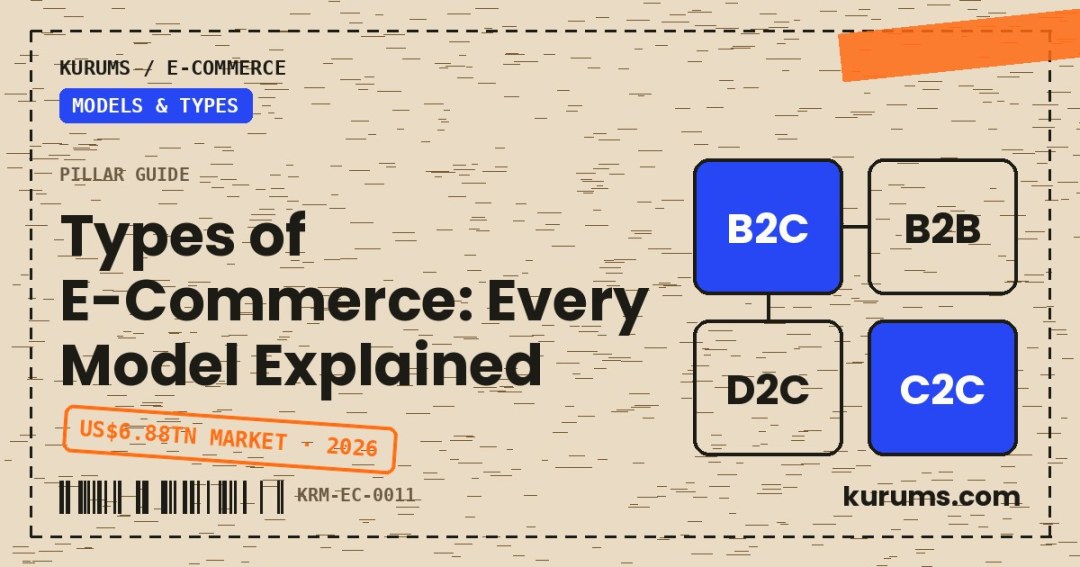
B2B by transaction value, B2C by number of buyers. Global retail e-commerce alone is forecast at about US$6.88 trillion in 2026, roughly 21% of all retail sales.
Which type is easiest to start?
C2C and marketplace-based B2C: the platform supplies the traffic, payments and trust. You pay for that in fees and in not owning the customer.
Which type has the best margins?
D2C on paper, because no retailer takes a cut. In practice customer acquisition cost often replaces the retailer's margin.
Ask ten founders what "an e-commerce business" is and you will get ten different companies: a factory selling pallets to distributors through a portal, a teenager reselling trainers on an app, a skincare brand with a subscription, a supermarket's delivery arm. They share a checkout page and very little else. Their margins, cash cycles, legal duties and growth levers are different, and advice that is right for one is wrong for another.
This guide is the map for the rest of the Kurums E-Commerce pillar. It sorts e-commerce the way investors and operators actually do: first by the parties to the sale, then by the revenue model, then by where the stock sits.
What are the main types of e-commerce?
There are five classic types, defined by who is on each side of the transaction: business-to-consumer (B2C), business-to-business (B2B), direct-to-consumer (D2C), consumer-to-consumer (C2C) and business-to-government (B2G). A sixth, consumer-to-business (C2B), covers creators and freelancers selling to companies.
| Type | Who sells to whom | Typical order | What drives profit | Example |
|---|---|---|---|---|
| B2C | Retailer to shopper | Small, frequent | Conversion rate, repeat rate | An online electronics store |
| B2B | Company to company | Large, negotiated | Account retention, credit terms | A parts distributor's ordering portal |
| D2C | Brand or maker to shopper | Small to medium | Gross margin vs acquisition cost | A mattress or cosmetics brand's own site |
| C2C | Individual to individual | Small, one-off | Platform take rate | Second-hand fashion apps |
| B2G | Company to public body | Very large, tendered | Compliance, win rate | E-procurement portals |
| C2B | Individual to company | Project-based | Reputation, volume | Stock photo and freelance platforms |
The labels describe relationships, not company types. A single brand can sell D2C on its own site, B2C through a marketplace and B2B to boutiques through a wholesale platform, all in the same week.
How does B2C e-commerce work, and what makes it hard?
B2C e-commerce sells finished goods to individual shoppers through a website, app or marketplace. It is the most visible type and the most crowded: low barriers to entry mean you compete on price, delivery speed and trust, and you pay for almost every visitor.
The scale is real. EMARKETER's forecast, as published by Shopify, puts global retail e-commerce at roughly US$6.88 trillion in 2026, about 21.1% of worldwide retail sales, up from 20.5% a year earlier. In the United States, Census Bureau data cited by industry trackers shows online sales at about 17% of retail in mid-2026.
The difficulty is that B2C demand is rented. A typical store converts somewhere between 1.4% and 3% of sessions depending on the benchmark you use, and around seven in ten carts are abandoned (Baymard Institute's long-running average is 70.22%). That is why the numbers in our e-commerce metrics guide matter more here than in any other model: a B2C store lives or dies on conversion rate, average order value and repeat purchase rate.
Pure B2C retailers also carry inventory risk. If you buy stock and resell it, your cash is tied up for the full cycle from supplier payment to customer payment, which is why many small sellers start with the lighter models in our comparison of dropshipping, private label, wholesale and print-on-demand.
Why is B2B e-commerce bigger than it looks?
B2B e-commerce is the online sale of goods between companies: manufacturer to distributor, wholesaler to retailer, supplier to factory. It is larger than consumer e-commerce by value because orders are bigger and repeat on contract, yet it is less visible because most of it happens behind a login.
Three things separate B2B from B2C:
- Price is not public. Buyers see customer-specific price lists, volume breaks and negotiated terms.
- Payment is on account. Net-30 or net-60 invoicing replaces card checkout, so the seller is effectively lending money and needs credit control.
- The buyer is a team. A purchasing manager, a finance approver and an end user may all touch one order, so approval workflows matter as much as the product page.
B2B comes in two flavours. A private portal is your own ordering site for existing customers. A B2B marketplace is a shared venue where buyers find new suppliers: Alibaba.com for manufactured goods, Faire and Ankorstore for independent retail. We compare those venues in how to find wholesale suppliers and in the Kurums comparison of B2B purchasing marketplaces.
What is D2C, and is it really more profitable?
Direct-to-consumer means the brand that makes or designs the product sells it straight to the end customer, skipping wholesalers and retailers. The brand keeps the retailer's margin and owns the customer data. The catch is that it also inherits the retailer's costs: marketing, fulfilment, returns and service.
A simplified example shows why D2C margins are often overstated. A product costs 20 to make and retails at 100. Sold through a retailer at a wholesale price of 50, the brand earns 30 before overheads. Sold direct at 100, the brand appears to earn 80. Now subtract payment fees (about 3), pick, pack and shipping (10), returns (5) and paid advertising to find the customer (often 25 to 35 on a first order). The direct sale lands close to the wholesale one, and it carries more risk.
D2C wins when the second and third orders arrive without a second advertising bill. That is the logic behind subscriptions, loyalty programmes and email flows, and it is why D2C founders obsess over the ratio between customer lifetime value and acquisition cost, explained in plain language in CAC & LTV, Decoded and worked through with numbers in e-commerce unit economics.
How do C2C and recommerce platforms make money?
In consumer-to-consumer e-commerce, private individuals sell to each other and a platform sits in the middle. The platform holds no stock. It earns a take rate: a commission on each sale, listing or promotion fees, and increasingly payment and shipping-label margin.
C2C used to mean online auctions and classified adverts. Its growth today is in recommerce: second-hand fashion, refurbished electronics and collectibles. For a founder, C2C matters in two ways. First, it is the lowest-cost testing ground: you can validate demand for a product type with a handful of listings before buying stock. Second, the line between C2C and B2C is a legal one. Tax authorities and consumer law in most countries treat regular, for-profit selling as a business, whatever the app calls you. In the EU, platforms must report seller income under the DAC7 rules, so "casual" sellers who are really traders become visible.
What other e-commerce models sit on top of these types?
The who-sells-to-whom labels say nothing about how revenue is generated. Layered on top are five revenue models that can be combined with any of them.
| Revenue model | How it earns | Strength | Main risk |
|---|---|---|---|
| Own online store | Product margin on each order | You own the customer and the data | You must buy or earn all the traffic |
| Marketplace selling | Product margin minus platform fees | Instant demand and trust | Fees, rule changes, no customer ownership |
| Marketplace operator | Commission, ads, logistics services | Asset-light, scales with sellers | Chicken-and-egg liquidity problem |
| Subscription | Recurring billing for replenishment or curation | Predictable revenue | Churn after the first box |
| Social and live commerce | Sales inside video and creator content | Discovery without search intent | Dependence on creators and algorithms |
Marketplaces dominate the volume. ECDB's ranking of 2025 gross merchandise value puts Amazon first at about US$847 billion, followed by Pinduoduo (about US$780 billion) and Douyin (about US$656 billion); only two of the world's ten largest platforms are Western. Where to sell, and what it costs, is covered in marketplace vs own store vs social commerce and country by country in top online marketplaces by country.
Social and live commerce was built in China, where shopping inside short video is now one of the largest channels in the country. Our company story on how China turned shopping into a show explains the mechanics that TikTok Shop and others are now exporting.
Agentic commerce is the newest layer: AI assistants that search, compare and check out on a shopper's behalf. EMARKETER's base case, cited in its US Ecommerce 2026 report, has AI-driven sales at 3.2% of US retail e-commerce in 2026, rising to 15.8% by 2030. It is too early to call it a model of its own, but it changes how products get discovered, which we cover in adapting your business for agentic commerce.
What is cross-border e-commerce, and why did it get harder in 2026?
Cross-border e-commerce is selling to a customer in another customs territory. It multiplies the addressable market, and it multiplies the paperwork: import duty, VAT or sales tax registration, product compliance, returns across borders and currency conversion.
Two rule changes reshaped the low-price end of this model. The United States ended its US$800 duty-free de minimis treatment on 29 August 2025. The European Union followed on 1 July 2026: parcels valued at €150 or less, previously exempt from customs duty, now attract a flat €3 duty per item category as an interim measure running to mid-2028, on top of the import VAT that has applied from the first euro since 2021. The EU acted after low-value parcel volumes roughly doubled to about 4.6 billion in 2024.
For sellers who hold stock inside the destination market, little changes. For factory-direct models it is a structural cost, which is one reason cross-border platforms have been building local warehouses and recruiting local sellers.
Which e-commerce type fits which business?
Match the model to what you already have. A manufacturer has product and capacity but no audience, so B2B portals and marketplaces come first. A creator has an audience but no product, so print-on-demand, D2C and social commerce fit. A retailer has supplier relationships and local trust, so B2C with click-and-collect is the natural step.
| You already have | Start with | Add next | Watch this metric |
|---|---|---|---|
| A factory or workshop | B2B portal, B2B marketplace | D2C site for a hero product | Order frequency per account |
| A physical shop | B2C store, local marketplace | Click-and-collect, loyalty | Repeat purchase rate |
| An audience or community | D2C, print-on-demand, social | Subscription | Lifetime value to acquisition cost |
| A unique product idea | Marketplace to validate | Own store once demand is proven | Contribution margin per order |
| Spare-time and small capital | C2C resale, dropshipping | Private label of what sells | Cash conversion cycle |
Whatever you choose, three questions decide whether it works. Do you earn money on the first order or only on the third? Who owns the customer relationship, you or a platform? And how many days pass between paying your supplier and being paid by your customer? The rest of this pillar is organised around those questions: metrics, market entry data, marketplaces, store tools and suppliers.
What legal and tax basics apply to every type?
Every e-commerce model, regardless of size, has to handle four obligations: consumer protection (clear pricing, withdrawal or return rights where the law grants them), tax collection in the customer's jurisdiction, data protection for the personal data in orders, and product safety for what you sell.
The practical points most new sellers miss:
- Tax follows the customer. In the EU, VAT is charged at the buyer's country rate once you pass the union-wide distance-selling threshold of €10,000, reported through the One-Stop Shop. In the US, sales tax obligations depend on each state's economic nexus rules.
- Marketplaces may collect tax for you, but not everything. Deemed-supplier rules shift some VAT and sales tax collection to the platform. Income tax, product compliance and accounting remain yours.
- B2B sales are not exempt from compliance. Reverse-charge VAT, valid tax IDs and contract terms replace consumer law, they do not remove the paperwork.
None of this is a reason to delay. It is a reason to choose your first market deliberately and to set up bookkeeping from the first order; our review of accounting software for e-commerce is a sensible starting point, and a local accountant is worth an hour of fees before you ship abroad.
Frequently asked questions
What are the 4 main types of e-commerce?
The four most cited are B2C (business to consumer), B2B (business to business), C2C (consumer to consumer) and C2B (consumer to business). Most modern guides add D2C, where a brand sells direct, and B2G, where companies sell to public bodies.
Is D2C the same as B2C?
D2C is a subset of B2C. In both, the buyer is a consumer. In D2C the seller is the brand or maker itself, with no retailer in between. A multi-brand online shop is B2C but not D2C.
Is dropshipping a type of e-commerce?
Dropshipping is an inventory model, not a customer type. It describes where the stock sits (with the supplier) and can be used in B2C, D2C-style branding or even B2B.
Which e-commerce type needs the least capital?
C2C resale and marketplace-based selling need the least, because the platform supplies traffic and payments and you can start with a few units. Own-brand D2C needs the most, because you fund product development, stock and advertising before the first sale.
Keep reading in the E-Commerce pillar
- Shopify — Global ecommerce sales growth report (EMARKETER forecast)
- EMARKETER — US Ecommerce 2026
- ECDB — Top 10 global platform ranking, 2025 GMV
- Baymard Institute — cart abandonment rate statistics
- Council of the EU / Avalara — end of the €150 customs duty exemption
- AA — EU ends duty-free treatment for low-value e-commerce imports (1 July 2026)
Prices, fees and market figures were checked in November 2026 and change often; confirm on the provider’s own page before you commit. Kurums has no paid relationship with the companies named here.
Discover more from Kurums | Business Intelligence
Subscribe to get the latest posts sent to your email.