
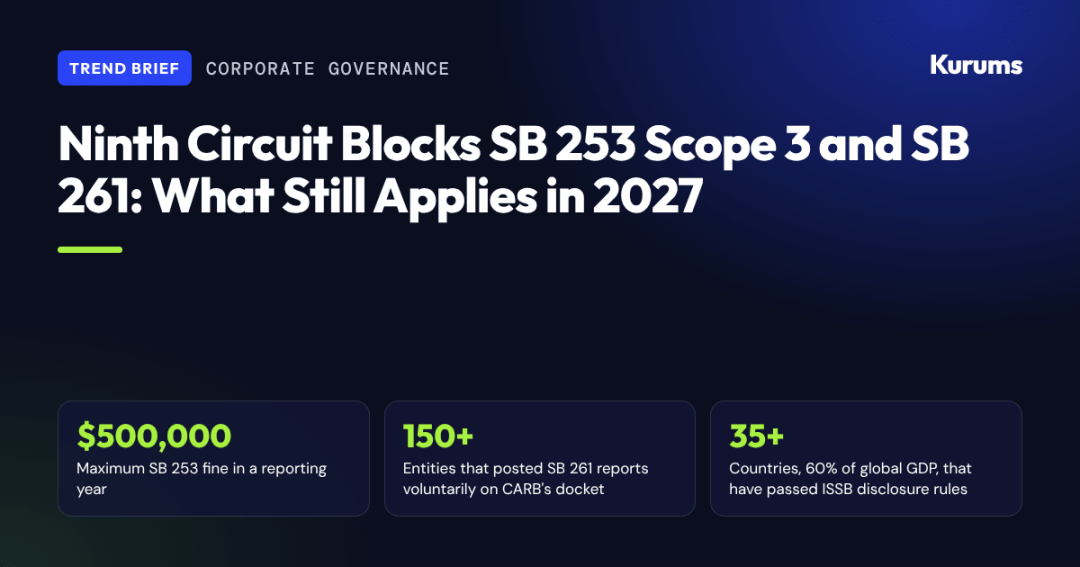
California's Scope 3 mandate and climate-risk report are on hold after a preliminary ruling, but Scope 1 and 2 reporting, assurance and non-California obligations still stand.
On November 9, 2026, the Ninth Circuit found SB 253's Scope 3 requirement and all of SB 261 likely unconstitutional and ordered preliminary relief, while leaving Scope 1 and 2 reporting in force. It is not a final judgment. The district court must still decide whether Scope 3 can be severed from SB 253. Limited assurance on Scope 1 and 2 is expected in 2027, and EU and ISSB-aligned obligations are untouched. Pause California-only Scope 3 work; keep the data infrastructure.
What the Ninth Circuit decided on November 9
On November 9, 2026, a three-judge panel of the US Court of Appeals for the Ninth Circuit ruled in Chamber of Commerce of the United States v. Sanchez (No. 25-5327), the business-group challenge to California’s two climate disclosure laws. According to a Morgan Lewis memo on the Harvard Law School Forum on Corporate Governance, the court reversed the district court in part. It sided with the challengers on SB 253’s Scope 3 emissions requirement, which was scheduled to start in 2027, and on all of SB 261, the climate-related financial risk law, on First Amendment compelled-speech grounds. It declined to block SB 253’s Scope 1 and Scope 2 reporting.
The reasoning turns on one line. Kirkland & Ellis summarizes it this way: Scope 1 and 2 figures are factual data about a company’s own operations, which the majority treated as commercial speech that likely survives intermediate scrutiny. Scope 3 covers third parties in the value chain, and SB 261 asks for predictive judgments about climate risk. Both were treated as noncommercial speech likely to fail strict scrutiny. Judge Jacqueline Nguyen wrote the majority opinion; ESG Dive quotes her describing SB 261 as requiring “value-laden judgments on a politically fraught subject.” Judge Mark Bennett, dissenting in part, would have blocked both statutes in full.
The ruling landed one day before the first SB 253 filing deadline of November 10, 2026. That deadline was not moved.
Read the posture carefully: preliminary, and not yet final
This is a ruling on a preliminary injunction: a prediction about who is likely to win, not a final judgment on either law. Morrison Foerster notes that both sides still argue the merits in the trial court.
The sources describe the mechanics differently, which matters for anyone writing a board memo:
- Morgan Lewis and Latham & Watkins describe Scope 3 and SB 261 as enjoined or preliminarily enjoined.
- Troutman Pepper Locke says the opinion did not itself enjoin anything. It reversed the denial of an injunction and left the district court to enter one, after first deciding whether Scope 3 can be severed from the rest of SB 253. Cooley uses similar wording: Scope 3 is “likely to be enjoined.”
- Troutman adds that new injunctive relief will likely cover only the plaintiff associations and their members. SB 261 stays paused under the Ninth Circuit’s November 18, 2025 injunction pending appeal, and CARB later said it would not enforce the law against any covered entity during the appeal.
On further review, Beveridge & Diamond put the deadline for panel or en banc rehearing petitions at November 23, 2026, absent an extension. None of the sources reviewed for this article reports whether a petition was filed. Kirkland notes that a certiorari petition to the Supreme Court is also possible.
What is paused and what still applies
| Obligation | Status after November 9 | What to watch |
|---|---|---|
| SB 253 Scope 1 and 2 (revenue over $1 billion) | In force. First reports were due November 10, 2026. Limited assurance expected from 2027, reasonable assurance from 2030. | Severability ruling; CARB’s 2027 template and deadline. |
| SB 253 Scope 3 | Found likely unconstitutional; preliminary relief ordered, with the district court to implement it. | Scope of the injunction; CARB’s Scope 3 rulemaking. |
| SB 261 climate-risk report (revenue over $500 million) | Paused since November 18, 2025; found likely unconstitutional in full. | New CARB advisories; final judgment. |
| EU CSRD and ISSB-aligned regimes | Not affected, per Kirkland. | Each jurisdiction’s own timetable. |
| SEC filings | Material climate risks still fall under existing rules and 2010 SEC guidance, per Kirkland. | Consistency with voluntary reports. |
Kirkland reports that SB 253 penalties can reach $500,000 in a reporting year, so the surviving part of the statute is not a soft obligation.
The severability question is the real 2027 risk
The item most likely to change plans is not Scope 3. It is whether SB 253 survives without it. The Ninth Circuit sent that question back to the district court. If the Scope 3 provisions cannot be separated from the statute, Kirkland says the court would likely strike SB 253 entirely, Scope 1 and 2 included.
Law firms do not expect that outcome. Kirkland notes SB 253 has an express severability clause. Morrison Foerster calls a non-severability ruling a “remote possibility” and does not expect a trial-court decision before 2027. Even so, Scope 1 and 2 teams are planning a stricter 2027 cycle against rules that are not written yet. Kirkland lists the open points: the 2027 template, the detail CARB will require, accepted assurance standards and the deadline itself.
Why the data work should not be dismantled
Pausing work aimed solely at California Scope 3 filings looks reasonable; the Ropes & Gray attorneys quoted by ESG Dive called it a “low-risk proposition.” Dismantling the underlying data collection is a different decision, and several facts argue against it.
- Other regimes still ask for it. Kirkland states that companies subject to the EU Corporate Sustainability Reporting Directive, to ISSB-aligned regimes that require Scope 3, or to their own voluntary Scope 3 commitments are unaffected. Its alert, citing the IFRS Foundation, counts more than 35 countries representing 60% of global GDP that have passed ISSB disclosure rules.
- Investors were part of the court’s reasoning. The panel credited evidence that investors rely on emissions data, including CalPERS describing Scope 1 and 2 data as “crucial.”
- Climate-risk reporting continues voluntarily. Kirkland reports that more than 150 entities posted SB 261 reports on CARB’s voluntary docket while the law was paused.
- The pause could end. Morrison Foerster warns that a final judgment allowing SB 261 enforcement could leave limited time to comply.
Linklaters puts the sequencing well: inventory every separate legal, contractual and investor reporting expectation before scaling back emissions data collection or climate-risk assessments.
What search interest shows
Google Trends data for the United States over the 90 days to November 26, 2026 gives a rough read on attention. These are relative indices from 0 to 100, scaled to the peak among the four terms compared. They are not search volumes, and daily values for specialist terms are spiky.
| Search term | 90-day average | Prior 30 days | Last 7 days | Peak |
|---|---|---|---|---|
| ESG reporting | 7.9 | 6.5 | 18.4 | 100 on Aug 27 |
| scope 3 emissions | 5.1 | 5.2 | 15.6 | 81 on Oct 10 |
| climate disclosure | 2.7 | 4.8 | 5.9 | 81 on Nov 11 |
| SB 253 | 1.9 | 4.9 | 4.3 | 70 on Nov 10 |
The “SB 253” and “climate disclosure” peaks on November 10 and 11 fall on the filing deadline and one to two days after the November 9 opinion, so linking them to the ruling and the deadline is reasonable. The earlier peaks for “scope 3 emissions” (October 10) and “ESG reporting” (August 27) match no event in the sources used here, so no cause is claimed. What is notable is the last week: “scope 3 emissions” averaged 15.6, about three times its prior-30-day level, and “ESG reporting” rose to 18.4 from 6.5. Statute-specific searches have cooled while broader terms have climbed, which is consistent with attention moving from the ruling itself to its effect on reporting programs. That is an interpretation, not something the data proves.
Search interest: scope 3 emissions vs SB 253
Google Trends, United States, Aug 26, 2026 to Nov 25, 2026. Daily index, 0–100, relative to the highest point among the terms compared; it shows relative attention, not search volume.
How boards and reporting teams should adjust 2027 plans
This is analysis, not legal advice. The sources point to a consistent approach.
For the board and corporate secretary
- Record the ruling accurately in committee materials: preliminary relief, a remand on severability, and possible further review. Avoid language that says the requirements are gone.
- Ask whether the company belongs to a plaintiff association, given Troutman’s point about who the injunction may cover.
For reporting and compliance leads
- Keep proof of the November 10 submission and its supporting data, as Morgan Lewis advises.
- Split the Scope 3 workplan into what was built only for California and what also serves CSRD, ISSB-aligned filings, customer requests or public targets. Pause the first group; keep the second.
- Start assurance-provider conversations now. Kirkland stresses that companies need lead time while CARB’s 2027 rules are still pending.
What to do next
- Verify the November 10, 2026 Scope 1 and 2 report or statement of non-reporting was submitted to CARB, and archive proof of submission.
- Brief the board or relevant committee using precise wording: preliminary relief, severability remand, further review possible.
- Tag every Scope 3 workstream as California-only or multi-purpose; pause only the California-only items.
- Inventory CSRD, ISSB-aligned, contractual and investor reporting commitments before cutting any data collection.
- Open discussions with assurance providers about limited assurance on 2027 Scope 1 and 2 reports.
- Assign an owner to monitor the district court, rehearing or certiorari filings, and CARB advisories.
Frequently asked questions
Is SB 253 Scope 3 reporting cancelled for 2027?
Not formally. The Ninth Circuit found the requirement likely unconstitutional and ordered preliminary relief, and law firms expect it will not be enforced while litigation continues. A final judgment, rehearing or Supreme Court review could still change the outcome, so treat it as paused.
Do companies still have to report Scope 1 and 2 emissions in California?
Yes. The court declined to block Scope 1 and 2 reporting for companies with more than $1 billion in revenue doing business in California. The first deadline was November 10, 2026, and limited assurance is expected to apply to 2027 reports. CARB has not yet finalized the 2027 deadline or template.
What is the status of SB 261 climate-risk reports?
SB 261 has been paused since a Ninth Circuit order on November 18, 2025, and the November 9, 2026 opinion found the whole law likely unconstitutional. CARB previously said it would not enforce it during the appeal. Reporting is effectively voluntary for now.
Does the ruling affect EU CSRD or ISSB reporting?
No. Kirkland states that companies subject to the EU Corporate Sustainability Reporting Directive, ISSB-aligned regimes that require Scope 3, or their own voluntary commitments are not affected. The decision concerns only what California may compel under the First Amendment.
- Harvard Law School Forum on Corporate Governance (Morgan Lewis): Ninth Circuit Reverses Lower Court, Enjoining Enforcement of SB 261 and SB 253 Scope 3 Emissions Disclosure Requirements (2026-11-25)
- Kirkland & Ellis: Kirkland Alert: Ninth Circuit rules on California climate disclosure laws
- ESG Dive: What's next for California's climate laws following an appeals court split decision (2026-11-12)
- Morrison Foerster: Ninth Circuit ruling on California emissions disclosures (client alert) (2026-11-11)
- Troutman Pepper Locke: Ninth Circuit Rules on Challenge to California's Climate Disclosure Laws (2026-11-13)
- Linklaters: California climate disclosure laws face temporary partial federal court block
- Cooley: Ninth Circuit Leaves SB 253 Scope 1 and 2 Reporting in Place, Blocks Scope 3 and SB 261 (2026-11-10)
- Beveridge & Diamond: Ninth Circuit Limits California Climate Disclosure Laws; November 10 SB 253 Reporting Deadline Remains in Effect (2026-11-10)
- Latham & Watkins (Environment, Land & Resources blog): Ninth Circuit Halts SB 261 and SB 253's Scope 3 Reporting; Scope 1 and 2 Reporting Remains (2026-11-26)
Search-interest figures are from Google Trends (United States, 90 days to November 26, 2026). This article is analysis for operators, not legal, tax or investment advice. Last updated November 26, 2026.
Discover more from Kurums | Business Intelligence
Subscribe to get the latest posts sent to your email.