
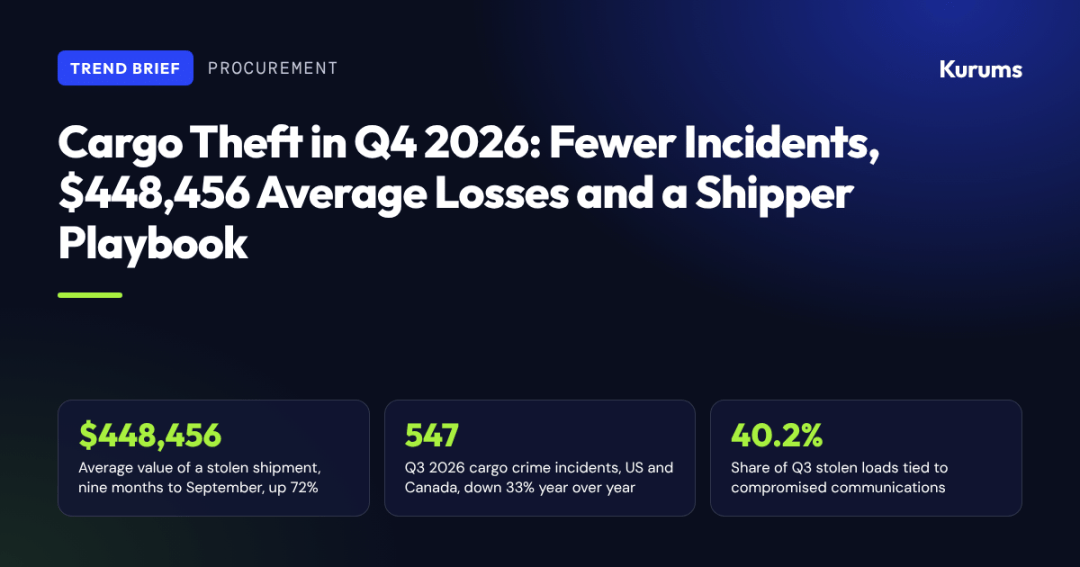
Reported cargo theft incidents fell 33% in Q3 2026 while losses rose 12%. Most stolen loads now involve real carrier credentials, which changes what shippers need to check.
Cargo theft is getting rarer and costlier. Verisk CargoNet logged 547 incidents in Q3 2026, down 33% year over year, but losses rose 12% to $230.1 million and the average stolen shipment reached $448,456. Highway's data ties more than 80% of stolen loads to real carrier credentials in the wrong hands. With holiday risk elevated and truckload capacity tight, shippers should verify people as well as carriers, tighten dock release and review liability limits.
What happened: fewer thefts, much larger losses
Cargo theft in North America is becoming less frequent and more expensive. Verisk CargoNet recorded 547 supply chain crime incidents across the US and Canada in the third quarter of 2026, down 33% year over year and 19% below the second quarter, while estimated losses rose 12% to $230.1 million, according to Transport Topics. The average documented value of a stolen shipment reached $448,456 in the nine months to September, up 72% on a year earlier, The Loadstar reported from CargoNet’s Thanksgiving warning.
The method has changed too. A FreightWaves SONAR analysis published on November 25 says more than 80% of stolen loads in Highway’s third-quarter data involved real carrier credentials in the wrong hands. Its summary line: “Freight fraud no longer depends on fake carriers.”
Three other items landed in the same fortnight. Federal prosecutors in Los Angeles charged 14 people over an alleged scheme to steal more than $22.5 million of merchandise from at least 36 freight trains, FOX 11 Los Angeles reported on November 19. Security firms, meanwhile, told trade media that single thefts of AI data center hardware now run to tens of millions of dollars.
What the data shows
The figures come from different networks and are not directly comparable. Each measures the activity its own members or clients report.
| Source | Period and scope | Headline figures | What it tells a shipper |
|---|---|---|---|
| Verisk CargoNet | Q3 2026, US and Canada | 547 incidents (down 33% year over year); $230.1 million estimated losses (up 12%) | Thieves are choosing fewer, richer loads |
| Verisk CargoNet | Nine months to September 2026 | Average stolen shipment value $448,456 (up 72%) | Cargo insurance limits and carrier liability caps deserve a fresh look |
| Highway Freight Fraud Index | Q3 2026, Highway’s own network | 184 stolen loads (down 28.1% on Q2); 40.2% tied to compromised communications; 36.4% direct theft by carriers | Identity checks need to cover the person, not only the carrier |
| Overhaul | Q3 2026, US | 629 incidents (down 8%); electronics 23.3% of thefts; pilferage 32.9% of events | Partial losses from trailers remain the most common event type |
| Verisk CargoNet | Thanksgiving periods, 2021 to 2025 | 252 incidents, an estimated $23.9 million stolen; 58 incidents in 2025 against a peak of 79 in 2024 | Holiday weeks carry concentrated risk |
Highway’s index, as summarised by FreightWaves on November 7, adds detail on how identities are taken over. Reports of carrier ownership changes rose 111.4% from the prior quarter to 518. Unauthorized changes to FMCSA contact records reached 15,491, up 12.7% from the second quarter. California accounted for nearly half of Highway’s incidents, followed by New Jersey and Texas.
Two cautions apply. Highway’s numbers describe its own network, not national totals, and the company credited stronger verification for part of the decline while warning against attributing it to any single measure. And Scott Cornell, chairman of the Transported Asset Protection Association, told Transport Topics: “Two quarters to me does not make a trend yet.”
Why the timing matters: the holiday window
CargoNet counted 252 thefts across the last five Thanksgiving periods, with an estimated $23.9 million in goods stolen, The Loadstar reported. The Tuesday and Wednesday before the holiday and the Monday after accounted for 62% of those incidents. California, Illinois and Texas made up 56% of reported thefts.
That puts Monday, November 30 inside the pattern CargoNet describes, with year-end shutdowns still ahead. “The groups behind these schemes are patient, and they plan around the calendar,” Keith Lewis, vice president of operations at Verisk CargoNet, said in the warning.
The truckload market adds pressure. SONAR’s national tender rejection index stood at 12.78%, roughly double the 6.3% of a year earlier, with refrigerated rejections near 22%, according to the FreightWaves analysis. As the analysis puts it: “Tight capacity creates urgency, and urgency is the condition fraud schemes exploit.”
Public attention is following the rail case
Google Trends data for the US shows where public attention went. On a relative index of 0 to 100, which measures search interest against the peak in the period and not search volume, “train heist” averaged 15.7 over the last seven days, compared with 2.3 over the prior 86 days, and peaked at 100 on November 20, the day after the Los Angeles indictment was announced. “Cargo theft” averaged 3.9 in the last seven days against 2.9 before, with its own peak of 69 on October 28. Rising related queries included “data center hardware cargo theft”.
Search interest: cargo theft vs train heist
Google Trends, United States, Aug 27, 2026 to Nov 27, 2026. Daily index, 0–100, relative to the highest point among the terms compared; it shows relative attention, not search volume.
The spectacular case draws the searches. The loss data points elsewhere, to valid credentials and email accounts.
Three patterns behind the numbers
Hijacked identities
FreightWaves describes criminals gaining access to carrier email accounts and using familiar addresses to request shipment details, so brokers receive messages that appear to come from trusted partners. Highway’s stated position is that brokers must verify the individual accessing shipment information, not just the carrier. Direct theft, where a carrier accepts a legitimate load and then takes it, rose from 31.3% to 36.4% of Highway’s stolen load reports.
Rail and intermodal
The Los Angeles indictment alleges that a crew coordinated through Instagram, cut train air hoses to force emergency stops near Pico Rivera and Fullerton, and moved Nike sneakers, Milwaukee tools and electronics to stash houses between February 2024 and August 2026. “The scale of the theft is staggering,” First Assistant US Attorney Bill Essayli said. These are allegations, and the defendants are presumed innocent unless convicted.
AI and data center hardware
Ron Greene, executive vice president of risk and intelligence at Overhaul, told Transport Topics: “We’re seeing every week very large thefts, to the tune of tens of millions of dollars per load.” In a FreightWaves article sponsored by Overhaul, the firm’s David Warrick said single pallets of Blackwell chips can be worth $17 million to $20 million, and that the most common scheme involves fake paperwork from a driver at a legitimate trucking company that has been subcontracted twice. These are vendor estimates, not audited loss data. His point about location: “Anywhere where there’s a handoff in the supply chain tends to open up a level of weakness.”
How to respond, by role
Procurement and sourcing managers
- Check what broker and 3PL contracts say about carrier vetting: who verifies identity, how often, and whether double brokering or re-subcontracting is prohibited or requires written consent.
- Ask providers which verification tools they use and whether they screen the individual user as well as the carrier authority.
- Compare cargo liability limits in contracts with current average shipment values. A limit set when loads were worth less may no longer cover a typical loss.
Logistics and transportation managers
- Treat any change of contact details, bank details or pickup arrangements received by email as unverified until confirmed through a number already on file.
- Tighten dock release: match driver identity, tractor and trailer numbers and pickup reference against the tender before loading, and record them.
- Plan holiday and year-end spot coverage in advance so that urgency does not override vetting.
- Use tracking with alerts for unscheduled stops on high-value loads. The recovery example in the Overhaul piece relied on that signal plus local law enforcement.
Supply chain leaders and category owners for high-value goods
- Map every handoff for electronics, metals, food and beverage, and data center components, and decide which ones need sealed, direct, no-subcontract moves.
- Check replacement lead times for constrained components. Warrick noted that a lost component may have no automatic replacement, so the exposure is schedule as well as value.
Risks and open questions
The decline in incident counts may not last. Two quarters of lower numbers sit alongside rising average values, and the datasets disagree on scale because each sees only part of the market. Lewis put the visibility problem this way: “No single shipper, broker, or carrier can see the whole picture, and the criminals count on that.”
Screening has a capacity cost. Highway estimated that one form of targeted screening would reduce available carrier capacity by about 7%, and its report did not quantify how many thefts screening prevented. With rejections doubled, tighter vetting and load coverage pull in opposite directions.
Enforcement is uncertain. Tony Pelli of BSI Consulting told Transport Topics that enforcement under current law does not seem to be helping much, and Warrick called for legislation with “a punishment that sticks”. The fuller FreightWaves SONAR analysis of how liability is shifting toward shippers sits behind a subscriber paywall, so that question is not assessed here.
What to do next
- Confirm every emailed change to carrier contacts, bank details or pickup plans by calling a number already on file.
- Require brokers and 3PLs to state in writing how they verify the individual accepting a load, not only the carrier authority.
- Match driver identity, tractor and trailer numbers and pickup reference at the dock before releasing any load, and keep the record.
- Compare contract liability limits and cargo insurance cover against current shipment values for your highest-value lanes.
- Prohibit or require written consent for re-brokering and subcontracting on high-value freight.
- Arrange holiday and year-end spot capacity in advance with carriers that are already vetted.
- Report suspicious pickups, cloned carriers and fake dispatchers to your broker and law enforcement on the same day.
Frequently asked questions
Is cargo theft going up or down in 2026?
Both, depending on the measure. Verisk CargoNet recorded 547 incidents in Q3 2026 across the US and Canada, down 33% year over year, but estimated losses rose 12% to $230.1 million. The average stolen shipment was worth $448,456 in the nine months to September, up 72%. Thieves appear to be taking fewer, higher-value loads.
What does compromised communications mean in freight fraud?
It describes criminals gaining access to a carrier's email account and using the familiar address to request shipment information, so a broker believes it is dealing with a trusted partner. Highway attributed 40.2% of its Q3 2026 stolen load reports to this method. The figure covers Highway's own network, not the whole market.
When is cargo theft risk highest around Thanksgiving?
Verisk CargoNet's data for the five Thanksgiving periods from 2021 to 2025 shows 252 incidents and an estimated $23.9 million stolen. The Tuesday and Wednesday before the holiday and the Monday after accounted for 62% of incidents, and California, Illinois and Texas made up 56% of reported thefts, according to The Loadstar.
Which goods are cargo thieves targeting most?
It varies by dataset. CargoNet says food and beverage had the most incidents in Q3 2026 and has historically led over Thanksgiving. Overhaul's US data puts electronics first at 23.3% of thefts, with food and beverage at 13.5%. Security firms also report very high-value thefts of AI data center hardware and continued interest in metals.
- FreightWaves: Real Credentials, Wrong Hands: Freight fraud trends and what they cost shippers (2026-11-25)
- The Loadstar: Cargo crime gangs are patient, and they 'plan around the calendar' (2026-11-26)
- FreightWaves: Compromised communications linked to 40% of stolen loads in Highway fraud report (2026-11-07)
- Transport Topics: Truckers grapple with selective, price-conscious criminals (2026-11-16)
- FOX 11 Los Angeles: 14 charged in $22.5M Los Angeles train heist ring targeting Nike shoes (2026-11-19)
- FreightWaves (sponsored by Overhaul): Cargo Thieves Are Chasing AI Hardware Down the Dirt Road to the Data Center (2026-11-23)
Search-interest figures are from Google Trends (United States, 90 days to November 27, 2026). This article is analysis for operators, not legal, tax or investment advice. Last updated November 27, 2026.
Discover more from Kurums | Business Intelligence
Subscribe to get the latest posts sent to your email.