
Taste Note - Amazon Sales & Selling Best Sellers
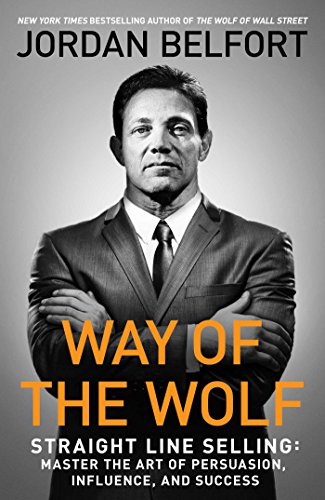
Way of the Wolf: The Straight Line System, Read With Both Eyes Open
A Kurums Book Taste review of Way of the Wolf for sales leaders who want to understand the most imitated - and most abused - closing system in the industry.
Why this book fits Kurums
Belfort's Straight Line system trains more boiler rooms than business schools care to admit - which is precisely why legitimate sales leaders should read it: to extract the genuinely strong mechanics (tonality, certainty-scaling, looping) and to recognize the manipulation patterns when competitors, counterparties, or your own reps deploy them.
For the Kurums Sales audience this is the pressure-selling literacy course: paired with Pink's mother-test ethics and Voss's empathy-first tactics, it completes the persuasion spectrum - and its three-tens framework is, stripped of its origins, a legitimately useful diagnostic for stalled transactional deals.
What the book argues
The core model is the three tens: a prospect buys when certainty is high on three things - the product, you, and your company - each scored one to ten, with the sale's job being to raise all three past threshold while keeping the conversation on the 'straight line' from open to close rather than wandering ('Pluto'). The companion insight is the action threshold: different buyers need different certainty to act, and lowering perceived risk (guarantees, trials) moves the threshold itself - a mechanic every legitimate offer designer already uses under other names.
The delivery chapters are the system's real substance: tonality as the hidden channel (certainty, scarcity, sincerity carried by voice patterns - his inventory of tones is the best practical treatment in print), the four-second first impression (sharp as a tack, enthusiastic, an expert), and scripted looping - answering an objection, then re-selling one of the three tens, then asking again - which turns objection handling into a controlled cycle rather than improvisation. Scripts are defended unapologetically: professionals rehearse so attention can go to the listener.
Read critically, the system's weakness is its blindness to the other side of the table: discovery is thin, the buyer's interests are instrumental, and the loop pressed past genuine 'no' becomes the harassment that made its author infamous - he now wraps it in ethics disclaimers the mechanics don't enforce. The professional reading: adopt the certainty diagnostic and tonality craft inside a methodology that does real discovery (SPIN) and honest risk-reversal ($100M Offers), audit your own floor for unsupervised looping, and treat the book as both toolbox and vaccine.
Key ideas, translated to your desk
Diagnose stalled deals on three tens
Product, seller, company - score the buyer's certainty on each. The stall usually lives in one, and it is often not the product.
Tonality is half the message
Record your reps' calls and listen with the content muted. Certainty and sincerity travel by tone; train it deliberately.
Know looping - and cap it
One respectful loop after an objection is persistence; three is pressure. Set the house limit explicitly and enforce it in QA.
Use it at work
- Add the three-tens diagnostic to deal reviews for transactional pipelines.
- Run a tonality training block using call recordings - content aside, voice alone.
- Write your objection-loop policy: structure allowed, repetition capped, 'no' honored.
- Use the book in enablement as contrast study beside Pink's mother test.
Read it if
- You lead transactional or inside sales and want its dominant system understood.
- You QA sales calls and need to spot pressure patterns by name.
- You can mine flawed sources for valid mechanics without importing the flaws.
You can skip it if
- Your sales are consultative enterprise deals - this system actively harms them.
- The source's history makes the content unusable in your culture; legitimate choice.
- You seek discovery and qualification method - there is nearly none here.
This book appears in
Curated Tasting Menus that chain this title into a reading route.
Discover more from Kurums | Business Intelligence
Subscribe to get the latest posts sent to your email.