
Taste Note - Amazon Startup Best Sellers
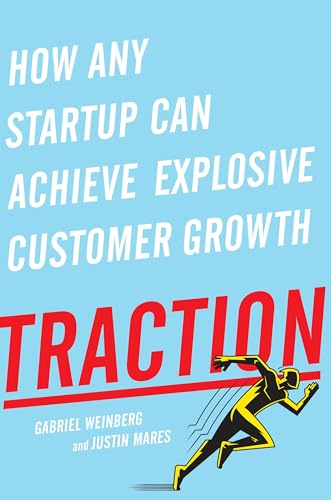
Traction: The Bullseye Framework for Finding a Startup's Growth Channel
A Kurums Book Taste review of Traction for founders and growth leads who need a structured way to test acquisition channels instead of betting on the one they already know.
Why this book fits Kurums
Most startups fail for lack of customers, not lack of product. Weinberg, founder of DuckDuckGo, and Mares argue that founders spend too little time on distribution and default to the channels they already know. Traction maps nineteen customer acquisition channels and offers a simple framework - Bullseye - to test them systematically.
For the Kurums Startup audience the book turns growth from a vague priority into a process: brainstorm every channel, rank, run cheap parallel tests, and focus on the one that works. The channel chapters, built from interviews with founders who scaled through each, are a checklist worth revisiting at every stage.
What the book argues
The first argument is the fifty-percent rule: founders should spend about half their time on traction while building the product, because distribution informs what to build and traction tests can run alongside development. Waiting until launch to think about customers wastes months and often reveals that the product cannot be sold economically through any available channel.
The second argument is the Bullseye framework. Brainstorm how each of the nineteen channels - from viral marketing, PR, and content marketing to SEO, SEM, social ads, sales, business development, trade shows, offline events, community building, and speaking engagements - could work for your business. Rank them into three rings: the most promising, the possible, and the long shots. Run cheap tests on the inner ring to measure cost per customer, volume, and quality, then focus on the single channel that moves the core metric. Most startups grow through one dominant channel at a time.
The third argument is that channels change with the company's stage and saturate over time. What works to win the first hundred customers rarely works for the next hundred thousand, and competitors eventually crowd any channel that becomes visible. The book's channel chapters give tactics, metrics, and warnings for each, and the closing advice is to keep the Bullseye running: test new channels while optimizing the current one so the next growth engine is ready before the first stalls.
Key ideas, translated to your desk
Spend half the time on traction
Treat distribution as part of product work. Run channel tests while building so the go-to-market plan is validated before launch, not after.
Test channels in parallel, cheaply
Pick the three most promising channels and run small tests on each. Compare cost per customer, volume, and quality before committing budget.
Focus on one channel, then repeat
Concentrate on the channel that moves the core metric, but keep testing new ones so you are ready when it saturates.
Use it at work
- Run a Bullseye workshop: brainstorm all nineteen channels for your business and rank them into three rings.
- Design three low-cost channel tests with clear success metrics and a fixed two-to-four-week window.
- Track cost per acquisition and customer quality by channel in one simple dashboard.
- Schedule a quarterly review of channel saturation and new test candidates.
Read it if
- You are a founder or growth lead without a reliable acquisition channel yet.
- Your team defaults to one channel because it is familiar, not because it was tested.
- You liked The Lean Startup and want its go-to-market counterpart.
You can skip it if
- You need deep, current tactical guides for a single channel such as paid social or SEO.
- Your business already has a proven, scalable acquisition engine.
- Some channel examples from 2015 feel dated - the framework ages better than the tactics.
This book appears in
Curated Tasting Menus that chain this title into a reading route.
Discover more from Kurums | Business Intelligence
Subscribe to get the latest posts sent to your email.