
Taste Note - Amazon Sales Best Sellers
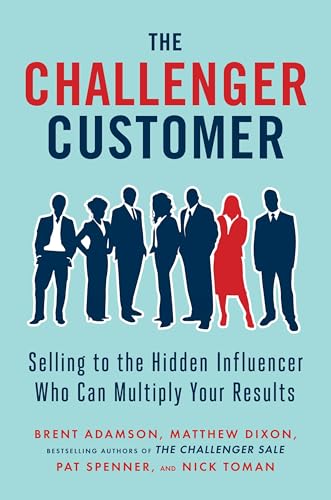
The Challenger Customer: Winning the Buying Group, Not Just the Friendly Contact
A Kurums Book Taste review of The Challenger Customer for sales leaders who keep losing complex deals to group indecision rather than to competitors.
Why this book fits Kurums
The Challenger Sale told sales teams to teach, tailor and take control. Its follow-up, written by the same CEB research team, asks what happens on the customer's side of the table. B2B purchases are now decided by groups of stakeholders with different priorities, and the authors argue that the real obstacle is getting that group to agree. The book reframes the rep's job from persuading one contact to helping a buying group reach a decision it can defend.
For the Kurums Sales audience this is a pipeline problem as much as a skills problem. If your forecast keeps slipping because deals stall in committee, or your champions are friendly but cannot move their organisation, the book gives you a way to spot the people who can and to equip them for the internal work you cannot do yourself.
What the book argues
The book opens by arguing that the hardest part of a modern B2B sale is not the supplier choice but the customer's internal consensus. As more stakeholders join a purchase, the chance that the group agrees to buy anything falls, and deals are lost to no decision. Suppliers that pitch their solution to each stakeholder separately make the problem worse, because they deepen disagreement rather than resolve it.
Next it argues that not all stakeholders are equally useful. The authors describe Mobilizers, who drive change inside their organisations and come in three types: Go-Getters, Teachers and Skeptics. Talkers, described as Guides, Friends and Climbers, are pleasant and accessible but rarely move the organisation. Blockers resist change. The uncomfortable message is that reps tend to gravitate toward Talkers because they are easy to reach, while Mobilizers are more demanding and more valuable.
Finally the book argues for a different selling motion. Reps should lead to their solution, not with it, by offering commercial insight that disrupts how the customer thinks about its own business. They should tailor that insight to Mobilizers and then equip those Mobilizers to build consensus, helping the buying group learn together and agree on the problem before any solution is debated. The goal is a group that buys rather than a supplier that pitches.
Key ideas, translated to your desk
Consensus is the real competitor
Track no-decision losses as a separate category. If they outnumber competitive losses, your problem is group alignment, not price or product.
Find the Mobilizer
Test contacts by how they react to a provocative idea. People who push back with substance are more useful than those who simply agree.
Lead to, not with
Open with an insight about the customer's business, and introduce your offer only after the group agrees there is a problem worth solving.
Use it at work
- Add a stakeholder map to every late-stage opportunity and mark each contact as Mobilizer, Talker or Blocker.
- Report no-decision losses separately in your next pipeline review and set a target to reduce them.
- Build one commercial insight per segment that challenges how customers think about a costly problem.
- Give Mobilizers a short internal business case they can present to their own colleagues without you.
Read it if
- Your complex deals stall in buying committees more often than they are lost to competitors.
- Your reps have good relationships but champions who cannot get budget approved.
- You applied The Challenger Sale and want the customer-side research that completes it.
You can skip it if
- You sell transactional, single-buyer products where committees rarely form.
- You want a step-by-step talk track; the book is a research-based framework, not a script.
- Your team has not yet built commercial insight; start with The Challenger Sale first.
This book appears in
Curated Tasting Menus that chain this title into a reading route.
Discover more from Kurums | Business Intelligence
Subscribe to get the latest posts sent to your email.