
Taste Note - Amazon Negotiating Best Sellers
Negotiating the Impossible: Framing, Process and Empathy When the Deal Looks Dead
A Kurums Book Taste review of Negotiating the Impossible for legal and commercial leaders who need to break deadlocks without leaning on money or muscle.
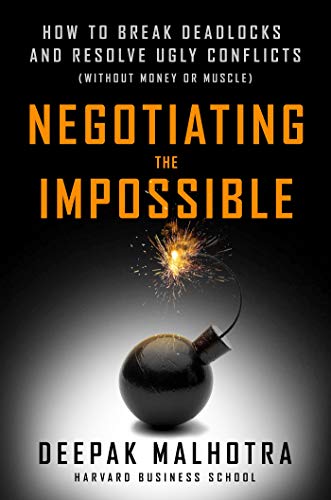
Why this book fits Kurums
Most negotiation books assume you have something to trade: a price to move, a concession to offer, a walk-away option to wave. Legal teams often face the opposite situation. The contract dispute has already escalated, the counterparty has dug in publicly, the budget for concessions is gone and litigation would cost more than anyone wants to admit. Deepak Malhotra, a Harvard Business School professor who teaches and advises on negotiation, wrote this book for exactly that moment, and he argues that the deal is rarely as dead as it looks.
For the Kurums Law audience, the value is that the book gives you levers that do not depend on leverage. General counsel, contract managers and dispute leads can use it to reopen talks that have frozen, to stop a counterparty from defining the problem on their terms, and to design the process of a negotiation before anyone argues about the substance. It is the most practical companion to Getting to Yes on the Kurums shelf when talks freeze.
What the book argues
Malhotra organizes the book around three sources of power that remain available when money and muscle are not. The first is framing. How a proposal is described, what it is compared with and which story surrounds it can matter as much as the terms themselves. He argues that negotiators who let the other side frame the issue have already given away much of the outcome, and that a good frame makes it easier for the counterparty to say yes without feeling that they lost.
The second source is process. Before you argue about what the deal should be, you can negotiate how the negotiation will run: who is at the table, in what order issues are taken, how much time is allowed and what happens if talks stall. Malhotra warns that surprises in process breed distrust even when the substance is fair, and that deadlines, sequencing and momentum can be designed instead of left to chance. Many deadlocks, in his account, are really process failures that both sides misread as disagreements about terms.
The third source is empathy, which Malhotra treats as a strategic tool rather than a soft virtue. Understanding the other side's constraints, audiences and fears lets you shape offers they can actually accept, give them room to save face and avoid pushing them into public positions they cannot retreat from. He is explicit that empathy does not mean agreeing or conceding; it means seeing the problem accurately enough to solve it, including when the other side is behaving badly, issuing ultimatums or claiming that nothing can change.
Key ideas, translated to your desk
Fight for the frame first
Before trading terms, decide how the issue is described and what it is compared with. If the other side's framing wins, you will spend the rest of the talks negotiating inside their story.
Negotiate the process, not just the deal
Agree on participants, sequence, timing and what happens if talks stall before substance is discussed. A clear process prevents the surprises that turn a commercial disagreement into a dispute.
Make yes easy to explain
Ask who the other negotiator must report to and what they need to say afterwards. Offers that help them justify the outcome internally close faster than offers that are merely generous.
Use it at work
- Before the next escalation meeting, write down how the counterparty is framing the dispute and draft one alternative frame you can put on the table first.
- Propose a written process for stalled talks: who attends, which issues come first, the timetable and the step if no agreement is reached.
- Map the other side's constraints and internal audiences on one page before drafting any settlement offer.
- Treat an ultimatum as an opening statement: acknowledge it, avoid repeating it back, and steer the conversation to the interests behind it.
Read it if
- You manage contract disputes, renegotiations or supplier conflicts where litigation is possible but undesirable.
- Your team has the standard negotiation toolkit but stalls when the other side refuses to move.
- You liked Getting Past No and want a more modern, example-rich take on breaking deadlocks.
You can skip it if
- You need a contract-drafting or legal-procedure reference rather than a negotiation strategy book.
- Your negotiations are routine price discussions where both sides already want to close.
- You prefer quantitative negotiation analysis with models and data over case-driven argument.
This book appears in
Curated Tasting Menus that chain this title into a reading route.
Discover more from Kurums | Business Intelligence
Subscribe to get the latest posts sent to your email.