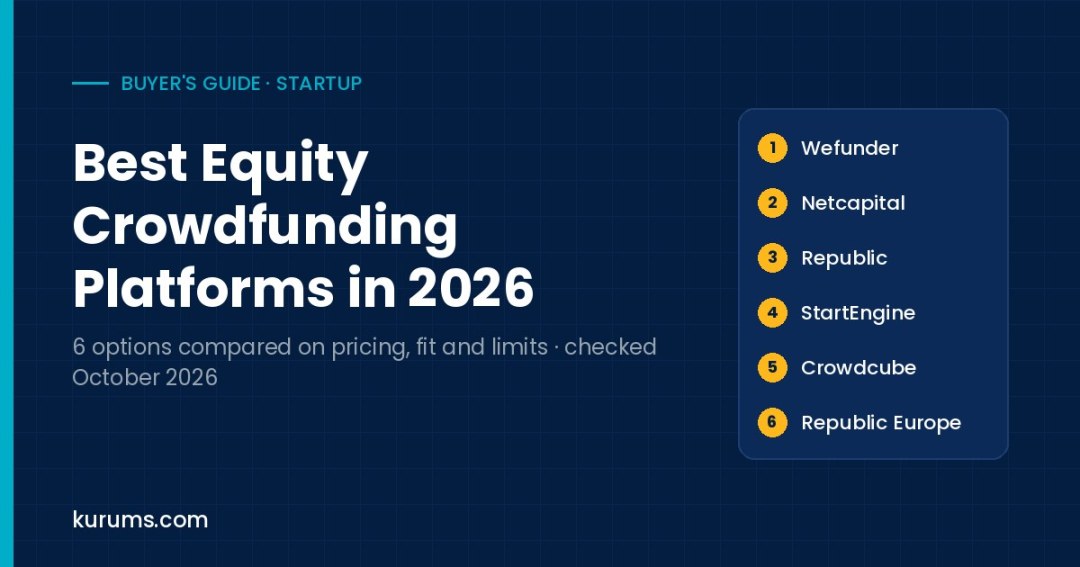
Buyer's guide · Startup
We compared six equity crowdfunding platforms for founders on published success fees, upfront costs, investor-side fees, offering types and raise limits, and the market each one serves.
- US founder wanting a published fee: Wefunder — Reg CF fee is 7.9 percent of the amount raised, charged only when the round closes, with nothing upfront.
- Small US raise watching costs: Netcapital — A July 2026 Form C disclosed Netcapital's portal fee as 4.9 percent of securities sold through Reg CF.
- US startup expecting a curated listing: Republic — Republic says it takes commission only on successful campaigns, with a baseline Form C and escrow cost of about 3,000 dollars.
- Company planning Reg CF then Reg A+: StartEngine — Supports Reg CF raises up to 5 million dollars a year and Reg A+ raises up to 75 million dollars.
- UK company offering EIS relief: Crowdcube — Publishes listing fees from 4,995 pounds and a success fee of 5 to 8 percent depending on offer type.
Equity crowdfunding lets a private company sell shares, SAFEs or other securities to the public through a regulated online platform. In the US, most startup raises use Regulation Crowdfunding (Reg CF), which allows up to 5 million dollars in 12 months through an SEC-registered funding portal or broker-dealer, while larger companies use Regulation A+. In the UK, platforms are authorized by the Financial Conduct Authority. Founders use equity crowdfunding to raise from customers and fans, to fill a round alongside angels, or to reach investors outside their network. Buyers are consumer brands, early-stage startups and community businesses, typically raising from a few hundred thousand dollars to a few million.
We compared each platform on six fields: published founder fees, upfront costs, investor-side fees, offering types and limits, market served, and the main limitation we found. Platforms are listed in buyer order, starting with US platforms that publish fees and ending with UK and European platforms. The order is not a quality ranking. Fees were checked on official pricing and help pages and, where platforms do not publish fees, in SEC Form C filings, on 12 October 2026. Fees in filings are examples from specific offerings and can vary. This article is general information, not investment, legal or financial advice.
Equity Crowdfunding Platforms compared at a glance
| Platform | Pricing | Best for | Link |
|---|---|---|---|
| 1. Wefunder | Reg CF: 7.9% of amount raised on close; private rounds free for founders | US founders wanting published fees | Site → |
| 2. Netcapital | Flat fee plus % of raise; one July 2026 Form C disclosed 4.9% cash compensation | Smaller US raises | Site → |
| 3. Republic | Commission on success only; Form C $1,500 upfront; Sept 2026 Form C: 6% above $100k + 2% securities | Curated US startup raises | Site → |
| 4. StartEngine | Quote-based; fees not published on raise page | Companies planning Reg CF and Reg A+ | Site → |
| 5. Crowdcube | Listing fee 4,995 to 9,995 pounds; success fee 5% to 8%; 2.5% platform fee | UK companies offering EIS relief | Site → |
| 6. Republic Europe (formerly Seedrs) | Quote-based; fees not shown on pages we could load | UK and Irish companies seeking EU reach | Site → |
Pricing checked 12 October 2026 on each vendor's official pricing or product pages. Prices are list prices in USD unless stated; "Quote-based" means the vendor does not publish a price. Order follows buyer fit and pricing transparency, not a quality score. Confirm billing basis, minimums and taxes with the vendor before you buy. Methodology is described below.
The 6 options in detail
Wefunder
Best for US founders wanting published feesBest for: US startups and small businesses that want a clear success fee and no upfront platform charge for a Reg CF community round.
| Attribute | Wefunder |
|---|---|
| Published founder fees | Reg CF community round: 7.9 percent of the amount raised, taken only when the round closes; private rounds free for founders |
| Upfront costs | Nothing charged upfront; Wefunder says it is always free to start raising |
| Investor-side fees | 2 percent on ACH or wire ($8 min, $150 max per transaction); 5.5 percent plus $2 on cards |
| Offering types and limits | Community rounds, private rounds, SPVs, syndicates and funds on one platform |
| Market served | US companies raising from the public and from their own networks |
| Main limitation | Wefunder-introduced private round investors pay 5 percent management fees and 10 percent carry |
- Fee is charged only on a successful close, so a failed round costs no platform fee.
- Investors you invite through your own link to a private round pay no carry or management fees.
- A 7.9 percent fee on a 1 million dollar round is 79,000 dollars, before legal, accounting and marketing costs.
Our take: Wefunder publishes its Reg CF fee in its help center: 7.9 percent of the amount raised in a community round, taken only when the round closes, and nothing upfront. Private rounds are free for founders, and investors who come through your own link pay no fees, while Wefunder-introduced investors in private rounds pay management fees and carried interest. Investors in community rounds pay a transaction fee of 2 percent on ACH or wire, capped at 150 dollars, or 5.5 percent plus 2 dollars on cards. In practice, Wefunder suits founders with an engaged customer base who can drive early commitments, since platform traffic alone rarely fills a round. Before launching, budget for a Form C, financial statement review or audit depending on raise size, and campaign marketing. Ask how SPVs are used to keep your cap table clean. Compared with Republic, Wefunder publishes its fee openly; compared with Netcapital, its percentage is higher but it is published in advance.
Netcapital
Best for smaller US raisesBest for: Small US companies raising modest Reg CF rounds that want a lower percentage fee.
| Attribute | Netcapital |
|---|---|
| Published founder fees | Netcapital describes a flat fee plus a percentage of the raise; a July 2026 Form C disclosed 4.9 percent of securities sold via Reg CF |
| Upfront costs | Flat fee amount not published; ask for the current fee agreement |
| Investor-side fees | One July 2026 offering agreement states no fees are payable by the investor |
| Offering types and limits | Reg CF through Netcapital Funding Portal, Inc., an SEC-registered funding portal and FINRA member |
| Market served | US companies, often early-stage, raising smaller Reg CF rounds |
| Main limitation | Fee details are not published on the website, so terms may differ by offering |
- Disclosed percentage fee in a recent filing is lower than Wefunder's published rate.
- Netcapital says there are no hidden costs beyond the flat fee and percentage.
- Without a published fee schedule, you must request terms and check them against filings.
Our take: Netcapital runs an SEC-registered funding portal for Reg CF offerings. Its issuer page describes the fee as a flat fee plus a percentage of the raise without listing amounts. A Form C filed in July 2026 by one issuer disclosed that the portal would receive cash compensation of 4.9 percent of securities sold through Reg CF, and its record ownership agreement states that investors pay no fees. Because fees in filings reflect a single offering, ask for your own fee agreement before you commit. In practice, Netcapital suits founders raising smaller amounts who want a lower percentage and are prepared to bring most investors themselves. Before signing, ask for the flat fee amount, what marketing support is included, how investor funds are held in escrow, and how securities are held after close. Compared with Wefunder, the disclosed percentage is lower; compared with Republic, its disclosed fee structure in that filing had fewer components.
Republic
Best for curated US startup raisesBest for: US startups that can pass a selective review and want a platform with a broad retail investor audience.
| Attribute | Republic |
|---|---|
| Published founder fees | Commission only on successful campaigns; a September 2026 Form C disclosed the greater of $15,000 or 6 percent above $100,000, plus 2 percent in securities |
| Upfront costs | Form C $1,500 upfront; escrow about $1,500 from proceeds; attorney review $0 to $3,500; financials $1,000 to $4,000 |
| Investor-side fees | Investor administrative fee typically 2.5 percent ($5 min, $250 max); card processing about 2.5 percent |
| Offering types and limits | Reg CF offerings; Republic Europe serves UK and Ireland separately |
| Market served | US startups, consumer brands and community businesses |
| Main limitation | Commission rate is not published on the help page, and the filing example includes a $5,000 onboarding fee |
- Republic itemizes baseline Form C and escrow costs at about 3,000 dollars.
- Commission is charged only on successful campaigns.
- Total cost can include a cash fee, a securities commission and an onboarding fee, so it may exceed a flat percentage platform.
Our take: Republic says it takes commission only on successful campaigns and itemizes the upfront costs of a Reg CF raise: 1,500 dollars for Form C at the start, about 1,500 dollars of escrow paid from proceeds, attorney review between 0 and 3,500 dollars through its partners, and financial statements between 1,000 and 4,000 dollars. Its help center does not show the commission rate, but a Form C filed in September 2026 through Republic's portal disclosed a cash fee of the greater of 15,000 dollars or 6 percent of amounts raised above 100,000 dollars, 2 percent of securities sold, and a 5,000 dollar onboarding fee. Investors pay an administrative fee of typically 2.5 percent, capped at 250 dollars. In practice, Republic suits startups that expect to benefit from the platform's audience and are comfortable with a multi-part fee. Ask for your exact fee schedule and model it against Wefunder's flat 7.9 percent. Compared with StartEngine, Republic is less focused on Reg A+.
StartEngine
Best for companies planning Reg CF and Reg A+Best for: Growth-stage consumer and tech companies that may move from a Reg CF raise to a larger Reg A+ offering on the same platform.
| Attribute | StartEngine |
|---|---|
| Published founder fees | Quote-based; StartEngine does not publish issuer fees, and past issuer filings show equity commissions paid to StartEngine |
| Upfront costs | Raise page describes low upfront costs for Reg CF compared with Reg A+, without amounts |
| Investor-side fees | Not published on raise page; optional Venture Club membership for investors at $275 per year |
| Offering types and limits | Reg CF up to $5M per year via StartEngine Capital LLC; Reg A+ up to $75M; Reg CF launch in 4 to 6 weeks |
| Market served | US companies raising from retail investors; Canadian subsidiary formed in 2025 |
| Main limitation | No published fee schedule, and premium marketing services cost extra |
- Reports 1.2 billion dollars raised for startups and over 1,000 rounds including SeedInvest.
- Offers a secondary trading market for some shares after the raise.
- Issuer fees are not published, and StartEngine Premium marketing is sold for an additional fee.
Our take: StartEngine supports Reg CF raises of up to 5 million dollars a year through StartEngine Capital LLC and Reg A+ offerings of up to 75 million dollars. Its raise page says Reg CF campaigns can launch in 4 to 6 weeks and reports 1.2 billion dollars raised across more than 1,000 rounds, including rounds completed on SeedInvest. The parent company changed its name to StartEngine Inc. in June 2026, according to its Regulation A filing. Fees are not published; the raise page refers only to low upfront costs for Reg CF compared with Reg A+, and filings by past issuers show equity commissions paid to StartEngine. Optional StartEngine Premium marketing is sold for an additional fee. In practice, StartEngine suits companies with consumer brands that may graduate to Reg A+. Ask for the full fee schedule, including cash and equity commissions, before signing. Compared with Wefunder, it publishes less about fees; compared with Crowdcube, it serves US rather than UK raises.
Crowdcube
Best for UK companies offering EIS reliefBest for: UK companies raising from the public that want published listing and success fees and support for EIS-eligible rounds.
| Attribute | Crowdcube |
|---|---|
| Published founder fees | Success fee up to 8 percent for Full Access offers and 5 percent for Focus offers; 2.5 percent platform fee on funds raised, plus VAT |
| Upfront costs | Listing fee from 4,995 pounds (Focus Raise) to 9,995 pounds (Full Access) |
| Investor-side fees | Investor fees covered in a separate help article; annual nominee fee of 750 or 1,000 pounds charged to the company |
| Offering types and limits | Equity and convertible rounds, secondary share sales and employee share liquidity programs |
| Market served | UK companies, with guidance for raising from investors outside the UK |
| Main limitation | Listing fees are due regardless of outcome, unlike success-only US platforms |
- Publishes a full founder fee schedule in its help center.
- Supports EIS-eligible rounds and explains how to apply for EIS relief with HMRC.
- The combined listing, success and platform fees can be higher than US success-only models for smaller raises.
Our take: Crowdcube is an FCA-regulated UK platform that publishes its founder fees. A Focus Raise, marketed only to your network, carries a 4,995 pound listing fee and a 5 percent success fee. A Full Access raise, marketed to the wider Crowdcube community, carries a 9,995 pound listing fee and a success fee of up to 8 percent. A 2.5 percent platform fee applies to all funds raised, with VAT on that fee, and an annual nominee fee of 750 or 1,000 pounds applies after the first 12 months. In practice, Crowdcube suits UK consumer and tech companies that want to offer EIS tax relief and can bring lead investment before going live. Crowdcube's help center also covers convertibles, secondary sales and employee liquidity programs. Before applying, model total fees on your target raise and ask how the nominee structure affects your cap table. Compared with Republic Europe, Crowdcube publishes more fee detail; compared with US platforms, it charges a listing fee upfront.
Republic Europe (formerly Seedrs)
Best for UK and Irish companies seeking EU reachBest for: UK and Irish companies that want a regulated platform covering both UK and EU investors under the Republic brand.
| Attribute | Republic Europe (formerly Seedrs) |
|---|---|
| Published founder fees | Quote-based; founder fees not shown on the pages we could access |
| Upfront costs | Not published on the pages we could access |
| Investor-side fees | Not published on the homepage; check the GB and EU Terms of Service |
| Offering types and limits | Equity crowdfunding under UK FCA and Central Bank of Ireland authorization |
| Market served | UK and Republic of Ireland, with entities for UK and EU investors |
| Main limitation | We could not verify current fees, so request a full schedule before applying |
- Seedrs Limited is FCA-authorized (FRN 550317) and Seedrs Europe Limited is regulated by the Central Bank of Ireland.
- The seedrs.com domain now redirects to Republic Europe, part of the Republic group.
- Fee information was not available on the pages we checked, which makes comparison with Crowdcube harder.
Our take: Seedrs, a long-running UK equity crowdfunding platform, now trades as Republic Europe, and the seedrs.com domain redirects to europe.republic.com. Seedrs Limited is authorized by the UK Financial Conduct Authority and Seedrs Europe Limited is regulated by the Central Bank of Ireland, which lets the platform serve investors in the UK and Ireland. The pages we could access did not list founder fees, so treat it as quote-based and ask for a full schedule covering any listing, success, legal and nominee fees. In practice, Republic Europe suits UK and Irish companies that want access to both UK and EU investors and value the link to the wider Republic network. Before applying, ask how shares are held after the raise, whether EIS or SEIS advance assurance support is offered, and what ongoing fees the company pays. Compared with Crowdcube, it covers an EU entity; compared with Republic in the US, it operates under different regulators and terms.
How to choose an equity crowdfunding platform
Pick the right exemption first
In the US, Reg CF allows up to 5 million dollars in 12 months through an SEC-registered intermediary, with investment limits for non-accredited investors and a one-year resale restriction. Reg A+ allows larger raises, up to 75 million dollars on StartEngine, but costs more to prepare. In the UK, platforms operate under FCA authorization and often support EIS or SEIS rounds. Decide how much you need and who your investors are before choosing a platform. This is general information, not legal or investment advice; work with securities counsel.
Model the total fee, not the headline rate
Fees come in several parts. Wefunder charges 7.9 percent on close. A Republic filing showed a cash fee plus 2 percent in securities and an onboarding fee. Crowdcube charges a listing fee, a success fee and a 2.5 percent platform fee. Add legal review, Form C preparation, financial statement review or audit, escrow and marketing. Build a spreadsheet with your target raise and minimum raise, and calculate net proceeds on each platform. The cheapest headline rate is not always the lowest total cost.
Check what investors pay
Investor-side fees affect conversion. Wefunder charges investors 2 percent on bank transfers, capped at 150 dollars, and more on cards. Republic charges an administrative fee of typically 2.5 percent, capped at 250 dollars. A Netcapital filing stated no investor fees. High investor fees can discourage small checks, which matter in community rounds. Ask each platform how fees are shown at checkout and whether you can cover them for investors.
Plan how investors will appear on your cap table
A crowdfunding round can add hundreds of investors. Platforms use SPVs, nominee structures or crowd SAFEs to keep the cap table manageable for future venture investors. Wefunder uses SPVs for equity raises, and Crowdcube offers a nominee structure with an annual fee. Ask how voting, information rights and future fundraising work under each structure, and whether later venture investors have accepted it. Your lead investor and counsel should review this before you launch.
Bring your own momentum
Platforms provide infrastructure and an audience, but most successful raises start with commitments from customers, existing investors and the founder's network. Crowdcube's help center encourages bringing lead investment before going live. Before choosing, ask each platform what marketing support is included, what costs extra, how many campaigns in your category closed in the last year, and how they handle campaigns that miss the minimum. A platform cannot replace a clear story and an engaged community.
How equity crowdfunding platform fees work
US Reg CF platforms usually charge founders a success fee on money raised, sometimes with upfront or securities-based fees. Wefunder publishes 7.9 percent of the amount raised, taken only on close, with nothing upfront. Netcapital describes a flat fee plus a percentage, and one July 2026 Form C disclosed 4.9 percent. Republic says it charges commission only on successful campaigns; one September 2026 filing showed a cash fee of the greater of 15,000 dollars or 6 percent above 100,000 dollars, 2 percent in securities and a 5,000 dollar onboarding fee. StartEngine does not publish its fees.
UK platforms often add a listing fee. Crowdcube charges 4,995 pounds for a Focus Raise and 9,995 pounds for Full Access, plus a success fee of 5 or up to 8 percent and a 2.5 percent platform fee with VAT. On top of platform fees, budget for legal review, offering documents, financial statements, escrow and marketing. Republic estimates a baseline Form C and escrow cost of about 3,000 dollars, plus 0 to 3,500 dollars for attorney review and 1,000 to 4,000 dollars for financials. Investors may also pay transaction or administrative fees.
Ask every platform for a written fee schedule and compare net proceeds at your minimum and target raise. Fees in SEC filings are useful benchmarks but reflect individual offerings and may change.
Kurums Match: which one fits you?
Pick the situation closest to yours. Each answer jumps to the matching card above.
I want a clear, published success feeUS Reg CF raise
Wefunder → Wefunder publishes 7.9 percent on close with no upfront platform fee.
I'm raising a small Reg CF round from my communitySmall raise, cost-sensitive
Netcapital → A recent Netcapital filing disclosed a 4.9 percent cash fee and no investor fees.
I may need Reg A+ after my first raiseLarger future raise
StartEngine → StartEngine supports both Reg CF up to 5 million dollars and Reg A+ up to 75 million dollars.
I'm a UK company offering EIS reliefUK, EIS-eligible
Crowdcube → Crowdcube publishes its full fee schedule and explains EIS relief for investors.
I want to reach investors in the UK and IrelandUK and EU investors
Republic Europe (formerly Seedrs) → Republic Europe operates under both FCA and Central Bank of Ireland authorization.
Buying tip
Before you sign, ask each platform for its written fee schedule and calculate net proceeds at both your minimum and target raise, including legal, financial statement and escrow costs. This is general information, not investment or legal advice.
Equity Crowdfunding Platforms: frequently asked questions
How much can a startup raise with Reg CF?
The SEC allows a company to raise up to 5 million dollars through Regulation Crowdfunding in a 12-month period. All transactions must take place online through an SEC-registered intermediary, either a funding portal or a broker-dealer. Securities bought in a Reg CF offering generally cannot be resold for one year. This is general information, not legal or investment advice.
What fees does Wefunder charge founders?
Wefunder's help center states a fee of 7.9 percent of the amount raised in a Reg CF community round, taken only when the round successfully closes, with nothing charged upfront. Private rounds are free for founders. Investors pay a transaction fee of 2 percent on ACH or wire, with an 8 dollar minimum and 150 dollar maximum, or 5.5 percent plus 2 dollars on cards.
Does Republic publish its commission rate?
Republic's help center says it charges commission only on successful campaigns and lists upfront costs such as a 1,500 dollar Form C, but the rate was not shown on the pages we checked. A September 2026 Form C through Republic's portal disclosed a cash fee of the greater of 15,000 dollars or 6 percent above 100,000 dollars, 2 percent in securities and a 5,000 dollar onboarding fee.
What happened to Seedrs?
Seedrs now trades as Republic Europe, part of the Republic group, and seedrs.com redirects to europe.republic.com. Seedrs Limited remains authorized by the UK Financial Conduct Authority, and Seedrs Europe Limited is regulated by the Central Bank of Ireland. Ask the platform directly for its current founder fee schedule.
Is equity crowdfunding cheaper than a venture round?
Not necessarily. Crowdfunding success fees of roughly 5 to 8 percent, plus legal, financial statement, escrow and marketing costs, can exceed the transaction costs of a priced venture round. The advantage is access to customers and smaller investors. Compare net proceeds and the long-term cap table effect. This is not financial or investment advice.
Can non-US companies raise on US crowdfunding platforms?
Reg CF is generally available to US-organized companies, so many founders outside the US form a US entity first. StartEngine formed a Canadian subsidiary in 2025 to support Canadian offerings. UK companies typically use FCA-regulated platforms such as Crowdcube or Republic Europe. Speak with securities counsel in each market before choosing.
Related comparisons
Last updated 13 October 2026 · Pricing checked 12 October 2026.
Disclosure: Kurums is reader-supported through advertising. We currently have no affiliate, sponsorship or partnership relationship with any product compared on this page; if that changes, this page will say so and affected links will carry sponsored attributes.
Discover more from Kurums | Business Intelligence
Subscribe to get the latest posts sent to your email.