
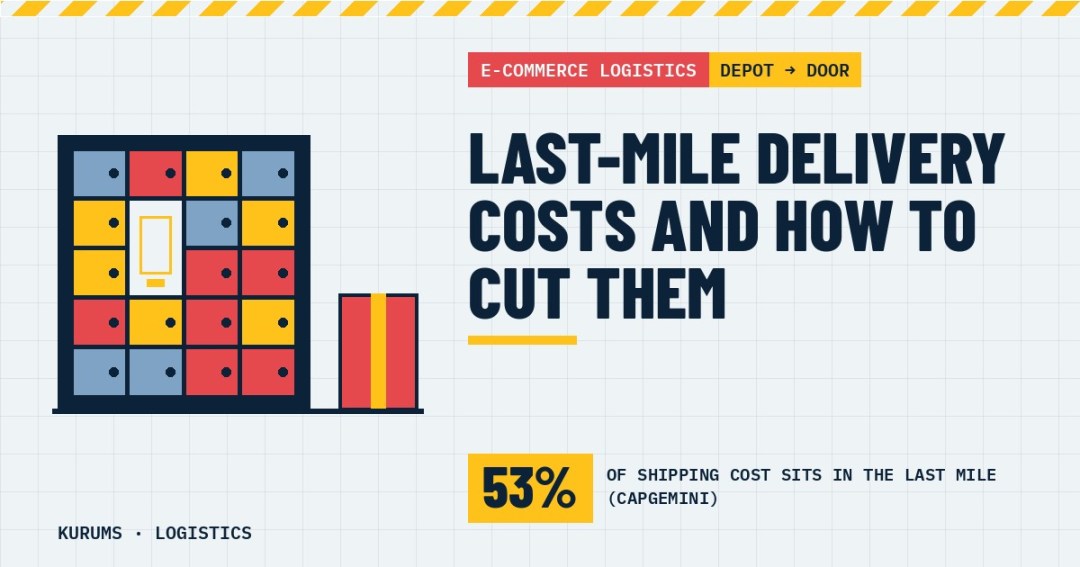
The last mile is roughly half the cost of shipping a parcel.
Capgemini's research puts it at 53%, up from 41% in 2018. Home-delivery networks are estimated by McKinsey at 60 to 70%.
Stop density is the whole game.
A van that drops 150 parcels at 150 doors does far more work than one that fills two locker banks. Cost per parcel follows parcels per stop.
Out-of-home delivery has become mainstream in Europe.
Last Mile Experts counted more than 646,000 lockers and pick-up points across Europe in 2025, and InPost alone ended 2025 with 61,196 lockers.
Failed deliveries are a hidden tax.
Each failed attempt in Europe is estimated to cost €14 to €17 once the second attempt, storage and customer service are counted.
What is last-mile delivery?
Last-mile delivery is the final leg of a parcel's journey: from the carrier's local depot or sorting hub to the place where the customer receives it. That place may be a home, a workplace, a parcel locker or a staffed pick-up point. The term has nothing to do with distance. A "last mile" can be 800 metres in a city centre or 60 kilometres in a rural district.
It follows the first mile, when a parcel is collected from the seller or warehouse, and the middle mile, when it travels in bulk between sorting centres by truck, rail or air. The first two legs move thousands of parcels together. The last one moves them one at a time, and that is the source of its cost. For the full chain, see the Kurums overview of e-commerce logistics and fulfilment models.
Why is the last mile so expensive?
Because consolidation stops. A line-haul truck carries thousands of parcels between two points and its cost is shared across all of them. A delivery van carries perhaps 100 to 200 parcels to nearly as many addresses, and every address needs parking, walking, a doorbell and often a wait.
Research puts numbers on it. The Capgemini Research Institute found that the last mile accounts for 53% of total shipping cost, up from 41% in its 2018 study. McKinsey's analysis of home-delivery networks puts the last mile at 60 to 70% of overall parcel delivery cost. The two figures measure slightly different things, but they agree on the conclusion: the final leg costs more than everything before it.
| Cost driver | Why it bites in the last mile |
|---|---|
| Labour | A driver's time is spent on stops, not on distance. Labour is commonly cited as around half of last-mile cost |
| Stop density | Few parcels per stop means the fixed time per stop is spread thinly |
| Failed first attempts | Nobody home means a second trip, storage, or a customer-service contact |
| Urban access | Congestion, restricted zones, emissions rules and scarce kerb space slow every round |
| Rural distance | Long gaps between addresses raise fuel and time per parcel |
| Returns | The same network runs backwards, usually with no consolidation at all |
What does a failed delivery really cost?
More than the second van trip. A failed first attempt sets off a chain: the parcel returns to the depot, is stored, is rescheduled or redirected, and frequently generates a "where is my order" contact. Address-data firm Loqate has estimated the average cost of a failed delivery across Europe at €14 to €17.
First-attempt failure rates vary widely by market and carrier, with industry sources quoting anything from low single digits to a quarter of home deliveries. The spread is the point: it is driven by things a seller can influence, such as address quality, delivery notifications and whether the customer was offered a slot or a pick-up option.
How do parcel lockers and pick-up points lower the cost?
They restore consolidation. One driver can fill a locker bank that serves hundreds of recipients in a single stop, and nobody needs to be at home. This is out-of-home (OOH) delivery, and it comes in two formats: automated parcel machines (APMs), better known as lockers, and staffed pick-up and drop-off points (PUDOs) in shops and kiosks.
The network has grown quickly in Europe. Last Mile Experts' annual study counted more than 646,000 out-of-home points across Europe in 2025. InPost, the largest locker operator, ended 2025 with 61,196 lockers and about 94,500 out-of-home locations in total, and delivered 1.4 billion parcels in the year, up 25%. By mid-2026 its locker count had risen to roughly 68,900. In early 2026 a consortium that includes FedEx and Advent made an all-cash offer for the company, with completion expected in the second half of the year, which says a good deal about how the large carriers value that infrastructure.
| Delivery option | Parcels per stop | Customer needs to be present | Typical use |
|---|---|---|---|
| Home delivery | About one | Often, for larger or signed-for items | Default in most markets |
| Workplace or neighbour | About one | No | Reduces failed attempts |
| Staffed pick-up point (PUDO) | Dozens | No, within opening hours | Returns and collections |
| Parcel locker (APM) | Dozens to hundreds | No, usually 24 hours | Dense urban and suburban areas |
Industry estimates put the saving from out-of-home delivery at around 30 to 40% of last-mile cost compared with home delivery. Treat that as a network-level figure: whether any of it reaches your rate card depends on your carrier and your volume. What a seller reliably gains is fewer failed deliveries and a returns route that customers find easy.
Which levers can a seller actually pull?
A seller does not run the vans, but several decisions upstream shape what the last mile costs.
- Offer delivery choice at checkout. Show a locker or pick-up option next to home delivery, and price it lower if your carrier does. Many customers prefer it, and each one who chooses it is a cheaper, more reliable delivery.
- Ship from closer. Holding stock in two or three regions shortens delivery zones, which is where a multi-warehouse 3PL earns its fee. See Best E-Commerce Fulfilment Providers.
- Shrink the parcel. Carriers charge on dimensional weight. Right-sized packaging reduces the bill on every single order.
- Avoid split shipments. Two parcels for one order means two last miles. Hold stock so that complete orders ship from one place.
- Use more than one carrier. Regional carriers and newer last-mile networks are often cheaper on specific zones. Rate-shopping tools are compared in Best Shipping Software.
- Fix the data. Validated addresses, phone numbers and accurate weights prevent surcharges and failed attempts.
- Design returns on purpose. Label-free drop-off at a locker or shop consolidates returns. The Kurums guide to backhaul and reverse logistics covers the freight side of the same idea.
How should you price delivery to customers?
Start from the true cost per parcel by product, not from what competitors display. Four approaches are common, and each suits a different margin structure.
| Pricing approach | How it works | Suits |
|---|---|---|
| Flat rate | One delivery price for every order | Catalogues with similar parcel sizes |
| Free over a threshold | Free delivery above a basket value | Raising average order value |
| Calculated at checkout | The live carrier rate is passed on | Bulky, heavy or highly variable goods |
| Free on everything | Delivery cost is built into product prices | High-margin, small, light products |
A threshold works best when it sits a little above the current average order value, so that customers add an item to reach it. Whatever you choose, review it when carrier contracts renew. The big parcel carriers have been prioritising revenue per parcel over volume: Pitney Bowes' Parcel Shipping Index reports US parcel revenue growing faster than volume in 2025, which means the average parcel got more expensive to send.
What is changing in last-mile delivery in 2026?
- Consolidation among carriers and locker networks. The offer for InPost and a run of European deals and network-sharing agreements are redrawing who covers which country.
- City access rules. More European cities are tightening emissions and kerb-space rules for delivery vehicles, which favours cargo bikes, electric vans and lockers.
- Cross-border parcels cost more to clear. The US ended its duty-free threshold in August 2025 and the EU began charging a flat €3 customs duty per item on low-value consignments on 1 July 2026, pushing sellers towards holding stock inside the destination market.
- Marketplaces as carriers. Amazon Logistics became the largest US parcel carrier by volume in 2025, with about 6.9 billion parcels according to Pitney Bowes.
None of these changes alter the arithmetic. The last mile is cheap when many parcels share a stop and nobody has to come back, and expensive when they do not.
How do you work out your own cost per delivered parcel?
Add four numbers for a month and divide by parcels successfully delivered: carrier charges including surcharges, packaging, the cost of redeliveries and returns to sender, and the customer-service time spent on delivery queries. Sellers who do this usually find the true figure is meaningfully above the rate on the carrier's price list, and that a small share of products or postcodes causes most of the excess. Those are the places to act first: change the packaging, change the carrier for that zone, or steer those orders towards a pick-up point.
Frequently asked questions
What percentage of shipping cost is the last mile?
Capgemini's research puts the last mile at 53% of total shipping cost, up from 41% in 2018. McKinsey estimates it at 60 to 70% of parcel delivery cost in a home-delivery network.
What is out-of-home delivery?
Delivery to a place other than the recipient's home or workplace, mainly automated parcel lockers and staffed pick-up and drop-off points. The customer collects the parcel when it suits them.
Are parcel lockers cheaper than home delivery?
For the carrier, yes, because one stop serves many recipients and there are no failed attempts. Industry estimates put the saving at around 30 to 40% of last-mile cost. How much reaches a seller's rates depends on the carrier and the contract.
How can a small seller reduce last-mile costs?
Validate addresses at checkout, offer a pick-up option, right-size packaging to reduce dimensional weight, avoid split shipments and compare more than one carrier for each delivery zone.
What is the difference between first mile, middle mile and last mile?
The first mile collects the parcel from the seller or warehouse. The middle mile moves it in bulk between sorting centres. The last mile takes it from the local depot to the customer.
Keep reading in the Logistics hub
- Capgemini Research Institute: The Last-Mile Delivery Challenge
- McKinsey: Out-of-Home Delivery
- Last Mile Experts: Out-of-Home Delivery in Europe
- Trans.info: InPost first-half 2026 volumes
- Pitney Bowes Parcel Shipping Index
Rates, rankings and market figures were checked in November 2026 and move quickly; confirm with the carrier, forwarder or publisher before you commit. Kurums has no paid relationship with the companies named here.
Discover more from Kurums | Business Intelligence
Subscribe to get the latest posts sent to your email.