
A packaging manufacturer needs a new head of operations. Two internal managers are plausible candidates, each with more than a decade in the business. The chief executive feels the company needs “fresh thinking” and engages a search firm. The appointee, Richard, arrives from a larger competitor with an impressive CV and a salary a fifth higher than his predecessor’s.
Richard’s first six months are difficult. He does not know which of the plant’s informal arrangements are essential and which are habits. He proposes a scheduling system that was tried and abandoned three years earlier. The two internal managers are civil and unhelpful. One leaves for a competitor within the year, taking two supervisors with her. By the eighteen-month mark Richard is doing well, and the chief executive considers the appointment a success. No one has added up what the first year cost.
When a senior or specialist role falls vacant, an organisation can promote someone it knows or bring in someone it does not. The choice is usually framed as one between continuity and new ideas. Underneath, it is shaped by a set of psychological biases that make outsiders look better than they are and insiders look worse.
This guide reviews the evidence on how internal and external appointments turn out, explains why decision-makers so often favour the stranger, and looks at what the choice does to the people on both sides.
Outsiders cost more and start slower.
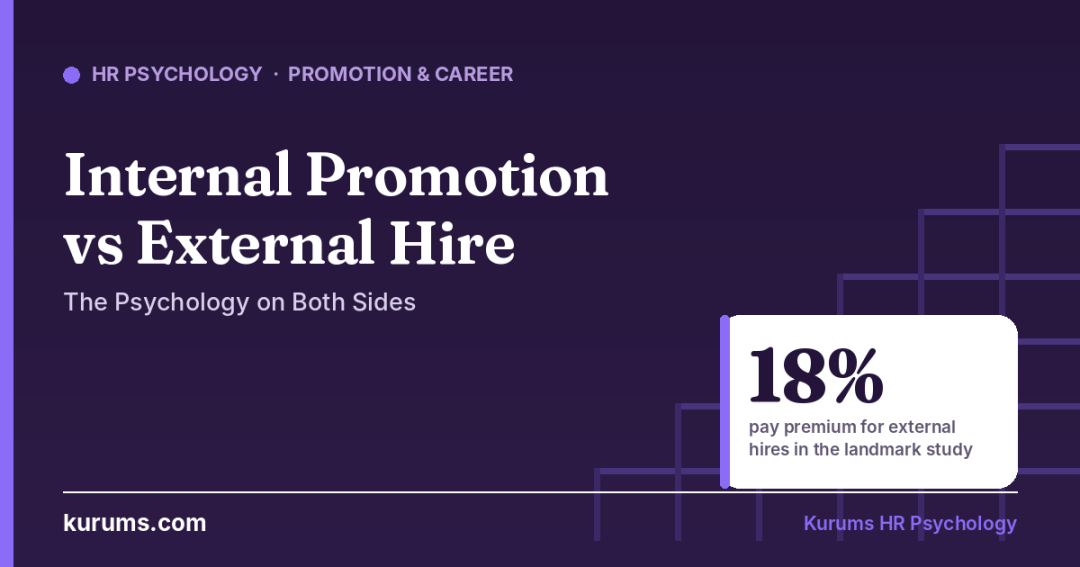
External hires in the best study were paid about 18% to 20% more and rated lower for two years.
We compare a documentary with a trailer.
Insiders’ flaws are known; outsiders are seen at their best.
Assess alike, onboard properly, tell insiders first.
Use one process for both, count the full cost and manage the people who were overlooked.
What does the evidence say about external hires?
The most thorough study followed thousands of appointments in a single large firm.
Analysing six years of personnel data from the investment banking arm of a US financial services company, Matthew Bidwell found that external hires into a given job received significantly lower performance evaluations for their first two years than internal promotees into the same job, were more likely to leave, and were paid around 18% to 20% more. External hires who stayed did go on to be promoted faster.
Paying more to get less, as the paper’s title put it. The reasons are not mysterious. An internal candidate already knows the organisation’s systems, products, people and unwritten rules. An outsider must learn all of that while doing the job. Bidwell found the externals had more education and experience on paper, which is presumably why they were hired and paid more. Those credentials did not make up for the lack of firm-specific knowledge until a couple of years had passed.
Related research on star performers points the same way.
Boris Groysberg studied more than a thousand star security analysts on Wall Street. When stars moved to a new firm, their performance typically dropped and remained lower for years. Those who moved with their team, or to a firm with stronger support, fared better. Much of what looked like individual talent depended on the colleagues, systems and relationships of the firm they had left.
Performance is less portable than CVs suggest.
Why do outsiders look better than they are?
Several biases push in the same direction.
You see the insider’s flaws and the outsider’s highlights. After ten years you know every mistake an internal candidate has made. You know the external candidate through a CV, references they chose and a few hours of their best behaviour. The comparison is between a documentary and a trailer.
Novelty feels like quality. New ideas from outside seem fresher than the same ideas from a colleague. Researchers Tanya Menon and Jeffrey Pfeffer documented a preference among managers for knowledge from external sources over identical knowledge from internal ones, partly because learning from an outsider does not involve conceding status to a rival down the corridor.
Role typecasting. An internal candidate is seen as the job they do now. Decision-makers who remember someone as a junior analyst find it hard to picture them as a director, however much they have grown.
The grass is greener. A vacancy often follows a period of dissatisfaction. An outsider carries none of the association with the old problems.
People value what seems scarce or hard to obtain. A candidate who must be courted, has other options and comes at a price feels more valuable than one who is already on the payroll and would say yes tomorrow.
The pay premium follows from the same logic. An outsider has to be compensated for the risk of moving, described in job offer psychology, and negotiates from an anchor set by the market, while the insider’s pay is anchored on their current salary plus a standard promotion increase.
When is an external hire the right call?
There are good reasons, and they should be stated explicitly instead of resting on a general wish for “fresh thinking”.
| Situation | Lean internal | Lean external |
|---|---|---|
| Skills needed | Exist in the organisation or can be developed in time | Genuinely absent and slow to build |
| Strategy | Continuing or refining | A real change of direction the insiders have not experienced |
| Knowledge the role depends on | Firm-specific: systems, clients, relationships | General: transferable across firms |
| Internal bench | Credible candidates exist | No one within reach of ready |
| Culture | Healthy; worth preserving | Needs challenge from someone not formed by it |
| Time available | Need effectiveness quickly | Can absorb a long ramp-up |
Note the last row. External hires take longer to become effective. If the role cannot wait, that points toward the insider, which is the opposite of what many urgent searches assume.
What happens to the insiders who were overlooked?
They draw conclusions. An internal candidate passed over for an outsider has been told that years of service and knowledge counted for less than a stranger’s CV. The reactions are those described in our guide to being passed over, with an added element: the newcomer is usually paid more, and that tends to become known.
The effects spread beyond the individuals concerned. Everyone watching learns something about whether effort here leads anywhere. Where senior roles are routinely filled from outside, ambitious people work out that the way to get promoted is to leave, and many do. This erodes what researchers call the psychological contract, the unwritten understanding that loyalty and development will be met with opportunity; see our guide to the psychological contract.
Then there is the practical matter of cooperation. The newcomer depends on exactly the people who were overlooked for the knowledge they lack. Overt sabotage is rare. Withholding the unrequested warning, such as “we tried that in 2023 and here’s why it failed”, is common, and enough to make the first year much harder.
If you hire externally over credible internal candidates, tell those candidates before the announcement, explain the specific reason and say what their own future looks like. Leaving them to hear it with everyone else almost guarantees a resignation or a year of quiet non-cooperation.
What is it like to be the outsider?
Harder than the hiring process suggested. The new hire has been courted and told how much the organisation needs their experience. They arrive to find that their experience does not fit, that colleagues are watchful, and that expectations, raised by the price paid for them, are high and immediate.
Research on leadership transitions, popularised by Michael Watkins and others, finds that a large share of externally hired senior leaders struggle or fail in the first eighteen months, and that the usual cause is not lack of ability but failure to read the culture and build relationships. Common errors are acting too fast to prove value, importing solutions from the previous employer and neglecting the people whose support they need.
An outsider’s success depends heavily on onboarding. That means more than a laptop and an induction day.
Give every external senior hire an internal “guide”: a respected peer, not their manager, whose job for the first six months is to explain how things actually work and to tell the newcomer when they are about to repeat something that has already failed.
How do you give internal candidates a fair assessment?
By correcting for the asymmetry of information.
Assess both the same way. Put internal and external candidates through the same structured process, with the same questions and exercises, as described in the case for structured interviews. Do not let the insider be judged on reputation and the outsider on interview performance.
Look for evidence about the outsider’s weaknesses. Take references you choose, not only those offered. Ask what the person was like in a bad quarter.
Update your picture of the insider. Ask people who work with them now, not people who remember them from years ago. Give them a chance to present how they would approach the role.
Price the options honestly. Include the search fee, the salary premium, the slower ramp-up and the risk of losing overlooked insiders. Set that against the cost of developing an internal candidate who is 80% ready.
How do you build a bench so the question arises less often?
Most external searches for senior roles are the result of earlier neglect. When there is no credible internal candidate, it is usually because nobody was given the experience that would have made them one.
Succession planning need not be elaborate. For each critical role, identify one or two people who could plausibly fill it in one to three years, list what they lack and give them assignments that supply it. Review the list twice a year. The biases to watch for in choosing those people are covered in our guide to promotion bias.
A healthy mix matters too. An organisation that never hires from outside becomes insular. One that always does tells its own people they have no future. Many firms aim to fill a clear majority of senior roles internally while bringing in outsiders deliberately for new capabilities.
The packaging manufacturer changed one thing after its experience. Internal candidates for any role at head-of level are now assessed alongside external ones through the same process, and the business case for an external hire has to state the capability gap and the full first-year cost. Its next two senior appointments were internal. The third was external, into a newly created sustainability role, and came with a guide.
Frequently asked questions
Is it better to promote internally or hire externally?
It depends on whether the capability exists inside. Internal promotees usually become effective faster, cost less and are less likely to leave. External hires make sense when the organisation needs skills or perspectives it lacks and cannot develop in time.
Why do external hires get paid more than internal promotions?
Outsiders must be compensated for the risk of moving and negotiate from market rates, while internal pay is usually anchored on current salary plus a standard increase. Decision-makers also tend to overvalue candidates who are scarce and unfamiliar.
Do external hires perform better than internal candidates?
On average, not at first. A major study found external hires received lower performance ratings than internal promotees for about two years and had higher exit rates, despite stronger credentials on paper.
How do you keep internal candidates motivated after an external hire?
Tell them before the announcement, give the specific reason, set out their development path and involve them in the newcomer’s onboarding in a way that recognises their expertise.
Discover more from Kurums | Business Intelligence
Subscribe to get the latest posts sent to your email.