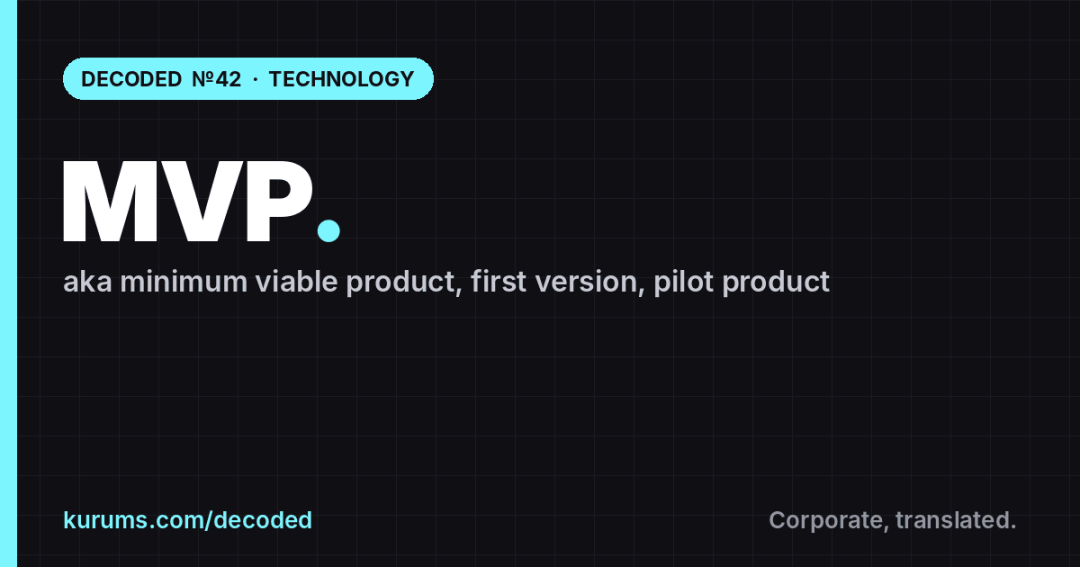
MVP.
aka minimum viable product, first version, pilot product
The simplest version of a product that works well enough to learn from.
What it actually means
An MVP, short for minimum viable product, is the smallest version of a product that real users can actually use, built to test whether an idea is worth pursuing. It includes only the core features needed to solve one problem, so a team can launch quickly, collect feedback and decide what to build next.
First, a quick clarification: in tech meetings, MVP does not mean most valuable player. Nobody is getting a trophy. It means a stripped-down first version you put in front of real people. A food delivery idea might start as a simple form and a few drivers instead of a full app. A new software feature might launch to a small group with basic design and one key function. The goal is learning, not perfection: do people use it, pay for it, come back?
The nuance people get wrong is the balance between minimum and viable. Too minimum, and the product is so broken that bad feedback tells you nothing about the idea. Too much, and you spend a year building features nobody asked for. A good MVP solves one problem properly and skips everything else. It also comes with a plan: what you want to learn, how you will measure it, and what you will do with the answer. Many teams accept some shortcuts in an MVP, which is fine, as long as they revisit them if the idea takes off.
Where you'll hear it
Let's cut the dashboard and the integrations. For the MVP, customers just need to upload a file and get a report back.
Translation: we will launch only the core feature first, see if people actually want it, then decide what else to build.
Also in investor pitches, where founders show traction from their MVP; in corporate innovation teams, where a new idea gets a small budget to build one before a bigger commitment; and in roadmap reviews, where someone asks which features are truly needed for launch and which can wait.
The pop-culture version
Before a band spends months in a studio, they often record a rough demo. A phone, a guitar, maybe a borrowed microphone. It is not polished, but it captures the song. They play it for friends and see who hums it the next day.
That demo is an MVP. It is the minimum needed to answer one question: is this song any good? If nobody cares, they saved months of studio time. If people love it, they know exactly where to invest.
But a demo still needs to be a real song. A random hum with no chorus would not tell anyone much. The same goes for an MVP: simple is good, but it must work well enough that people can judge the idea fairly.
The practical rule: an MVP should answer one clear question with the least work possible. Decide what you want to learn first, then cut every feature that does not help you learn it.
Say it like you mean it
“Let's launch the MVP to fifty users first and see if they come back next week.”
It treats the MVP as a small, real test with a clear way to measure success.“The MVP has to include every feature, or customers will not take us seriously.”
An MVP is deliberately minimal; adding everything defeats the point of testing early.You may also hear "iterate", meaning improve in small rounds based on feedback, and "pivot", meaning change direction when the MVP shows that the original idea is not working the way you hoped.
A practical guide to what a minimum viable product is, why companies build one, and the steps to plan, launch and learn from it.
Decoded next
Decoded by the Kurums editorial team. Kurums Decoded translates the language of business for people who are new to it. Definitions are kept short on purpose; the serious version above goes deep. Nothing here is financial, legal or career advice.
Discover more from Kurums | Business Intelligence
Subscribe to get the latest posts sent to your email.