
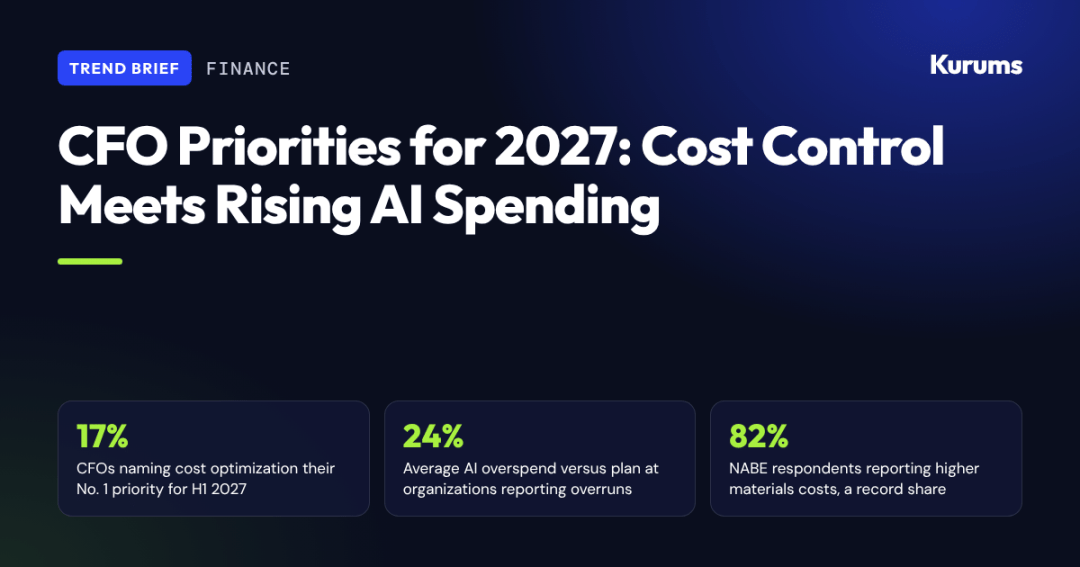
Finance chiefs head into 2027 asked to cut costs and fund AI at once, with input prices still climbing and no sign that borrowing gets cheaper soon.
A Gartner survey of 100 CFOs puts cost optimization as the most common number-one priority for the first half of 2027, while 35% name unpredictable AI costs as an execution challenge. Capgemini found AI overruns averaging 24% above plan. November data show growth cooling but still solid, materials costs rising at a record share of firms, and a Fed holding rates at 3.75% to 4%. The practical response is to budget AI as a metered cost with owners, limits and a measured return.
What the Gartner survey says about 2027
Gartner published its CFO priorities survey on November 23. According to CFO Dive, cost optimization was the most frequently chosen number-one priority for the first half of 2027, picked by 17% of the 100 CFOs surveyed. Building digital and AI skills within finance followed at 12%, improving financial planning maturity at 11% and improving finance process efficiency at 9%.
Counted a different way, the order shifts slightly. IT Brief reports that 52% of CFOs put finance process efficiency somewhere in their top five and 50% put enterprise cost optimization there.
The more useful finding is about readiness. Gartner found CFOs feel underprepared in three of the five most-cited areas: process efficiency, financial and enterprise data quality, and digital and AI skills. Analyst Mallory Barg Bulman said the acceleration of AI over the past year has changed the usual execution playbook and lowered confidence even in traditional areas such as process improvement.
AI is the cost line that will not hold still
Gartner’s release described boards and investors pressing finance leaders for clear, measurable returns on AI. That pressure arrives while the spending itself is hard to predict. In the survey, 35% of CFOs called managing the growth and unpredictability of enterprise AI costs an execution challenge.
Other recent surveys point the same way. A Capgemini Research Institute study of 500 senior executives at companies with more than $1 billion in revenue, covered by CFO Dive, found that:
- organizations that overran on AI spent an average of 24% more than expected, and 21% of them exceeded budget by more than 30%;
- two-thirds of overspenders reported financial consequences such as lower free cash flow or reduced discretionary spending;
- six in ten respondents lack a comprehensive view of AI expenses, and only 56% are fully confident they can forecast AI costs as adoption scales;
- CFOs now take part in approving major AI investments at 52% of organizations, up from 42% a year earlier.
Against that, only 24% of Gartner’s CFOs placed optimizing the finance technology vendor stack in their top five, the lowest of 14 priorities. Bulman argued it deserves a higher ranking because it helps control AI costs, reduces dependence on single vendors and preserves flexibility.
SAP shows how the AI return question is changing
SAP offers a concrete example of a finance chief working both sides of the problem. Speaking at a Morgan Stanley conference on November 19, CFO Dominik Asam said he would be surprised if SAP’s headcount did not flatten or decline as AI productivity gains mature, particularly in administrative functions, CFO Dive reported. He was describing SAP’s own plans.
On the cost side, CFO Dive notes that SAP replaced some of the more expensive AI models embedded in its products with cheaper alternatives, citing an October Reuters report. On the measurement side, Asam said SAP will introduce a new KPI in January, after fourth-quarter results, to give investors a clearer view of AI’s effect on the business, because the existing cloud ERP metric is no longer as meaningful.
The practical lesson: model choice is a cost lever, and yesterday’s headline metric may not explain AI-era performance.
The macro backdrop: solid growth, sticky costs
This week’s indicators describe an economy that is still growing while costs keep rising.
| Indicator | Latest reading | Why it matters for the budget |
|---|---|---|
| S&P Global Flash US Composite PMI | 54.6 in November, down from 55.9; a four-month low | Demand is cooling from a high level; S&P still sees about 3% annualized GDP growth in Q4 |
| Supplier delivery times (S&P manufacturing) | Longest delays since August 2022 | Working capital and safety stock assumptions need review |
| NABE Business Conditions Survey | 82% report higher materials costs; 69% expect further increases | Input inflation is broad; 43% of firms are raising their own prices |
| Conference Board Consumer Confidence | 103.3 in November, up from 91.9 | Consumer demand looks firmer, but 12-month inflation expectations are 5.7% |
S&P Global said selling prices and input costs both rose more slowly in November, helped by lower fuel prices, yet both remain elevated, and firms reported higher wage pressures.
NABE’s 82% figure is the highest in a series that began in July 1999. Its panel also reported that expectations for future sales and profits softened, and that elevated financing costs are constraining investment at some firms. The Conference Board linked the jump in confidence partly to lower uncertainty after the midterm elections, as CFO Dive noted.
Borrowing costs: plan for no relief
The Federal Open Market Committee held the federal funds target range at 3.75% to 4% on October 28. The statement records a 10–2 vote, and both dissenters preferred a quarter-point increase.
New York Fed President John Williams reinforced the tone in a November 23 speech. He put inflation at about 3.5% on the PCE measure and said the risk to price stability is “dialed up.” He expects inflation to slow to just above 2% next year and reach target in 2028. The committee next meets December 8–9.
None of this tells a treasurer where rates will be in mid-2027. It does suggest that a budget assuming cheaper debt in the first half carries more risk than one assuming flat or slightly higher funding costs. This is analysis, not advice; each company’s debt profile and hedging position will differ.
What Google Trends shows about attention
Google Trends data for the United States covering August 26 to November 26, 2026 compare four search terms on a 0–100 index, where 100 is the single highest day among them. These are relative interest scores, not search volumes.
- “Interest rates” dominates: a 90-day average of 17.7, with the peak of 100 on September 16. Interest has faded since, averaging 14.3 over the prior 30 days and 11.7 in the last seven.
- “CFO” is low and steady: 6.9 over 90 days, 7.4 over the prior 30 days, 5.9 in the last week, never above 12.
- “Cost optimization” and “AI ROI” barely register, averaging 0.2 and 0.1.
The reading is straightforward. Public attention goes to rates, and even that has cooled since mid-September. The vocabulary finance teams use for this week’s news is specialist language that general search does not pick up. When finance explains 2027 targets to the wider business, those phrases will need translating into terms budget owners already use.
Search interest: interest rates vs CFO
Google Trends, United States, Aug 26, 2026 to Nov 25, 2026. Daily index, 0–100, relative to the highest point among the terms compared; it shows relative attention, not search volume.
What to build into the 2027 budget
Treat AI as a metered cost
Usage-based AI pricing behaves more like a utility bill than a software license. Give each major AI workload a named owner, a monthly spending limit and a variance trigger, and include indirect costs such as human review and governance, which Capgemini found most CFOs cannot yet estimate with confidence.
Tie funding to a measured outcome
A Genpact survey cited by CFO Dive found only 15% of organizations had fully connected AI investments to specific profit-and-loss outcomes. Stage-gating AI funding against one agreed metric per initiative is a reasonable response.
Review the vendor stack
Overlapping tools and single-vendor dependence are where AI costs compound.
Run rate and input-cost scenarios
Build at least one case with flat or higher borrowing costs and continued materials inflation, and test pricing, working capital and covenant headroom against it.
Fund skills and data
CFOs told Gartner they are least ready on data quality and AI skills. Cutting those lines to hit a cost target would undermine the efficiency gains the plan depends on.
What to do next
- Pull the last 12 months of AI-related spend across IT, business units and finance into one view, including usage-based fees.
- Assign an owner, a monthly limit and a variance threshold to each major AI workload before the 2027 budget is locked.
- Add a flat-or-higher rate scenario to the 2027 plan and check interest cover and covenant headroom under it.
- Re-test materials and wage inflation assumptions against November PMI and NABE readings.
- List finance technology vendors, contract renewal dates and overlapping functions; flag consolidation candidates for Q1.
- Agree one outcome metric per funded AI initiative and a review date in the first half of 2027.
- Protect budget for finance data quality and AI training, and name who is accountable for each.
Frequently asked questions
What did Gartner's CFO survey find for 2027?
Among 100 CFOs, cost optimization was the most common number-one priority for the first half of 2027 at 17%, followed by digital and AI skills at 12%. By top-five mentions, process efficiency led at 52%.
Why is AI spending so hard to budget?
Much of it is usage-based and spread across teams. Capgemini found six in ten executives lack a comprehensive view of AI expenses, and organizations that overran spent an average of 24% above plan.
Should the 2027 budget assume lower interest rates?
The evidence this week does not support relying on it. The Fed held its target range at 3.75% to 4% in October with two members preferring an increase, and officials describe inflation as too high. A flat-or-higher case is the cautious planning assumption.
What is SAP's new AI metric?
SAP's CFO said the company will introduce a new KPI in January, after fourth-quarter 2026 results, to show investors AI's effect on the business. It will include revenue from the business data cloud segment and AI transformation tools.
Is the US economy slowing enough to change revenue plans?
Growth is cooling but remains solid. S&P Global's flash composite PMI fell to 54.6 in November, a four-month low, and still points to roughly 3% annualized fourth-quarter growth. NABE respondents reported softer expectations for future sales and profits.
- CFO Dive: CFOs prioritize cost control, efficiency for 2027: Gartner (2026-11-23)
- IT Brief Australia: CFOs prioritise efficiency & cost as AI reshapes finance (2026-11-24)
- CFO Dive: CFOs confront cash-flow risks as AI costs rise
- CFO Dive: AI productivity gains to slow headcount, SAP CFO predicts (2026-11-23)
- S&P Global: S&P Global Flash US PMI: Business activity growth and price pressures remain elevated in November but show signs of cooling (2026-11-23)
- CFO Dive: Business activity cools due to inflation but persists above trend: S&P (2026-11-23)
- National Association for Business Economics: November 2026 Business Conditions Survey Summary (2026-11-23)
- The Conference Board: US Consumer Confidence (November 2026) (2026-11-24)
- CFO Dive: Consumer sentiment surges following midterm elections: Conference Board (2026-11-24)
- Federal Reserve Board: Federal Reserve issues FOMC statement (2026-10-28)
- Federal Reserve Bank of New York: The Economic Mixdown (remarks by John C. Williams) (2026-11-23)
Search-interest figures are from Google Trends (United States, 90 days to November 26, 2026). This article is analysis for operators, not legal, tax or investment advice. Last updated November 26, 2026.
Discover more from Kurums | Business Intelligence
Subscribe to get the latest posts sent to your email.