
Taste Note - Amazon Corporate Governance Best Sellers
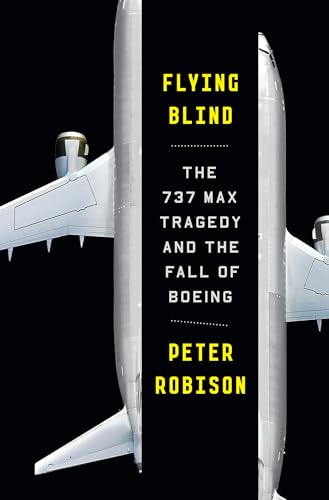
Flying Blind: The 737 MAX as a Case Study in What Boards Stop Seeing
A Kurums Book Taste review of Flying Blind for board members and governance leaders who need to see how financial priorities can quietly crowd out safety and engineering judgment.
Why this book fits Kurums
Peter Robison, a Bloomberg reporter who covered Boeing for years, tells the story of how one of America's most admired engineering companies produced the 737 MAX, an aircraft involved in two crashes that killed 346 people. The book is not mainly about aviation technology. It is about how a company's priorities, incentives and oversight changed over two decades, and how those changes made a catastrophic failure more likely without any single person deciding to accept it.
For the Kurums Corporate Governance audience, Flying Blind is a rare case where the link between culture, strategy and board oversight can be followed step by step. Directors, company secretaries, risk committee members and compliance leaders will recognize the pattern: cost targets that slowly outrank technical warnings, a regulator that relies heavily on the company itself, and a board that receives reassuring summaries instead of the signals that matter. It pairs well with Willful Blindness and Bad Blood on the Kurums governance shelf.
What the book argues
Robison argues that Boeing's decline began with a shift in what the company valued. He traces the 1997 merger with McDonnell Douglas, the arrival of executives shaped by a finance-first management style, and the later move of headquarters from Seattle to Chicago, away from the engineers who built the planes. In his account, a culture that once let engineering judgment win arguments gradually became one where share price, cost reduction and returns to shareholders set the agenda.
The book then follows how that culture shaped the 737 MAX. Facing competition from Airbus, Boeing chose to update an existing design rather than build a new aircraft, and treated minimizing extra pilot training as a commercial priority. Robison describes how the flight-control software known as MCAS was designed to rely on a single sensor and was not clearly explained to pilots, and how the certification process delegated much of the technical review to Boeing's own employees under the oversight of the Federal Aviation Administration.
Finally, Robison examines the response to the two crashes, the Lion Air accident in 2018 and the Ethiopian Airlines accident in 2019. He shows a company that defended its aircraft and its processes long after doubts had emerged, a board that had little direct aviation-safety expertise, and leadership changes that came only after the grounding, investigations and enormous financial and reputational cost. The lesson he draws is that risk oversight fails quietly, long before it fails visibly.
Key ideas, translated to your desk
Watch what wins the argument
Culture shows up in which voice prevails when cost and technical judgment conflict. Ask for examples of recent trade-offs, not statements of values.
Delegated oversight is still your risk
When a regulator, auditor or certifier relies on your own people, the board cannot treat that review as independent assurance. Build your own line of sight.
Expertise belongs on the board
If the company's core risk is technical, at least some directors need the knowledge to question management's answers. A dedicated committee helps only if it has that expertise.
Use it at work
- List the company's top three safety, product or operational risks and check whether any director has the expertise to challenge management on each one.
- Ask management for two recent cases where engineering, quality or compliance raised a concern that conflicted with a cost or schedule target, and how each was resolved.
- Review which external assurances depend on work performed by your own employees and report them separately to the audit or risk committee.
- Add a standing agenda item for unfiltered risk signals, such as hotline themes, quality escapes and regulator correspondence.
Read it if
- You sit on a board or risk committee overseeing a technically complex product or service.
- You want a narrative case study to use in governance training or board offsites.
- You found Willful Blindness persuasive and want a detailed corporate example of the same pattern.
You can skip it if
- You want a technical or engineering account of aircraft design and accident investigation.
- You need a governance handbook with frameworks and checklists rather than investigative journalism.
- You are looking for a balanced company history; the book is a critical account built around a failure.
This book appears in
Curated Tasting Menus that chain this title into a reading route.
Discover more from Kurums | Business Intelligence
Subscribe to get the latest posts sent to your email.