
A 500-person media company cuts 60 jobs on a Wednesday morning. Those affected receive a calendar invitation at 9.00 for a 9.15 video call. By 9.40 their system access has been removed. The rest of the company learns what has happened from the gaps in the messaging channels. At 11.00 the chief executive holds an all-hands meeting, describes the decision as “painful but necessary”, says the company is now “right-sized for the future” and takes no questions.
The leadership team expects relief among those who remain. What follows is different. For three weeks very little is produced. People spend hours in private chats trying to work out who was chosen and why. A rumour of a second round takes hold. Within four months, eleven people have resigned, among them four the company had classed as critical. One says in her exit conversation: “I watched how you treated Sam after fourteen years. I’m not waiting for my turn.”
When an organisation makes redundancies, attention goes to the people leaving: the selection, the legal process, the severance. That is necessary. It is not enough, because the future of the organisation rests with the people who are still there the next morning.
Those people are frequently described as the lucky ones. The research gives a more complicated picture. Survivors of layoffs often show lower commitment, lower performance and a higher rate of resignation, to the point where a badly handled reduction can lose the organisation more capability through later departures than through the cuts themselves.
Survivors are affected too.
Insecurity, guilt, anger and distrust are common among those who keep their jobs.
Layoffs trigger resignations.
Voluntary turnover rises after downsizing, and those with the most options leave first.
How leavers are treated is the message.
Fair criteria, dignity, honest explanation and a re-planned workload decide whether survivors stay.
What is layoff survivor syndrome?
The term describes the cluster of reactions seen among employees who remain after colleagues have been made redundant. It was popularised by the organisational consultant David Noer, who called it “layoff survivor sickness” in the early 1990s, and has been studied extensively, notably by Joel Brockner.
Typical reactions include the following.
| Reaction | What it looks like |
|---|---|
| Insecurity | “Am I next?” Constant scanning for signs of another round |
| Guilt | Discomfort at having been spared when respected colleagues were not |
| Anger | At leaders, for the decision or for how it was carried out |
| Grief | For lost colleagues and for the organisation as it was |
| Distrust | Scepticism toward anything leadership says |
| Overload | The same work with fewer people |
| Withdrawal | Lower effort, less initiative, caution about risk |
Not every survivor experiences all of these, and some, especially where the business was plainly in trouble, feel mainly relief. But the pattern is common enough that an organisation should expect it.
What does the research show about the effects?
Three findings are well established.
Job insecurity harms attitudes and health. A meta-analysis by Magnus Sverke and colleagues found that perceived job insecurity was associated with lower job satisfaction, commitment and trust, with poorer physical and mental health and with higher intention to leave.
Layoffs are followed by resignations.
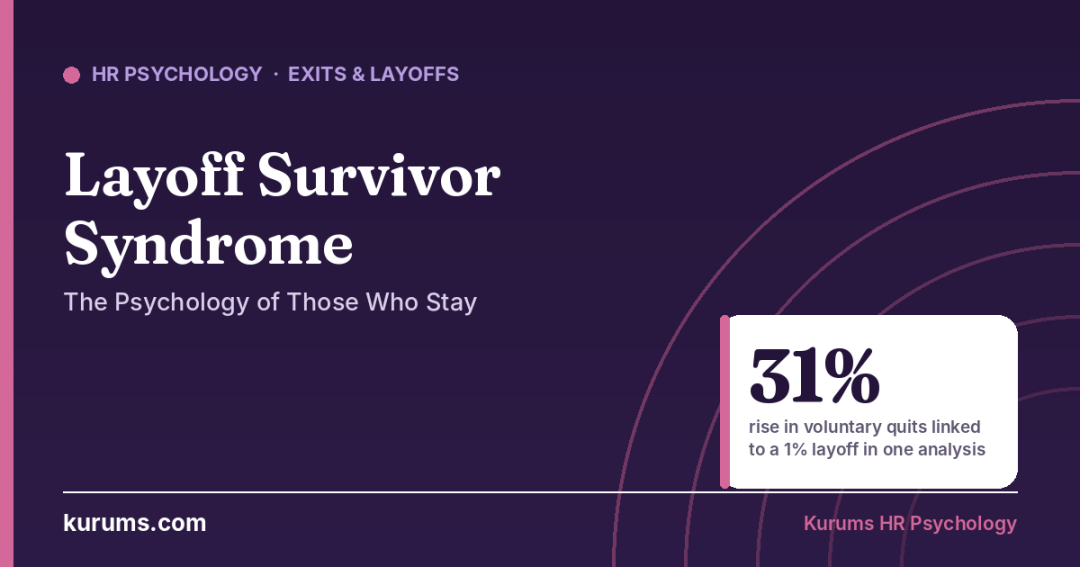
Analysing data from several hundred US firms, the authors found that downsizing predicted higher subsequent voluntary turnover. In their model, even a small layoff was associated with a disproportionately large rise in voluntary quits; a frequently quoted figure from the analysis is that a workforce reduction of 1% was followed by a 31% increase in voluntary turnover on average. The effect was weaker in firms with practices that conveyed procedural fairness and stronger job embeddedness.
The people who leave voluntarily after a layoff are not a random selection. They are those with the best outside options, who are often the people the organisation most wanted to keep.
The financial case is weaker than assumed. Wayne Cascio’s long-running research on downsizing found that firms that cut staff did not, on average, outperform comparable firms that did not, in profitability or share price over the following years. The savings in the plan are real. So are the costs that were left out of it: lost knowledge, lower productivity, departures, rehiring and reputational damage.
Why do survivors react this way?
Several psychological mechanisms combine.
The psychological contract has changed. Many employees hold an unwritten expectation that good work and loyalty are met with security. A layoff shows that the expectation was mistaken, for others and therefore for them. The mechanism is described in our guide to the psychological contract.
Survivors judge fairness as witnesses. Brockner’s research showed that survivors’ reactions depend heavily on how fairly they believe those who left were treated: whether the selection criteria made sense, whether notice and support were adequate, whether people were treated with dignity. Survivors identify with their former colleagues and conclude that this is how they will be treated in their turn. This is organisational justice observed at second hand, the subject of our guide to fair process.
Uncertainty is aversive in itself. Not knowing whether another round is coming keeps people in a state of sustained threat. Research on stress finds that unpredictable threats are harder to cope with than predictable ones.
It is a shock. In the terms of the unfolding model of turnover, a layoff is a powerful jolt that prompts every survivor to reassess. It also removes links, which lowers embeddedness, and it sets off the contagion effect, by which colleagues’ departures make leaving more likely.
Leaders who have agonised over a redundancy decision feel relief once it is done and assume others share it. They have had months to adjust. Survivors are at the start of the process, and to them the leader’s forward-looking optimism sounds like indifference.
What makes it worse?
The opening example includes most of the errors.
- Surprise. No warning that the business was in difficulty.
- Impersonal delivery. Mass video calls, email notices, immediate lock-outs that treat long-serving colleagues as security risks. The dismissal of around 900 employees on a single video call by the chief executive of the mortgage company Better.com in 2021 became a widely discussed example of how not to do it.
- Opaque selection. Nobody can tell why those people were chosen, so everybody assumes it could have been them.
- Corporate language. “Right-sizing”, “streamlining” and “a difficult decision for all of us”.
- No questions. One-way communication at the moment people most need answers.
- Repeated rounds. Each one renews the shock and confirms that nobody is safe.
- Visible unfairness. Executive bonuses paid the same quarter, or cuts that spare the senior ranks.
- Unchanged workload. The work of sixty people redistributed without discussion.
How should the departures be handled?
Well, for their own sake and because survivors are watching. The care taken with leavers is the message to those who remain.
When Nokia closed a plant in Bochum, Germany, in 2008, the closure provoked protests, a boycott and substantial reputational and financial cost. In its 2011 restructuring, which affected around 18,000 employees, the company ran a programme called Bridge, offering help to find another job inside or outside Nokia, training, and support and funding for starting a business. The company reported that a majority of affected employees knew their next step by the time they left, and that engagement and quality among remaining employees held up through the restructuring.
The principles are the usual ones. Give as much notice as you can. Have people told by their own manager, in person where possible. Explain the criteria. Provide meaningful severance and practical help. Allow people to say goodbye. The conversation itself is covered in our guide to the termination conversation, and our analysis of a tech layoff’s severance terms shows what a considered package can include.
What do survivors need?
Information, acknowledgement and a credible future, in roughly that order.
Explain the business reason honestly. People cope better with bad news they understand. Give the numbers.
Explain the selection. Not individual cases, but the criteria and the process. This is the largest single influence on whether survivors regard the layoff as fair.
Say what you know about the future, and what you do not. If you can say there will be no further cuts for a defined period, say so, and mean it. If you cannot, do not. “I can’t promise there will never be more changes. I can tell you that this plan was designed to be enough, and here is what would have to happen for that to change.”
Acknowledge the loss. Name the people who have gone and what they contributed. Allow time for sadness. Pretending that nothing has happened is read as callousness.
Deal with the workload. Decide what will no longer be done. Asking survivors simply to absorb the work tells them that the cost of the reduction has been moved onto them.
Be visible. Leaders who retreat behind closed doors after a layoff confirm the worst interpretations.
What about the managers?
Line managers are in the most difficult position. They often have to deliver the news to people they have worked with for years, and then lead the remaining team, while being survivors themselves and frequently fearing for their own jobs.
Researchers Andrew Molinsky and Joshua Margolis studied what they called “necessary evils”: work-required acts that cause harm to another person. They found that performing them takes a real emotional toll and that managers cope by a range of means, including detachment, which can make them seem cold at the very moment warmth is needed.
Managers need to be told early, trained in what to say, allowed to be honest and given somewhere to take their own reactions. An organisation that hands them a script on the morning and expects them to deliver it has set up both the managers and their teams to fail.
Are there alternatives to layoffs?
Often, and they are worth serious thought, because the full costs of layoffs are regularly underestimated.
- Hiring freezes and natural attrition. Slower and far less damaging.
- Reduced hours or short-time working. Common in parts of Europe, sometimes with state support.
- Temporary pay cuts. Starting at the top, with a clear explanation and an end date. The classic study of how explanation changes the reaction to a pay cut is described in our guide to organisational justice.
- Voluntary redundancy or sabbaticals. These give people a choice, at the risk of losing those you would prefer to keep.
- Redeployment and retraining. Moving people to where the work is.
Where a reduction is unavoidable, a single adequately sized round is less harmful than several small ones. Each round restarts the cycle of insecurity. Our layoff readiness guide sets out the planning steps.
Redundancy is closely regulated in most countries, with rules on consultation, selection criteria, notice and, in many places, collective processes. The psychology in this guide concerns how to behave within those rules. It does not replace them. Take legal advice before any announcement.
How long does recovery take?
Longer than leaders expect. Trust that was lost in a morning takes many months of consistent behaviour to rebuild. Studies following survivors over time find that negative effects can persist for a year or more and that they are prolonged by further rounds.
The signs of recovery are behavioural. People begin to raise problems again, to volunteer, to take ordinary risks and to make plans that assume they will be there next year. The climate involved is the subject of our guide to psychological safety. Until those behaviours return, the organisation is working at reduced capacity, whatever the headcount figure says.
Before announcing any reduction, write down what the eleven best people in the organisation will see and hear on the day, hour by hour. Then ask whether, having seen it, they would stay. If the honest answer is no, change the plan while there is still time.
The media company went on to lose a further fifteen people over the following year. Its head of people worked out afterwards that replacing the eleven who left in the first four months had cost more than the first-year savings from the sixty redundancies. In the board paper she wrote that the cuts had been necessary and that the manner of them had been a choice.
Frequently asked questions
What is layoff survivor syndrome?
It is the set of negative reactions, including insecurity, guilt, anger, distrust and reduced motivation, that employees commonly experience after colleagues have been made redundant while they themselves remain.
Why do employees quit after layoffs?
A layoff acts as a shock that prompts people to reassess their own security and how the organisation treats its staff. It removes working relationships, increases workload and signals that loyalty does not guarantee a job. People with good alternatives act on that reassessment.
How can companies support employees after layoffs?
Explain the business reason and the selection criteria honestly, treat departing colleagues with dignity, hold one-to-one conversations with everyone who remains, reduce or re-prioritise workload, communicate regularly and be truthful about what the future holds.
How long does survivor syndrome last?
It varies, but effects on trust, commitment and performance can last a year or more, and longer if there are further rounds of cuts or if the first round was handled badly.
Discover more from Kurums | Business Intelligence
Subscribe to get the latest posts sent to your email.