
Taste Note - Amazon Technology Best Sellers
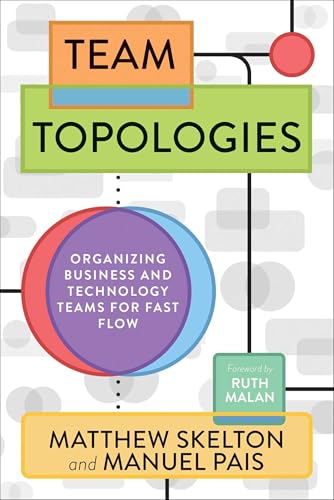
Team Topologies: Four Team Types and the End of Org-Chart Guesswork
A Kurums Book Taste review of Team Topologies for leaders who reorganize every eighteen months and keep rebuilding the same bottlenecks.
Why this book fits Kurums
Conway's Law guarantees that your architecture will mirror your communication structure whether you plan it or not - so the authors' move is to plan it: design team boundaries first, deliberately, as the primary tool for shaping both software and flow. The book gave the industry its current org-design vocabulary, and platform-team job postings everywhere quote it verbatim.
For the Kurums Technology audience this is the organizational layer the delivery trilogy assumes: Accelerate tells you loosely coupled teams win; Team Topologies tells you which teams to create, what each owns, and - through cognitive load - how much any team can own before flow collapses.
What the book argues
The foundations are Conway's Law taken seriously (use the reverse maneuver: choose the architecture you want and shape team communication to produce it) and cognitive load as the sizing constraint: a team - the fundamental delivery unit, long-lived, eight-ish people - can only master so much; responsibilities beyond that capacity show up as slow onboarding, shallow ownership, and queues. Team-first thinking replaces resource-allocation thinking: assign domains to teams, not tickets to individuals, and fit the domain to the team's load budget.
The taxonomy is the famous contribution: stream-aligned teams (the default - aligned to a product, service, or user journey, owning build-and-run end to end); enabling teams (specialists who grow capabilities in stream teams, then step away - teachers, not doers); complicated-subsystem teams (owning genuinely deep specialties - codecs, risk engines - so stream teams don't need PhDs); and platform teams (providing the underlying services - deployment, data, infra - as an internal product with a compelling 'thinnest viable' surface, measured by whether stream teams choose it, not whether they're forced to). Almost every failure pattern the book diagnoses - the overloaded shared-services queue, the ivory-tower architecture group, the DevOps team that became a third silo - is one of these four done wrong or missing.
The dynamics half keeps the design honest: exactly three interaction modes - collaboration (intense, discovery-phase, deliberately temporary), X-as-a-Service (clean consumption with minimal coordination), and facilitating (the enabling pattern) - with the rule that every inter-team relationship should name its mode and expected evolution. Fracture planes guide where to split monoliths and domains (along business capability, regulatory, or performance seams), and the sensing chapters treat organizational pain - too many meetings, surprise dependencies, queues at one team - as the signal to evolve the topology. The quiet radicalism: the org chart becomes a versioned, intentional artifact, redesigned by the same discipline as the architecture it shapes.
Key ideas, translated to your desk
Design teams before architecture
Conway's Law runs whether you steer or not. Choose the system boundaries you want and set team boundaries to match - the reverse maneuver is the whole game.
Budget cognitive load like money
Every domain a team owns spends capacity. When onboarding slows and queues form, the team isn't weak - it's over-mortgaged. Split the domain, not the team.
Name the interaction mode
Collaboration, X-as-a-Service, facilitating - undeclared modes default to meetings. Write the mode on every team-to-team edge and review it quarterly.
Use it at work
- Inventory current teams against the four types; label the ones that are none of them - those are your bottlenecks.
- Run a cognitive-load survey per team and rebalance domain ownership where the budget is blown.
- Recharter your platform group as an internal product with adoption as its KPI.
- Draw the team-interaction diagram with modes on every edge; schedule its first quarterly revision.
Read it if
- You are planning a reorg, a platform build-out, or a monolith decomposition.
- Your 'DevOps team' became a queue between dev and ops.
- You want the org-design layer under Accelerate's findings.
You can skip it if
- You run one or two teams - read the cognitive-load chapter and stop.
- Your topology already matches and flows; keep the book for the next scale step.
- You want people-management craft; this is structure, not leadership.
This book appears in
Curated Tasting Menus that chain this title into a reading route.
Discover more from Kurums | Business Intelligence
Subscribe to get the latest posts sent to your email.