
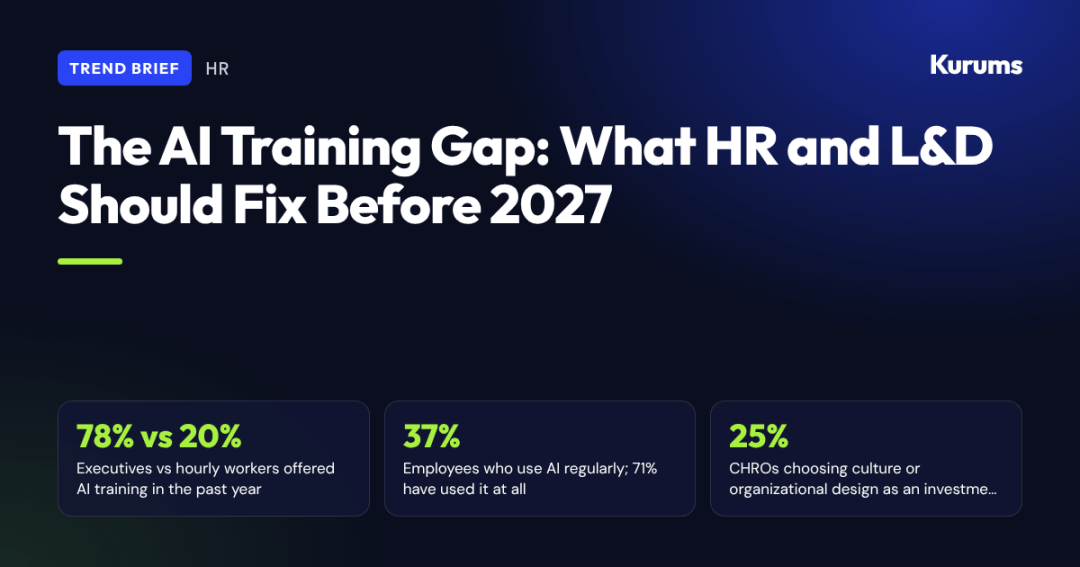
Employers are rolling out AI faster than they train people to use it, and the training that exists goes mostly to executives rather than the workers who need it.
A Marsh survey of more than 6,700 employees found 78% of executives were offered AI training in the past year, against 20% of hourly workers. i4cp reports only 25% of CHROs are prioritizing culture or organizational design alongside AI. An Express Employment Professionals-Harris Poll survey shows 76% of US hiring managers plan to reskill staff and 92% rate willingness to learn as essential or very important. For 2027, HR should audit training access by job level, equip managers to explain AI, and define how recruiters assess learning ability.
What happened this week
Three pieces of research landed within a few days of each other, and HR Dive covered all of them in the week of November 23. Together they describe one problem: AI tools have been distributed widely, but training, manager guidance and culture work have not kept pace.
- Training access is uneven. Marsh’s 2026 HR Technology’s Impact on the Workforce report, released November 18, surveyed more than 6,700 employees in 10 countries in July. It found that 71% of workers have used AI in their jobs, up from 39% in 2024, but only 37% use it regularly. HR Dive’s November 24 roundup grouped it with other studies pointing the same way.
- Culture is rarely part of the plan. The Institute for Corporate Productivity (i4cp) said in its 2027 Priorities & Predictions release that only 10% of organizations are continuously redesigning work, and only 25% of CHROs chose culture or organizational design as an investment priority.
- Hiring criteria are shifting toward learning ability. An Express Employment Professionals-Harris Poll survey of 1,006 US hiring decision-makers found 76% say their company plans to reskill employees in the next few months, up from 64% in spring 2025.
The access gap runs along the org chart
The share of employees who say their employer offered them AI training in the past year falls at each step down the hierarchy, and regular use and confidence fall with it.
| Group | Offered AI training in past year | Other Marsh findings |
|---|---|---|
| Executives | 78% | 64% use AI regularly; 9 in 10 confident doing their job with AI |
| Experienced professionals | 44% | 69% confident in AI’s benefits |
| Entry-level professionals | 32% | 20% use AI regularly |
| Hourly workers | 20% | About 5 in 10 confident doing their job with AI |
Marsh’s global workforce leader, Ravin Jesuthasan, described the result as a “stalled transformation”: access to tools has not turned into sustained use. Executives also have better access to mentorship, coaching and sandbox practice environments.
Content is a second problem. Marsh says most AI training focuses on technical skills, while judgment, critical thinking and contextual knowledge decide whether AI use improves performance. HR Dive’s report on the study cites a July analysis from The Conference Board with a similar conclusion: training often stops at AI literacy and basic prompting.
Audience matters too. A Hogan Assessments poll of 648 workers, reported by HR Dive, found managers hold more positive attitudes toward AI than nonmanagers.
Managers are the missing channel
Training is only part of what employees say they lack. In the Marsh survey, one in three employees said no one has discussed AI’s impact on their role or department. Among those who had heard something, only 21% named their direct manager or supervisor as the source.
The gap shows up in behavior. More than one in five employees report using AI tools their employer did not supply, and over one in ten say their organization provides no AI guidelines at all. Among employees who strongly agree they have adequate digital tools, 85% follow AI guidelines; among those who strongly disagree, 54% do. Jesuthasan argued that this “shadow AI” is a sign employees are filling gaps on their own, not only a compliance issue.
HR Dive’s coverage of the i4cp report cites a 2026 Gallup study in which 50% of CHROs said they were not confident their managers could guide employees’ AI use.
Culture and work design are where HR has leverage
Among organizations where HR leads AI implementation, 56% say they are mostly or fully AI-ready. Where IT leads without HR involved, the figure is 18%. Earlier i4cp research found that organizations with strong AI, skills and culture readiness were twice as likely to sustain superior market performance as those focused on technology alone. These are survey associations, not proof of cause.
CHROs named competing priorities (43%), change fatigue (33%) and resistance to change (30%) as their top internal obstacles. AI enablement is the most commonly anticipated human capital investment for 2027, cited by 58% of respondents.
As AI takes over routine analysis, coordination and entry-level work, companies may remove the tasks that taught people judgment. i4cp predicts “a talent shortage created from within.” For L&D, that means rebuilding the lost learning deliberately when a task is automated.
Hiring for willingness to learn
In the Express-Harris Poll data, eighty-six percent of hiring managers say they would rather reskill current employees for new roles than hire new ones, up from 79% in fall 2025. Among companies planning to add staff in the second half of 2026, 37% are doing so to get expertise in new areas.
When they do hire, 92% rate willingness to learn as absolutely essential or very important, including 57% who call it absolutely essential.
Among companies planning to reskill, 75% will use company-led programs, 62% on-the-job training from other employees and 58% third-party courses. HR Dive’s summary adds that roughly a third plan some training outside work hours and just over one-quarter plan AI-assisted training.
“Willingness to learn” is easy to claim in an interview. A reasonable approach is to treat it like any other competency: define it, ask for past evidence and score answers against a shared rubric. Screening is also getting harder: i4cp expects closer collaboration between talent acquisition and cybersecurity to counter AI-enabled candidate fraud.
Crunchbase News reported on November 19 that venture investors have put close to $4 billion this year into startups focused on recruiting, job search, HR and payroll, most with a heavy AI component. More tools will arrive whether or not training catches up.
What Google Trends shows about attention
Google Trends data for the United States covering August 26 to November 26, 2026 compares four search terms on a shared 0 to 100 index. These are relative interest scores, not search volumes.
- “AI training” averaged 58.6 over 90 days and peaked at 100 on September 19. The prior 30-day average was 57.4; the last seven days averaged 43.1.
- “AI skills” averaged 26.2, peaked at 47 on September 21 and averaged 18.6 over the last week.
- “Upskilling” averaged 0.9 and “reskilling” 0.2 on the same scale.
Two cautions apply. The last-week dip coincides with Thanksgiving week, so it should not be read as fading interest. And “AI training” is ambiguous: some of those searches are about training AI models, not training people.
Even so, the gap between plain-language terms and HR vocabulary is large. People search for “AI training” and “AI skills”; almost nobody searches for “upskilling” or “reskilling.” That is a practical hint for naming internal programs and course catalogs.
Search interest: AI training vs AI skills
Google Trends, United States, Aug 26, 2026 to Nov 25, 2026. Daily index, 0–100, relative to the highest point among the terms compared; it shows relative attention, not search volume.
A 2027 plan for HR and L&D
The surveys are self-reported and prescribe no program. What follows is analysis, not advice.
Measure access before buying more content
Break down AI training offered and completed by job level, function and hourly versus salaried status. If the pattern resembles Marsh’s, spend first on distribution: paid time, practice environments and coaching for the groups that get least.
Make managers the first audience
Give managers a short brief covering approved tools, expectations and likely role changes, and ask them to deliver it. Publish AI guidelines where none exist.
Tie culture work to the AI budget
Use the i4cp readiness figures to argue for HR co-leading implementation with IT, and phase change to respect the fatigue CHROs report.
Protect development paths
For each entry-level task being automated, record what skill it built and where that skill will now be learned.
Define learning ability in hiring
Agree on evidence and scoring for willingness to learn, and train interviewers to use it consistently.
What to do next
- Pull AI training offer and completion rates by job level and compare hourly, entry-level and executive groups.
- Check whether every employee can find written AI guidelines and a list of approved tools.
- Give each people manager a one-page brief on AI's expected impact on their team and a date to discuss it.
- Add judgment and critical-thinking practice to AI courses that currently cover only prompting.
- List entry-level tasks moved to AI this year and name the replacement learning experience for each.
- Write a shared interview rubric for willingness to learn and pilot it on open requisitions.
- Rename internal learning pages using the terms employees search for, such as AI training and AI skills.
Frequently asked questions
What is the AI training gap?
It is the distance between how widely AI tools have been deployed and how many employees have been trained and supported to use them. Marsh found 71% of workers have used AI at work but only 37% use it regularly, with training offers concentrated among executives.
Who is getting the least AI training?
According to Marsh's survey of more than 6,700 employees in 10 countries, 20% of hourly workers and 32% of entry-level professionals said their employer offered AI training in the past year. That compares with 44% of experienced professionals and 78% of executives.
Does HR involvement in AI rollouts make a difference?
i4cp reports that 56% of organizations where HR leads AI implementation describe themselves as mostly or fully AI-ready, compared with 18% where IT leads without HR. This is a survey association, so it supports the case for involvement without proving cause.
How can recruiters assess willingness to learn?
The surveys do not specify a method. One practical option is to treat it as a defined competency: ask candidates for specific past examples of learning something new, use the same questions for everyone, and score answers against a rubric agreed with hiring managers.
Is search interest in AI training falling?
Google Trends shows the US index for "AI training" averaged 43.1 in the last seven days against 57.4 for the prior 30 days. That week includes Thanksgiving, and the term can also refer to training AI models, so the dip is weak evidence of a real decline.
- Marsh (Mercer newsroom): Workplace AI use nearly doubles since 2024, but only one in three employees uses it daily, according to new Marsh study (2026-11-18)
- HR Dive: Executives get more AI training than other workers, hurting adoption, report finds (2026-11-20)
- HR Dive: Training is key to AI adoption — but is still hitting roadblocks (2026-11-24)
- i4cp via PR Newswire: AI Use Is Widespread, but Only 10% of Organizations Are Reinventing Work at Enterprise Scale (2026-11-18)
- HR Dive: Many companies use AI, but few pair it with culture changes, report says (2026-11-24)
- Express Employment Professionals: 76 Percent of US Companies Plan to Reskill Employees, Up From 64 Percent a Year Ago
- HR Dive: Employers expect new hires to have a 'willingness to learn' (2026-11-25)
- HR Dive: Why AI skill-building is only one part of the puzzle (2026-11-17)
- Crunchbase News: What's Next For Recruiting, Job Hunting And HR? More AI, Of Course (2026-11-19)
- Google Trends: US search interest: AI training, AI skills, upskilling, reskilling (Aug 26 to Nov 26, 2026) (2026-11-26)
Search-interest figures are from Google Trends (United States, 90 days to November 26, 2026). This article is analysis for operators, not legal, tax or investment advice. Last updated November 26, 2026.
Discover more from Kurums | Business Intelligence
Subscribe to get the latest posts sent to your email.