
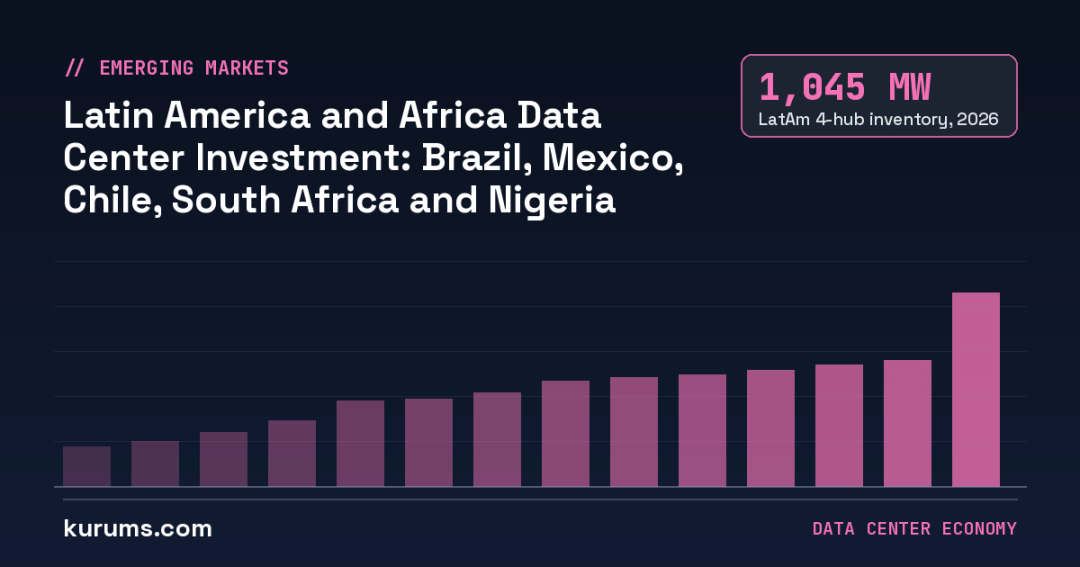
Latin America’s four main hubs (São Paulo, Querétaro, Santiago and Bogotá) held about 1,045 MW of data center inventory in early 2026, up 41.3% in a year, the fastest growth of any region according to CBRE. São Paulo leads with 537 MW, and Querétaro jumped 450% to 298 MW. Brazil signed its Redata tax regime into law in September 2026, ByteDance is building a R$200bn ($38bn) campus in Ceará, and grid operator ONS has received more than 20 GW of connection requests. In Africa, South Africa has roughly 350–450 MW and Nigeria about 136 MW. Eskom wants hyperscalers to take up to 6 GW of surplus power, Equinix plans 160 MW in South Africa, and MTN is launching a 150 MW AI data center programme. Arizton expects African data center investment to reach $8.76bn by 2031.
Latin America and Africa data center investment is growing from a low base, but both regions are now on the hyperscale and AI map. This guide, part of the Kurums Data Center Economy hub, covers Brazil, Mexico, Chile and Colombia, then South Africa, Nigeria, Kenya and other African markets: capacity, major projects, policy and the power question. For comparison with other emerging hubs, see our guides to India data center investment and the Gulf data center race.
Which Latin American market is largest?
São Paulo, with about 537 MW of inventory in CBRE’s 2026 count and roughly 70% of Brazil’s IT capacity. Querétaro in Mexico is the fastest-growing, up 450% in a year to about 298 MW.
Which African market is largest?
South Africa, with roughly 350–450 MW of installed capacity concentrated in Johannesburg and Cape Town. Nigeria (about 136 MW), Kenya and Egypt are the main challengers.
What holds both regions back?
Power and grid connections above all. Querétaro’s grid is constrained, Brazil’s operator is rationing connections, and in Africa reliable supply, currency risk and smaller local demand limit how fast hyperscale capacity can be built.
How much data center capacity does Latin America have?
CBRE’s Global Data Center Trends 2026 counts about 1,045 MW of inventory across São Paulo, Querétaro, Santiago and Bogotá, up 41.3% between Q1 2025 and Q1 2026. That growth beat North America’s four largest markets (33%), Europe (18.9%) and Asia-Pacific (13.4%).
About 306 MW came online in the region in a single year, according to CBRE as reported by w.media. The growth is uneven: Querétaro accounted for most of it, while São Paulo grew 8.9%, Santiago 12% and Bogotá was flat. CBRE identifies grid capacity, skilled labour and lower local demand than in other regions as the main constraints.
Forecasters expect strong investment through the decade. Arizton Advisory & Intelligence projects Latin American data center investment will exceed $17.63bn by 2031, and Mordor Intelligence expects the region’s data center construction market to grow from $6.05bn in 2026 to $8.96bn by 2031. For global context on market size projections, see our data center market forecast to 2030.
| Market | Inventory (MW) | Annual growth | Vacancy | Indicative rent |
|---|---|---|---|---|
| São Paulo, Brazil | 536.7 | +8.9% | 9.6% | $130–190 |
| Querétaro, Mexico | 298.2 | +450.2% | 10.6% | $250–270 per kW |
| Santiago, Chile | 165.8 | +12% | 3.3% | $190–210 |
| Bogotá, Colombia | 44.3 | Flat | n/a | $150–230 |
| South Africa (national) | ~350–450 | n/a | n/a | n/a |
| Nigeria (national) | ~136 | n/a | n/a | n/a |
Source: CBRE Global Data Center Trends 2026 (Latin American markets, via w.media, Jul 2026); McKinsey and w.media reporting (South Africa, Nigeria, 2026). Rent units as reported; CBRE’s monthly per-kW basis differs by market.
Why is Brazil Latin America’s biggest data center market?
Brazil combines the region’s largest economy and cloud market, São Paulo’s dense networks and cable landings, and an electricity mix that is about 89% low-carbon. Arizton counted 87 data centers in Brazil in June 2026, with 56 more in the pipeline expected to add over 4.5 GW, five times the current base.
About 70% of Brazil’s IT capacity sits in São Paulo state, where CloudHQ, Scala, Equinix, Ascenty and others operate large campuses and every major cloud provider runs a region. Alibaba Cloud launched its first South American region in Brazil in 2026. Terranova, a hyperscale platform launched by Actis in 2025, began building an AI-focused campus in Campinas in August 2026 with 216 MW of initial capacity rising to 386 MW, a $500m first phase and a substation that can scale from 300 MW to 1 GW. It uses closed-loop liquid cooling to limit water use in a water-scarce area.
The largest single project is outside São Paulo. ByteDance is building a data center at the Pecém port complex in Ceará, with a planned cost of R$200bn ($38.44bn), 200 MW of initial capacity and a possible expansion to nearly 1 GW, according to Bloomberg as reported by w.media. It is expected to be operational by late 2027. Pecém’s attraction is access to wind and solar power in Brazil’s northeast and to subsea cables landing in Fortaleza.
What does Brazil’s Redata law change?
Redata, the Special Taxation Regime for Datacenter Services, was signed into law by President Lula in September 2026. It suspends federal taxes on purchases of electronic components and ICT equipment for five years for approved developers and operators, in exchange for clean energy, water-efficiency and domestic-market commitments.
According to w.media’s summary of the Finance Ministry release, beneficiaries must meet their contracted power demand through supply contracts or self-generation from clean or renewable sources, achieve a water-efficiency index of 0.05 litres per kWh or less, supply 10% of their storage and processing capacity to the domestic market, and reinvest 2% of the value of products purchased back into Brazil. Companies need Finance Ministry authorisation and must be current on federal taxes.
The design reflects a deliberate bet: Brazil wants to host export-oriented AI capacity powered by its renewable grid, while ensuring local users benefit. Imported servers and GPUs are a large part of total project cost, as our cost per MW guide shows, so a tax suspension on that equipment can materially improve project returns.
Why is Querétaro Mexico’s data center capital?
Querétaro, about 200 km from Mexico City, offers land, lower seismic risk than the capital, fibre routes to the United States and proximity to Mexico’s largest enterprises. CBRE says its inventory rose 450.2% in a year to 298.2 MW, the strongest growth in Latin America.
The surge came from hyperscale deliveries; CBRE recorded 213 MW of net absorption, but vacancy rose from 0.9% to 10.6% as supply briefly outran leasing. Rents of $250–270 per kW are among the highest in the region. KIO Data Centers completed phases two and three of its 12 MW QRO2 facility (a $170m total investment) and is considering QRO3, a 100 MW project with potential investment of up to $1.3bn through 2030. Terranova opened its first Mexican data center in 2026 with 8.12 MW, scaling to 20 MW.
Power is the main limit. CBRE notes that Querétaro’s grid is constrained, forcing developers to build their own supply or work closely with local utilities. Arizton expects Mexico’s data center market to reach $3.48bn by 2031, second in the region only to Brazil. Edge and cable-landing projects are also emerging, such as Telxius’s AI-ready landing station and edge data center in Cancún connected to the Tikal subsea cable.
What about Chile, Colombia and the rest of Latin America?
Chile is the region’s third hub, with 165.8 MW in Santiago and the lowest vacancy in Latin America at 3.3%, according to CBRE. Colombia’s Bogotá market is smaller at 44.3 MW and driven mainly by domestic enterprises.
Santiago’s appeal is political stability, renewable power from the north’s solar resources and its role as a gateway to South America’s Pacific coast. Because Chile’s economy is relatively small, CBRE notes that growth depends on regional and international hyperscale deployments. Google is adding subsea cable systems connecting South America with North America and Europe, and AWS has announced a planned cloud region in Chile. Terranova has also announced a Chilean project, though details are not yet public.
Bogotá’s near-term demand is modest and enterprise-led, CBRE says. Elsewhere, Uruguay (Montevideo) is attracting interest for its stability and renewables, Paraguay for hydroelectric power and a favourable regulatory environment, and Buenos Aires for its large technology base once macroeconomic conditions stabilise.
How big is Africa’s data center market?
Africa’s data center market is still small, with Arizton estimating cumulative investment of $3.64bn by 2025 and forecasting $8.76bn by 2031. South Africa, Kenya, Nigeria and Egypt have attracted most of the capital, while Morocco and Tunisia are rising.
Demand is driven by mobile data growth, cloud adoption and data sovereignty rules that require some data to stay in-country. African Continental Free Trade Area secretary-general Wamkele Mene has estimated that the continent will need hundreds of new data centers over the next decade. The World Bank Group launched an AI infrastructure initiative in October 2026, with Cassava Technologies and NVIDIA as knowledge partners, to broaden access to shared AI compute in Africa and Latin America.
Capital is coming from global colocation groups, telecom operators, development finance and Gulf investors. The US Development Finance Corporation approved a $155m equity investment in carrier-neutral platform WIOCC in 2026. For profiles of the international operators involved, see our guide to the largest colocation providers.
Why does South Africa lead Africa’s data center market?
South Africa has the continent’s deepest cloud and colocation ecosystem, with roughly 350–450 MW of installed capacity (McKinsey estimates about 400 MW) concentrated in Johannesburg and Cape Town. Analysts expect 1.5–2.2 GW by 2030.
Teraco, now majority-owned by Digital Realty, is the largest carrier-neutral operator and is building a 120 MW solar PV plant while buying wind power through a PPA with NOA. Equinix plans a ZAR 7.5bn (about $438m) push in South Africa to add 160 MW; its Johannesburg facility opened in 2024 at 4 MW, rising to 20 MW, and Cape Town’s planning tribunal approved land rezoning for two Equinix data centers near the airport in July 2026. Microsoft committed ZAR 5.4bn (about $298m) by the end of 2027 on top of ZAR 20.4bn (about $1bn) invested over the previous three years. AWS, Microsoft, Google and Oracle all operate cloud regions in the country.
Power is both the problem and the opportunity. After years of load-shedding, state utility Eskom says it now has 3–6 GW of surplus capacity in cold reserve and is in talks with Amazon, Microsoft and Google to sell it, according to the Financial Times as reported by w.media. The catch is that Eskom’s fleet is largely coal-fired, which conflicts with hyperscalers’ decarbonisation goals. President Ramaphosa projects R50bn of digital infrastructure investment over three years.
What is happening in Nigeria, Kenya and Egypt?
Nigeria has about 136 MW of capacity but one of the fastest projected growth rates, with a forecast CAGR near 25% to 2031. Kenya is building an East African hub around Nairobi, and Egypt is leveraging its position as a landing point for 17 subsea cables.
Nigeria
Lagos is the centre of West Africa’s data center market. MTN, Africa’s largest mobile operator, announced in October 2026 a 150 MW AI data center plan through Africa Data Hub Holding, a joint venture between its Bayobab infrastructure arm and a UAE-based investment platform, starting in South Africa and Nigeria. Digital Parks Africa plans a carrier-neutral facility in Lagos called NDC1. Forecasts cited by w.media put Nigeria’s data center market at $1.09bn by 2031, against $5.28bn for South Africa. Power reliability and foreign-exchange risk remain the main hurdles.
Kenya
Digital Realty opened its 6.2 MW Nairobi Two (NBO2) data center in 2026, with iColo now under the Digital Realty brand in Kenya and Mozambique. iXAfrica will host Oracle’s cloud region in Nairobi. AMACO Energy Group is seeking approval for a $1.5bn off-grid AI data center in Mombasa, and the government is funding 27,000 km of new fibre. The Communications Authority has proposed a dedicated licence for colocation operators. Kenya’s geothermal and hydro power give it one of Africa’s cleanest grids, a selling point for AI workloads.
Egypt and North Africa
A venture of Vodafone Business, Elsewedy Electric and Cassava Technologies, Africa Data Centers Egypt, targets a $1bn, 200 MW build-out starting at 20 MW. Egypt’s regulator has issued ten data center licences in two years. In Morocco, FiveNines Group will develop a 20 MW data center near Casablanca as part of the $1.2bn Nexus AI Factory project.
What are the biggest risks for investors in these regions?
The main risks are grid capacity, currency volatility, smaller local demand and regulatory uncertainty. Projects that depend on export demand or a single anchor tenant carry more risk than those serving established domestic cloud markets.
In Latin America, Brazil’s real and Mexico’s peso can move sharply against the dollar, while equipment is priced in dollars. Grid rationing in São Paulo and Querétaro can delay projects by years. In Africa, power reliability, foreign-exchange convertibility in markets such as Nigeria, and smaller hyperscale demand mean that facilities often start small and expand in phases. The coal-heavy grid in South Africa complicates hyperscalers’ clean-energy targets, discussed in our article on data center sustainability.
The upside case is strong. Both regions have young, fast-digitalising populations, data sovereignty rules that favour local capacity, and in Brazil’s case one of the cleanest large grids in the world. Investors can gain exposure through global REITs with emerging-market platforms or private funds, as outlined in our guide to how to invest in data centers, and should study private equity platforms such as Actis’s Terranova and NextStream to see how capital is being deployed.
Frequently Asked Questions
Which country has the most data centers in Latin America?
Brazil. Arizton counted 87 data centers in June 2026, with 56 more in the pipeline that could add over 4.5 GW. About 70% of Brazil’s IT capacity is in São Paulo state, which CBRE puts at roughly 537 MW, the largest single market in Latin America. Mexico is second, led by Querétaro.
What is Brazil’s Redata?
Redata is Brazil’s Special Taxation Regime for Datacenter Services, signed into law in September 2026. It suspends federal taxes on ICT equipment purchases for five years in exchange for clean power, a water-efficiency index of 0.05 litres per kWh or less, supplying 10% of capacity to the domestic market and reinvesting 2% of purchases in Brazil.
How much data center capacity does South Africa have?
South Africa has roughly 350 to 450 MW of installed data center capacity, with McKinsey estimating about 400 MW, mainly in Johannesburg and Cape Town. Analysts forecast 1.5 to 2.2 GW by 2030. Teraco, Equinix, Africa Data Centres and the major cloud providers are the key players.
Is Africa a good place to build data centers?
Africa offers fast-growing digital demand and data sovereignty rules that favour local hosting, but projects face power reliability, currency and demand-scale risks. Most succeed by starting small and expanding in phases. South Africa, Kenya, Nigeria and Egypt are the most developed markets, with Morocco rising.
Discover more from Kurums | Business Intelligence
Subscribe to get the latest posts sent to your email.