
Taste Note - Amazon Technology Best Sellers
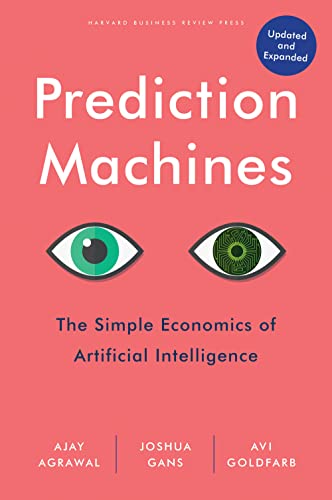
Prediction Machines: The Economics That Make AI Decisions Tractable
A Kurums Book Taste review of Prediction Machines for executives who need an AI investment framework sturdier than the demo of the week.
Why this book fits Kurums
Between Mollick's hands-on experiments and Harari's civilizational stakes, the AI shelf needed its economics layer: the Toronto trio's single move - treat AI as a drop in the cost of prediction, like computing was a drop in the cost of arithmetic - converts hype into standard price theory, with every consequence (complements rising in value, workflows decomposing, strategy changing at thresholds) following logically.
For the Kurums Technology audience the updated edition's framework is directly operational: the AI canvas for scoping projects, the decomposition of decisions into prediction versus judgment, and the strategic threshold question - at what prediction quality does your business model flip? - structure both pilots and board conversations.
What the book argues
The foundational economics: when something becomes cheap, we use more of it - and we discover prediction hiding inside tasks never framed that way (translation, driving, diagnosis, hiring are all prediction problems once data is sufficient). Simultaneously, the complements to prediction appreciate: data (the new input with decreasing-returns caveats honestly treated), judgment (deciding what to predict and what outcomes are worth - irreducibly human in their framing), and action. The first managerial consequence is decomposition: break any decision into prediction, judgment, data, and action, and ask which parts the cheap new input transforms.
The tools-and-workflow chapters operationalize it: the AI canvas forces teams to specify, for each candidate deployment, the prediction (exactly what is being predicted), judgment (how outcomes are valued, including error asymmetries), action, outcome, and the three data types (training, input, feedback). Workflows then get re-engineered rather than sprinkled: some tasks absorb AI as a tool, others decompose and recombine - their recurring examples (from radiology's re-bundling to fulfillment's anticipatory shipping) show jobs as task-bundles whose composition shifts with prediction costs.
The strategy chapters contain the book's sharpest idea: thresholds. Improving prediction quality changes business models discontinuously - Amazon's hypothetical flip from shop-then-ship to ship-then-shop once return-rate predictions clear a bar - so executives should ask where their industry's thresholds sit and who reaches them first. Trade-offs close it honestly: more AI means data-feedback loops that advantage incumbents, new risks (bias at scale, security of input data, homogenization), and the C-suite reallocation of what remains scarce - judgment about what the organization should value. The 2022 update folds in the generative wave without changing the frame: generation, too, is prediction - of the next token - and the economics hold.
Key ideas, translated to your desk
Decompose before you deploy
Split any target decision into prediction, judgment, data, action. Fund the prediction; keep deliberate human ownership of the judgment - and write both down.
Fill the canvas or skip the pilot
If a team cannot name the predicted variable, the error costs, and the feedback data, the project is theater. The one-page canvas is the cheapest filter you'll ever run.
Find your threshold
Ask what your business would do differently at 95% prediction accuracy that it cannot at 80% - that gap is your AI strategy, and someone is racing toward it.
Use it at work
- Run the AI canvas on your top five automation candidates; kill the ones with unnamed judgment.
- Map two core workflows as task bundles and mark which tasks are predictions in disguise.
- Write the threshold memo for your industry: the accuracy level at which the model flips, and your distance from it.
- Pair with Co-Intelligence in exec education: Mollick for the hands, this for the spreadsheet.
Read it if
- You allocate AI budgets and need a framework that survives vendor turnover.
- Your pilots succeed technically and die economically.
- You brief boards and want price-theory language instead of magic.
You can skip it if
- You want hands-on prompting practice - that is Mollick's lane.
- You hold an economics of innovation background; the frame may be familiar.
- You need deep governance treatment; pair with the AI Con and Nexus for that axis.
This book appears in
Curated Tasting Menus that chain this title into a reading route.
Discover more from Kurums | Business Intelligence
Subscribe to get the latest posts sent to your email.