
Taste Note - Amazon Production & Operations Best Sellers
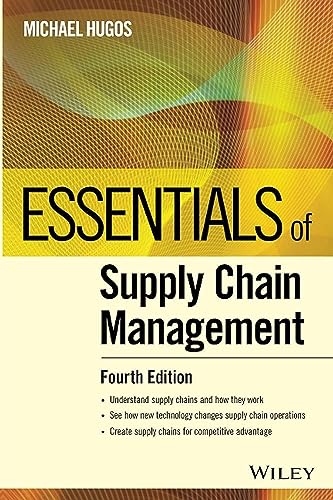
Essentials of Supply Chain Management: The One-Book Orientation for the Whole Function
A Kurums Book Taste review of Essentials of Supply Chain Management for managers who need the full map of the discipline before the next planning cycle.
Why this book fits Kurums
The lean shelf teaches philosophy; Hugos teaches the map. This is the book that defines the vocabulary a procurement or operations manager is assumed to have - the five drivers, the planning processes, the coordination failures - in the plainest prose the field has produced, which is why it survives edition after edition as the standard handout.
For the Kurums Procurement audience it completes the trio with The Goal and The Toyota Way: Goldratt gives the physics, Liker the management system, Hugos the organizational map - what all the functions are, how they fit, and which metrics each one answers for.
What the book argues
The framework is five supply chain drivers in perpetual trade-off between responsiveness and efficiency: production (what, how, when to make - factories and product mix), inventory (how much, where - cycle, safety, and seasonal stock), location (where facilities sit and what each does), transportation (mode trade-offs from ship to air), and information (the driver that tunes all the others, and the cheapest one to improve). Strategy, in Hugos's telling, is simply aligning the five drivers with what your market actually rewards - a commodity market pays for efficiency, a volatile one pays for responsiveness, and most supply chain pain is a driver tuned for the wrong market.
The operations chapters walk the planning stack: demand forecasting (and its reliable wrongness), aggregate planning, pricing's role in shaping demand, inventory mechanics (EOQ, safety stock against uncertainty), procurement's own cycle (sourcing, credit, collections), and order fulfillment and returns. The bullwhip effect gets the clearest short treatment in print - how small demand ripples amplify into violent upstream swings when each tier plans from its own orders rather than shared end-customer data - along with the coordination remedies: information sharing, aligned incentives, smaller order batches.
The later chapters cover measurement (a market-by-market scorecard: customer service, internal efficiency, demand flexibility, product development) and the technology layer treated as enabler rather than savior - a stance that has aged well through several enthusiasm cycles. It is an orientation, not a specialist text: the reader finishes knowing what every function does, which metrics govern it, and where their own company's weak driver is - which is exactly the briefing most managers were never given.
Key ideas, translated to your desk
Tune five drivers to one market
Production, inventory, location, transport, information - each set for responsiveness or efficiency. Most supply chains fail by tuning drivers to habit instead of to what customers pay for.
Information is the cheapest driver
Improving data sharing upgrades all four physical drivers without pouring concrete. Before the new warehouse, fix what each tier can see.
Plan against the bullwhip
Each tier forecasting from its own orders amplifies noise into chaos upstream. Share end-customer demand with key suppliers and watch their service to you improve.
Use it at work
- Score your five drivers responsive-vs-efficient and test the profile against what your market rewards.
- Share rolling end-customer demand data with your top three suppliers and measure the bullwhip damping.
- Adopt the four-category scorecard - service, efficiency, flexibility, development - per market, not company-wide.
- Use the book as the onboarding text for anyone touching the supply chain from finance, sales, or IT.
Read it if
- You inherited supply chain responsibility without the formal background.
- Your team argues in metrics that belong to different drivers without noticing.
- You want the orientation layer under The Goal's physics and Toyota's system.
You can skip it if
- You are a career supply chain professional - this is the text you assign, not read.
- You want advanced analytics and network optimization methods.
- You need sector-specific depth; the breadth is the point here.
Discover more from Kurums | Business Intelligence
Subscribe to get the latest posts sent to your email.