
Taste Note - Amazon Business Ethics Best Sellers
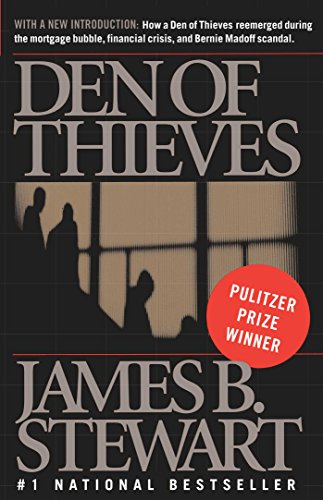
Den of Thieves: The 1980s Insider Trading Scandal as a Lesson in Controls and Culture
A Kurums Book Taste review of Den of Thieves for board members, compliance leaders and executives who need to see how misconduct spreads through a successful firm.
Why this book fits Kurums
James B. Stewart's Den of Thieves reconstructs the insider trading and securities fraud scandals that swept through Wall Street in the 1980s, centered on Dennis Levine, Ivan Boesky, Martin Siegel, Michael Milken and the firm Drexel Burnham Lambert. Stewart, a Wall Street Journal reporter at the time, traces how the schemes worked, how they connected, and how investigators and prosecutors eventually unwound them. It remains one of the most cited accounts of financial misconduct written for a general business audience.
For the Kurums Corporate Governance audience, the book is less about villains than about systems. It shows how confidential information leaks when incentives reward it, how a firm's success can silence the people whose job is to ask questions, and how a single cooperating witness can bring an entire network into view. If you oversee compliance, sit on an audit or risk committee, or run a business where people handle market-moving information, the patterns in this book are worth knowing well.
What the book argues
Stewart's first argument is that the scandal began with small, rationalized breaches of trust. He shows how an investment banker with access to confidential merger information began trading on it through secret offshore accounts, how others joined, and how each participant told himself the conduct was routine or harmless. Information that should have stayed inside deal teams became a currency, and the people trading it were often well paid, respected professionals who decided the rules did not apply to them.
His second argument is that these schemes were connected and that success hid them. Boesky's arbitrage business and the deal flow at major firms created a market for advance knowledge of takeovers. Drexel Burnham Lambert, under Milken's high-yield bond operation, became enormously profitable and powerful, which made internal challenge and external scrutiny harder. Stewart shows how a culture that celebrated results and tolerated secrecy left little room for control functions to do their work.
His third argument is that enforcement unravelled the network one link at a time. A tip to a brokerage compliance function led investigators to Levine, Levine's cooperation led to Boesky, and Boesky's cooperation helped prosecutors build cases against others, including Milken, who eventually pleaded guilty to securities violations. Drexel itself collapsed. The governance lesson is that misconduct inside a network is fragile once one participant talks, and that firms which rely on secrecy are carrying a risk they rarely price.
Key ideas, translated to your desk
Information is an asset with leaks
Treat confidential deal, earnings and customer data like cash: restrict access, log who sees it, and test the walls between teams regularly.
Star performers need more oversight, not less
When one unit produces outsized profits, the board should ask how, and make sure compliance can challenge it without career risk.
Make speaking up the safe option
The investigation started with a tip. A credible, protected whistleblower channel is often the first and cheapest line of detection.
Use it at work
- Review your insider list, trading windows and pre-clearance rules with the compliance lead, and check that they cover advisers and temporary staff.
- Ask the audit committee for a report on how information barriers are tested and when they last failed.
- Put the most profitable business line on next quarter's risk agenda and ask what would make its results unsustainable.
- Confirm that whistleblower reports reach someone independent of the business they concern, and that the board sees aggregate trends.
Read it if
- You serve on a board, audit committee or risk committee and want a vivid case study of control failures in a high-performing firm.
- You run compliance, legal or internal audit at a firm that handles market-sensitive information.
- You read The Smartest Guys in the Room or Barbarians at the Gate and want the other defining corporate scandal narrative of the era.
You can skip it if
- You want a practical compliance manual or a summary of current insider trading law; the book is history, not regulation.
- You prefer short business books; this is a long investigative narrative with a large cast.
- You are looking for a balanced reassessment of high-yield finance; the book focuses on misconduct rather than the market's broader legacy.
This book appears in
Curated Tasting Menus that chain this title into a reading route.
Discover more from Kurums | Business Intelligence
Subscribe to get the latest posts sent to your email.