
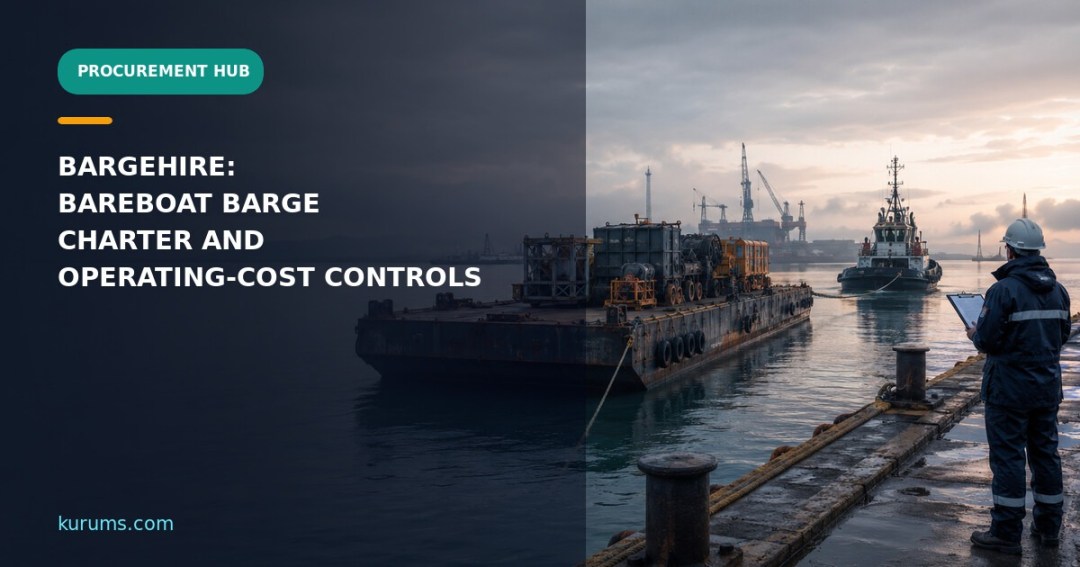
BARGEHIRE is a bareboat charter form for an unmanned, non-self-propelled seagoing barge. The charterer generally receives possession and operational control, so procurement must define condition, delivery, trading limits, towing interface, maintenance, insurance, class, repair authority, costs, incidents, off-hire and redelivery evidence before the hire period begins.
- Treat a bareboat barge charter as an operating asset transfer, not simply a freight-rate purchase.
- Record the barge's identity, condition, class or statutory status, equipment, inventory and defects at delivery.
- Allocate towing, crewing or unmanned-operation interfaces, maintenance, insurance, fuel, repairs and regulatory duties explicitly.
- Use inspection, incident, off-hire and redelivery records to protect both availability and end-of-charter cost.
What BARGEHIRE Transfers
The SSDER glossary lists BARGEHIRE as a term for barge hire, while BIMCO describes BARGEHIRE 2021 as a bareboat charter party designed for unmanned, non-self-propelled seagoing barges. That structure matters: a charterer may take possession and control of the barge and assume operating responsibilities that would sit with an owner or managed carrier under another arrangement.
Procurement should first decide whether it is buying a voyage, a towage service, a time charter, a managed asset or bareboat possession. The commercial price is not comparable across those models until the buyer normalises who supplies the tug, crew, maintenance, insurance, fuel, port services, class support and regulatory documentation.
Specify the Barge and Delivery Condition
The charter record should identify the hull, flag, class or statutory certificates, dimensions, draft, capacity, deck strength, tanks, pumps, lifting points, towing fittings, navigation or safety equipment and permitted cargo. Attach an inventory and a condition report with photographs, readings, certificates, known defects, spares and open repairs.
Define the delivery place, time, acceptance inspection, notice of defects and remedy. A barge that is technically present but cannot connect to the nominated tug, pass a port inspection or carry the specified cargo is not operationally delivered. Condition acceptance should preserve rights for latent defects and require the owner to provide records needed for insurance, class and safe operation.
Allocate Operation, Maintenance and Risk
A bareboat charter often shifts day-to-day operating cost and maintenance to the charterer, but the exact allocation must be written. Cover planned maintenance, emergency repair, dry-docking, corrosion, pollution prevention, cargo damage, towing connection, mooring, port fees, fuel or bunkers, spares, surveys and statutory inspections. State who can order work and who pays when an owner defect is discovered.
Trading limits should be specific: permitted waters, weather, draft, seasonal restrictions, cargo compatibility, towing configuration and ports or terminals. Link limits to the charterer’s voyage plan and to an approval process for deviations. Insurance clauses should identify hull, liability, pollution, war or special risks where relevant, deductibles, notice, claims control and the evidence needed after an incident.
Control Availability, Off-Hire and Redelivery
Measure the barge’s operational availability from documented readiness, not from the calendar hire period alone. Define when a defect, survey, weather event, tug failure, regulatory hold or owner-caused delay makes the barge unavailable and how any off-hire or service credit is calculated. The charter should also say whether cargo operations continue, stop or require a safety decision.
Redelivery should mirror delivery: location, notice, cleanliness, cargo residue, condition, inventories, certificates, repairs, environmental records and photographs. Agree a joint survey and a process for disputed defects. Without a baseline condition report, a charterer can be charged for pre-existing corrosion or a genuine owner-side defect, while an owner may receive an asset with unrecorded damage.
Worked Example: A Coastal Project Barge
A project team hires an unmanned deck barge for six months and assumes the owner’s quotation includes the tug, deck repairs and insurance. The charter form is accepted without a condition survey or cargo deck-load schedule. A coating defect is found after loading, the nominated tug cannot use the towing fitting, and the project loses a weather window while the parties argue over responsibility.
The corrected procurement package separates barge hire from towage, states the deck load and route, attaches a condition and equipment schedule, verifies certificates and towing compatibility, and sets repair authority and insurance notice rules. Daily readiness records connect defects to off-hire or recovery decisions. At redelivery, the same checklist closes the cost and condition record.
Metrics and Governance
For BARGEHIRE bareboat barge charter procurement, measure both service and evidence quality. Useful indicators include first-pass acceptance, exception rate, response time, unplanned cost, document completeness, damage or discrepancy rate, and the percentage of shipments that follow the approved process. A dashboard should distinguish a supplier failure from a carrier, terminal, broker or internal master-data failure.
Review the metric trend with procurement, logistics, finance, quality and the responsible specialist. Use a monthly exception sample to test whether the control worked in a real transaction, not just whether a field was filled. Repeated exceptions should change the sourcing strategy, contract, lane design or supplier development plan.
Keep the control proportionate to risk. High-value, regulated, time-critical or safety-sensitive cargo needs stronger evidence and faster escalation than a routine shipment. Record the decision owner, approval date, source documents and follow-up action so the next buyer can understand the operating history.
Supplier and Carrier Questions
- Which BARGEHIRE or related glossary condition is assumed in your quotation, procedure or service description?
- Which party owns each data field, physical handoff, inspection, document and exception?
- What evidence will be available before release, loading, movement, receipt, invoice approval or claim?
- What changes require advance notice, requalification, a revised price or a new risk decision?
- How will the supplier report incidents, delays, mismatches and corrective actions, and within what response time?
Implementation Sequence
Implement the control in a small, representative lane first. Capture the baseline process, test the required data and evidence, run a real transaction, and review every exception with the people who performed the work. Do not declare the control effective only because a supplier signed a procedure.
After the first three shipments or operating cycles, update the purchase-order clause, work instruction, scorecard and training. Scale the control to other suppliers only when the evidence is repeatable and the owner can explain what happens when the normal path fails.
Common Mistakes to Avoid
- Treating BARGEHIRE as a generic transport service without identifying the charter model and transferred control.
- Starting the hire clock before verifying condition, certificates, cargo suitability and towing compatibility.
- Leaving maintenance, dry-docking, spares, fuel, insurance, pollution and emergency repairs ambiguous.
- Using broad trading language without route, draft, weather, cargo and port restrictions.
- Redelivering without a joint survey, inventory, cleanliness record and evidence of latent or pre-existing defects.
Procurement Implementation Checklist
- Identify charter model, barge, owner, charterer, tug interface and operating authority.
- Verify dimensions, capacity, deck strength, fittings, certificates, class and permitted cargo.
- Complete delivery survey, inventory, photographs, readings, defects and acceptance exceptions.
- Allocate operation, maintenance, repairs, fuel, port, statutory, pollution and insurance costs.
- Define trading limits, readiness, off-hire, incident notice, claims and approval for deviations.
- Use a mirrored redelivery survey with condition, residue, equipment, certificates and repair close-out.
Frequently Asked Questions
What is BARGEHIRE?
BARGEHIRE is a bareboat charter-party form for an unmanned, non-self-propelled seagoing barge. The exact duties remain subject to the agreed contract.
Is BARGEHIRE the same as buying barge transport?
No. A bareboat charter can transfer possession and operating responsibility, while a voyage or managed service may leave those duties with the owner or carrier.
Who pays for maintenance under a bareboat charter?
The contract should allocate routine and emergency maintenance, dry-docking, defects, spares, approvals and cost recovery explicitly.
What should be checked before delivery?
Verify identity, condition, certificates, capacity, deck strength, equipment, fittings, cargo compatibility, route and towing or mooring interfaces.
What proves proper redelivery?
A joint survey, inventory, photographs, cleanliness and residue records, certificates, defect list and agreed repair or cost close-out provide the evidence.
Related Kurums Guides
- Freight Rates and Surcharges
- Freight Contracts and Parties
- Freight Network Design
- Cargo Security Hardware
- Billed Weight and VGM
- Waiting-Time and Arrival Controls
Standards and Authoritative Sources
- BIMCO — BARGEHIRE 2021
- BIMCO — Contracts and charter parties
- U.S. Army Corps of Engineers — Navigation
- IMO — Maritime safety
Glossary terms covered: BARGEHIRE, bareboat, barge, charter party, possession, maintenance, insurance, redelivery
Kurums.com · Procurement, sourcing and business operations
Discover more from Kurums | Business Intelligence
Subscribe to get the latest posts sent to your email.