Taste Note - Amazon Sales & Selling Best Sellers
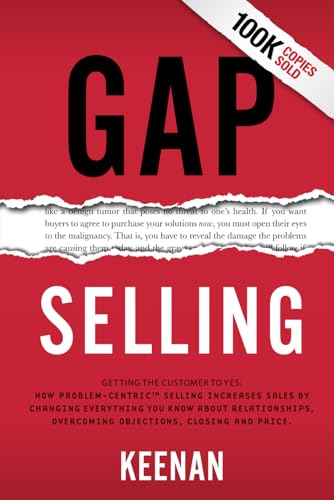
Gap Selling: Problem-Centric Selling That Starts With the Customer's Current State
A Kurums Book Taste review of Gap Selling for sales teams that want to stop pitching features and start diagnosing the business problem a buyer will actually pay to fix.
Why this book fits Kurums
Most sales methods treat discovery as a preamble to the pitch. Keenan flips that: the sale is the gap between a buyer's current state and the future state they want, and your job is to understand that gap so precisely that the value of closing it becomes obvious to the buyer without persuasion.
For the Kurums Sales audience the book gives a shared language for qualification and discovery - current state, future state, root cause, impact, emotion - that managers can coach and inspect in CRM notes, which is exactly where most pipelines go soft.
What the book argues
The first argument is that buyers do not buy products; they buy change. Every purchase is a move from a current state that has a problem to a future state where that problem is solved, and the size of the gap determines urgency and budget. Keenan's model breaks the current state into the physical environment, the technical and business problems, their root causes, the measurable impact, and the emotional cost to the people involved. Sellers who cannot describe these in the customer's words do not yet have a deal - they have a conversation.
The second argument attacks the relationship-first school. Keenan argues that trust is earned by expertise and diagnosis, not rapport; the buyer respects the seller who understands their problem better than they do. Objections, in this view, are symptoms of an incomplete diagnosis: price pushback means the gap was not quantified, delay means the impact was not felt, and the response is to return to discovery rather than to deploy a rebuttal script.
The third argument is operational. Gap selling demands that sellers know their buyers' problems deeply - the common problems the product solves, their root causes, and how they show up in different roles - so organizations must invest in a 'problem library' and train discovery as a skill. Closing becomes a natural confirmation that the gap is worth closing now, and forecasting improves because deals are qualified on documented gaps rather than on optimism. The approach is deliberately simple; its difficulty lies in the discipline of not pitching until the gap is clear.
Key ideas, translated to your desk
Sell the gap, not the product
Write every opportunity's current state, future state, root cause, and quantified impact in the CRM. If you cannot fill those four fields, the deal is not qualified.
Treat objections as missing diagnosis
When a buyer pushes back on price or timing, go back to discovery and size the impact again instead of reaching for a rebuttal.
Build a problem library
Document the problems your product solves, their root causes, and how they appear for each buyer role. Train new sellers on problems before features.
Use it at work
- Add current state, future state, root cause, and impact fields to opportunity records and make them required before proposal stage.
- Coach call reviews on the depth of discovery rather than on pitch delivery.
- Build a shared problem library with marketing and customer success, updated from won and lost deals.
- Re-run discovery on stalled deals and requalify any opportunity whose gap is not quantified.
Read it if
- Your reps pitch too early and discovery calls feel like demos.
- You want a qualification language managers can inspect in CRM records.
- You liked SPIN Selling and want a modern, plain-spoken take on diagnostic selling.
You can skip it if
- Your team already runs a rigorous diagnostic methodology such as MEDDICC with strong discipline.
- You sell low-cost transactional products where deep discovery is uneconomic.
- A brash, opinionated tone puts you off - Keenan writes the way he sells.
This book appears in
Curated Tasting Menus that chain this title into a reading route.
Discover more from Kurums | Business Intelligence
Subscribe to get the latest posts sent to your email.