
Yummy Pick - Amazon Marketing & Sales Best Sellers
Influence, New and Expanded: The Business Lessons for Marketers
A Kurums Book Taste review of Influence for marketers, sales teams, and business leaders who need sharper persuasion without louder messaging.
Why this book fits Kurums
Use it for offer pages, landing page copy, sales decks, trust signals, and campaign briefs.
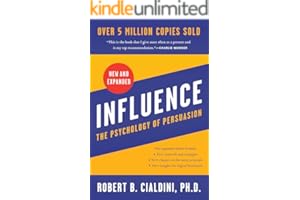
For the Kurums Marketing audience the New and Expanded edition matters: Cialdini added Unity as a seventh principle and refreshed the evidence base, so the book now covers the identity-driven persuasion that dominates community marketing and brand tribes.
What the book argues
Cialdini's core claim is that persuasion runs on fixed-action patterns: mental shortcuts people use to decide without deliberating. Seven principles trigger them - reciprocation, liking, social proof, authority, scarcity, commitment and consistency, and unity - and each works because it is usually right. We repay favors, trust experts, and follow the crowd because those heuristics serve us well; influence professionals simply arrange situations where the shortcut fires on cue.
Each principle gets a mechanism chapter built on field experiments. Reciprocation obliges even when the initial gift was uninvited (the free sample, the concession that triggers a counter-concession in door-in-the-face sequences). Commitment escalates: small public commitments reshape self-image, which is why the foot-in-the-door works and why written goals bind harder than spoken ones. Social proof peaks under uncertainty and similarity - testimonials work best from people who resemble the prospect, not from celebrities.
The new Unity chapter argues that shared identity - family, place, tribe, co-creation - is categorically stronger than liking: people do not just prefer insiders, they use different decision math for 'one of us.' Throughout, Cialdini maintains the ethical line that separates the book from a manipulation manual: use the principles to inform genuine value honestly present in the offer, because triggered compliance without substance destroys the trust the principles depend on.
Key ideas, translated to your desk
Give first, and make it meaningful
Reciprocity is strongest when the gift is significant, unexpected, and customized. A generic lead magnet triggers nothing; a personalized audit obliges.
Commitment compounds in public
Get small yeses in writing - a pilot, a survey answer, a stated goal - before asking for the big one. Each visible commitment rewrites the buyer's self-story in your favor.
Proof from peers beats proof from stars
Show prospects the customers who look exactly like them. Similarity, not fame, is what makes social proof convert.
Use it at work
- Redesign your nurture sequence so real value lands before any ask - and measure reply-rate lift.
- Add similar-company proof blocks to every landing page: same industry, same size, same problem.
- Sequence proposals as commitment ladders: diagnostic, pilot, rollout - each step publicly agreed.
- Audit your campaigns against all seven principles and fix the two you are not using at all.
Read it if
- You write offer pages, sales decks, or campaign briefs and want the underlying science.
- Your funnel leaks between interest and action for reasons you cannot name.
- You want the ethical framework that separates persuasion from manipulation.
You can skip it if
- You have the original memorized - Unity and updated studies are the main additions.
- You need channel tactics rather than psychology.
- Academic depth annoys you; Cialdini shows his experiments in full.
This book appears in
Curated Tasting Menus that chain this title into a reading route.
Discover more from Kurums | Business Intelligence
Subscribe to get the latest posts sent to your email.