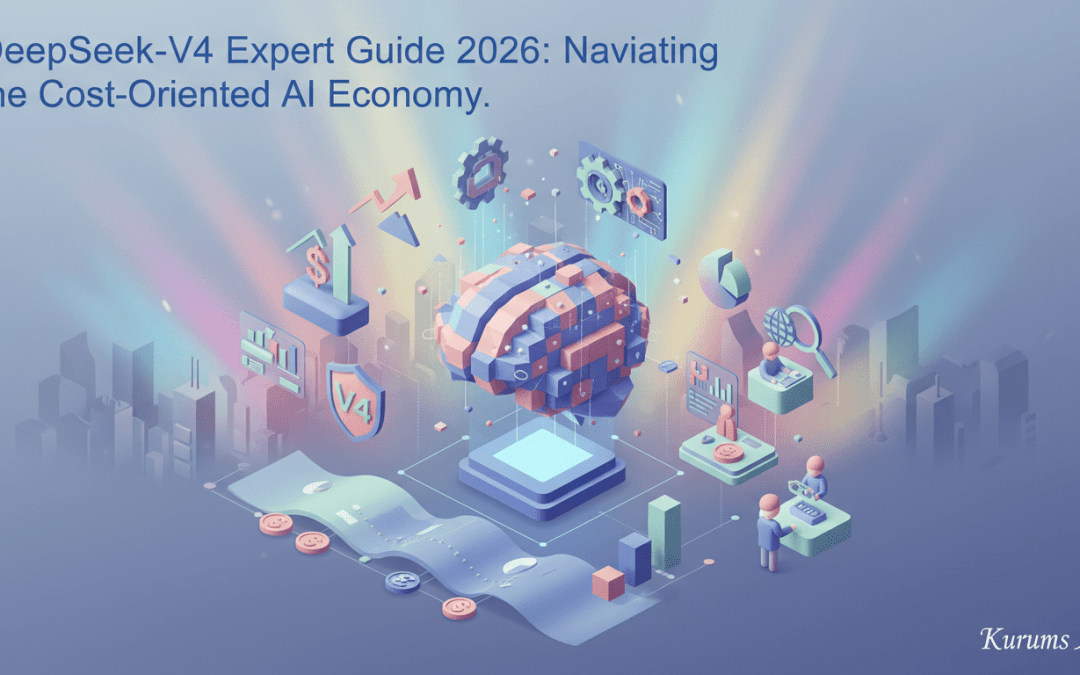
DeepSeek-V4 Executive Summary: The Efficiency Revolution
What is DeepSeek-V4? It is a state-of-the-art open-source Mixture-of-Experts (MoE) model that has achieved a 1/6 cost advantage over legacy closed-source models in 2026.
Key Innovation: Introduction of “Auto Trend Selection,” a dynamic resource allocation mechanism that optimizes inference based on real-time task complexity.
Economic Impact: Large-scale enterprises are reporting up to 80% reduction in API expenditures while maintaining or exceeding GPT-level performance benchmarks.
Strategic Takeaway: For 2026, the competitive advantage has shifted from “Who has the largest model?” to “Who has the most efficient inference economy?”
The honeymoon phase of “AI at any cost” is officially over. As we navigate the fiscal landscape of 2026, Chief Technology Officers (CTOs) and CFOs are no longer asking if a model can pass a Bar Exam; they are asking how much it costs to process a billion tokens at scale. Enter DeepSeek-V4, the model that has sent shockwaves through Silicon Valley by proving that high-performance intelligence doesn’t have to carry a premium price tag.
But wait, there’s more to this story than just a lower price point. DeepSeek-V4 represents a fundamental shift in how large language models (LLMs) are architected, trained, and deployed. By leveraging a radical 1/6 cost advantage, it is forcing a total re-evaluation of corporate technology budgets globally.
The Dawn of the Cost-Oriented AI Economy: Why 1/6 Matters
To understand the gravity of the 1/6 cost advantage, we must look at the historical context of AI spending. In 2023 and 2024, enterprises were locked into proprietary ecosystems where pricing was opaque and scaling was prohibitively expensive. DeepSeek-V4 has disrupted this “walled garden” approach by offering open-source weights coupled with an efficiency ratio that was previously thought impossible.
Think about it this way: if your organization was spending $1,000,000 monthly on high-end inference for customer service automation, data extraction, and internal R&D, DeepSeek-V4 allows you to achieve the same output for approximately $166,000. This isn’t just a marginal improvement; it is a structural transformation of the bottom line.
Dissecting the Mixture-of-Experts (MoE) 2.0 Architecture
How does DeepSeek-V4 achieve such radical efficiency? The answer lies in its refined Mixture-of-Experts (MoE) architecture. Unlike “dense” models that activate every single parameter for every single query (consuming massive amounts of compute), DeepSeek-V4 uses a sparse activation strategy.
The model contains hundreds of billions of parameters, but for any given token, it only “wakes up” a small fraction—the experts specifically trained for that type of task. In version V4, the routing mechanism has been optimized using Multi-head Latent Attention (MLA) and DeepSeekMoE refinements, ensuring that the overhead of choosing the right expert is minimized. This allows the model to maintain the reasoning capabilities of a 1-trillion parameter giant while only consuming the compute power of a much smaller model.
DeepSeek-V4 Technical Comparison: The 2026 Benchmark Table
The following table illustrates how DeepSeek-V4 stacks up against the prevailing industry standards in terms of cost, latency, and architectural efficiency.
| Feature / Metric | DeepSeek-V4 (Open-Source) | Proprietary Tier-1 (Closed) | Legacy MoE Models |
|---|---|---|---|
| Cost per 1M Tokens | $0.08 – $0.12 | $0.60 – $0.90 | $0.30 – $0.45 |
| Activation Ratio | ~3.5% of total params | 100% (Dense) or ~10% (MoE) | ~8-12% |
| Auto Trend Selection | Native / Integrated | Manual Prompt Tuning Req. | Not Available |
| Inference Speed (TPS) | 120+ Tokens/sec | 60-80 Tokens/sec | 40-50 Tokens/sec |
Auto Trend Selection: The Intelligence Behind the Economy
Perhaps the most “futuristic” feature of DeepSeek-V4 is Auto Trend Selection. In previous generations, developers had to manually decide which model version or parameter size to use for different tasks. V4 automates this via a meta-learning layer that identifies the “trend” or “category” of the incoming request in real-time.
Is the user asking for complex C++ kernel debugging? The model instantly routes to its logic-heavy sub-networks. Is it a creative marketing slogan? It shifts gears to its linguistic-heavy experts. This dynamic selection ensures that no “compute cycles” are wasted on over-processing simple queries, contributing heavily to that 1/6 cost reduction.
Strategic Implementation: How to Migrate to DeepSeek-V4
Transitioning to a cost-oriented AI strategy isn’t just about switching an API key. It requires a systematic approach to ensure that your infrastructure can handle the high-throughput capabilities of DeepSeek-V4.
- Audit Your Token Consumption: Identify which departments are high-volume (e.g., Customer Support, Code Generation) and prioritize them for V4 migration.
- Deploy on Distributed Hardware: Because DeepSeek-V4 is optimized for MoE, it performs best on hardware clusters that support fast inter-GPU communication (NVLink/InfiniBand).
- Implement the “Buffer Strategy”: Use V4 as your primary engine, with a smaller, hyper-fast distilled model for 1-sentence classification tasks.
- Validate with Comparative Benchmarking: Run A/B tests against your current closed-source models to prove the ROI to the board.
Financial Impact: Reallocating the “AI Tax”
In the tech world, the high cost of inference was often referred to as the “AI Tax.” Companies paid it because there was no alternative. With DeepSeek-V4, that tax has been slashed by over 80%. This capital isn’t just “saved”—it is being reallocated into Data Quality and Proprietary Fine-Tuning.
The result? Organizations are no longer just “using” AI; they are “owning” their AI intelligence. By spending less on the “rental” of proprietary model weights, they can invest in building custom layers that give them a true competitive moat.
Case Study: High-Volume Fintech Operations
A mid-sized European fintech firm processing 500 million tokens daily for transaction fraud analysis and customer sentiment reporting faced an annual AI bill of $12M. By migrating to DeepSeek-V4 on private cloud infrastructure:
- Their annual API/Inference cost dropped to $1.9M.
- Latency improved by 40% due to the MoE architecture’s efficiency.
- Data privacy improved as they no longer needed to send sensitive transaction logs to third-party providers.
The Role of Multi-Token Prediction (MTP) in 2026
DeepSeek-V4 doesn’t just predict the next token; it utilizes an advanced Multi-Token Prediction (MTP) training objective. By predicting multiple future tokens simultaneously during training, the model develops a deeper understanding of long-range dependencies and “global” context within a prompt.
Here is the deal: This makes the model significantly more robust in complex coding and reasoning tasks. While older models might “hallucinate” the end of a code block because they only focus on the immediate next character, V4’s MTP allows it to see the structure of the entire function before it even finishes the first line. This “foresight” is part of what allows it to use fewer parameters to achieve higher accuracy.
Security and Compliance in the Open-Source Era
One of the hidden costs of AI is compliance. In 2026, regulations like the EU AI Act and updated US privacy laws have made “Data Residency” a non-negotiable requirement. DeepSeek-V4, being open-weights, allows enterprises to run the model entirely within their own sovereign cloud boundaries.
Compliance Checklist for DeepSeek-V4 Deployment
- Verify Model Provenance: Ensure you are using official weights from DeepSeek’s verified repositories to avoid “poisoned” versions.
- Implement Guardrail Layers: Use an open-source moderation layer (like Llama-Guard) to filter inputs and outputs, as V4 is less “censored” than some corporate models.
- Audit Log Anonymization: Even when self-hosting, ensure your internal logging masks Personally Identifiable Information (PII).
Operational Excellence: Training vs. Inference Costs
While we focus on inference, it’s worth noting that DeepSeek-V4 was trained with a focus on Compute-Optimal Scaling. The DeepSeek team utilized a “Multi-stage Pre-training” approach that is 4x more efficient than standard transformer training pipelines.
| Metric | Traditional Training (V2/V3 Era) | DeepSeek-V4 Training Method |
|---|---|---|
| FLOPs per Token | Standard 6N | Reduced 1.5N (via MoE & MTP) |
| Hardware Utilization (MFU) | 45-50% | 72% (Hyper-optimized kernels) |
| Energy Consumption | High (Constant cooling) | 30% lower (Dynamic Load Balancing) |
Navigating the Potential Pitfalls
No technology is a silver bullet. While the cost advantages are undeniable, shifting to DeepSeek-V4 requires a different mindset than using a “managed” service like ChatGPT-4o or Claude 3.5.
Think about the trade-off: You are trading a high recurring subscription/usage cost for a slightly higher upfront engineering investment. For small startups, this might not make sense. For enterprises with high-volume usage, the math is overwhelmingly in favor of DeepSeek-V4.
The Future: Beyond DeepSeek-V4
As we look toward 2027, the “Cost-Oriented AI Economy” will only accelerate. DeepSeek-V4 has set a new baseline. We can expect subsequent models to focus on “On-device MoE,” where even mobile devices can run 100B+ parameter models locally by only activating 1% of the weights. The 1/6 cost advantage we see today is just the beginning of the “Intelligence Deflation.”
Final Verdict: Is DeepSeek-V4 Right for Your Organization?
If you are still paying full price for closed-source models in 2026, you are essentially donating your margin to the “Big Tech” tax. DeepSeek-V4 offers a clear path out. By leveraging its MoE architecture and Auto Trend Selection, you can scale your AI initiatives without scaling your budget into the stratosphere.
Next Steps for Implementation:
- Phase 1: Benchmarking. Download the weights and run a side-by-side quality comparison on your top 5 most common prompt types.
- Phase 2: Pilot. Move one non-critical high-volume service to DeepSeek-V4 using a managed provider like Groq or Together.ai to test performance.
- Phase 3: Internalization. Deploy on your own private cloud to maximize cost savings and data security.
The transition to a Cost-Oriented AI Economy isn’t just a choice—it’s a survival mechanism. DeepSeek-V4 is your primary tool in this new era. Are you ready to cut your costs by 80% and join the efficiency revolution?
Discover more from Kurums | Business Intelligence
Subscribe to get the latest posts sent to your email.