
Taste Note - Amazon Technology Best Sellers
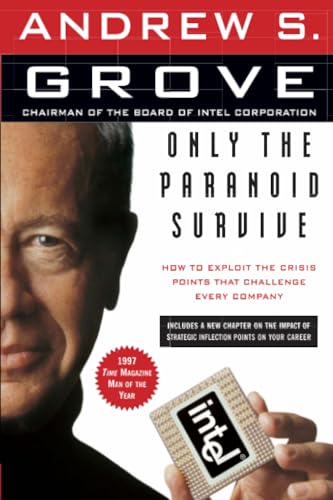
Only the Paranoid Survive: Strategic Inflection Points, From the CEO Who Lived One
A Kurums Book Taste review of Only the Paranoid Survive for leaders who suspect the ground is shifting and want the manual written inside the earthquake.
Why this book fits Kurums
Christensen theorizes disruption from the outside; Grove narrates it from the CEO chair - including the legendary scene where he and Gordon Moore fire themselves rhetorically ('if the board brought in new management, what would they do?') and walk Intel out of the memory business that built it. This is the operator's companion to The Innovator's Dilemma, written two years after it and arguing with it productively.
For the Kurums Technology audience the toolkit is permanently current: the six-forces diagnosis for telling noise from 10X change, the listening posts (Cassandras in the sales force, the divergence between what companies say and do), and the traversal doctrine for leading an organization through the valley of death between old strategy and new.
What the book argues
The framework extends Porter by one force and one question: when any competitive force - rivals, suppliers, customers, substitutes, entrants, or complementors (Grove's addition) - shifts by an order of magnitude, a strategic inflection point begins: the subtle moment when the old curve's logic quietly stops working and everything (strategy, structure, people) must change or the decline is permanent. His cases span his own industry (the PC's horizontal restructuring that destroyed vertical computer companies) and others - retail versus superstores, sound-era Hollywood, container shipping - establishing that SIPs are a general phenomenon wearing local costumes.
The Intel memory chapters are the heart: Japanese manufacturers hit memories with 10X cost and quality force; Intel debated, denied, and bled for two years - and the revolving-door thought experiment finally licensed the exit that insiders' identities had blocked ('we had been a memory company the way Ford was a car company'). Grove's honesty about his own denial gives the diagnostic chapters their authority: the signals are almost always present early - in middle managers and salespeople who reposition before headquarters does, in Cassandras whose bad news travels badly - and the strategic dissonance between declared strategy and actual behavior is itself the alarm.
The traversal doctrine is the management payload: let chaos reign, then rein in chaos - an experimentation phase where resources drift to new directions before clarity is possible, followed by a hard commitment phase with one clear direction articulated relentlessly; the valley of death crossed by transferring the best people to the new priority (resource shifts, not speeches, are the strategy); and the CEO's distinctive duty to expose themselves to the periphery where change arrives first. The closing career chapter - your career is your business, and it has inflection points too - made the book double as the first personal-disruption manual.
Key ideas, translated to your desk
Count the X's
Competitive shifts of 2X are weather; 10X is climate. Size every threat honestly by magnitude before choosing between adjustment and transformation.
Interview the replacement you
'What would new management do?' strips identity and sunk cost from strategy. Ask it formally, annually, and whenever the dissonance grows.
Strategy is where your best people go
Declarations follow resources, not the reverse. Move your strongest teams to the new curve and the organization will believe you.
Use it at work
- Run the six-forces 10X scan in your annual strategy review - complementors included.
- Create a Cassandra channel: structured, consequence-free routes for field bad news to reach the top raw.
- Audit strategic dissonance: list where actions and stated strategy diverge; each gap is a signal.
- When transformation is declared, publish the people moves first - it is the only announcement anyone audits.
Read it if
- Your industry faces a possible 10X force - AI being this decade's obvious candidate.
- You lead through a pivot and need the emotional honesty as much as the frames.
- You want the operator's rebuttal-and-confirmation of Christensen.
You can skip it if
- You want current-decade cases; the pattern is evergreen, the examples are vintage.
- No inflection point is plausibly near and your shelf time is scarce - though that belief is how chapters one through three begin.
- You need financial-restructuring mechanics; this is strategy and leadership.
This book appears in
Curated Tasting Menus that chain this title into a reading route.
Discover more from Kurums | Business Intelligence
Subscribe to get the latest posts sent to your email.