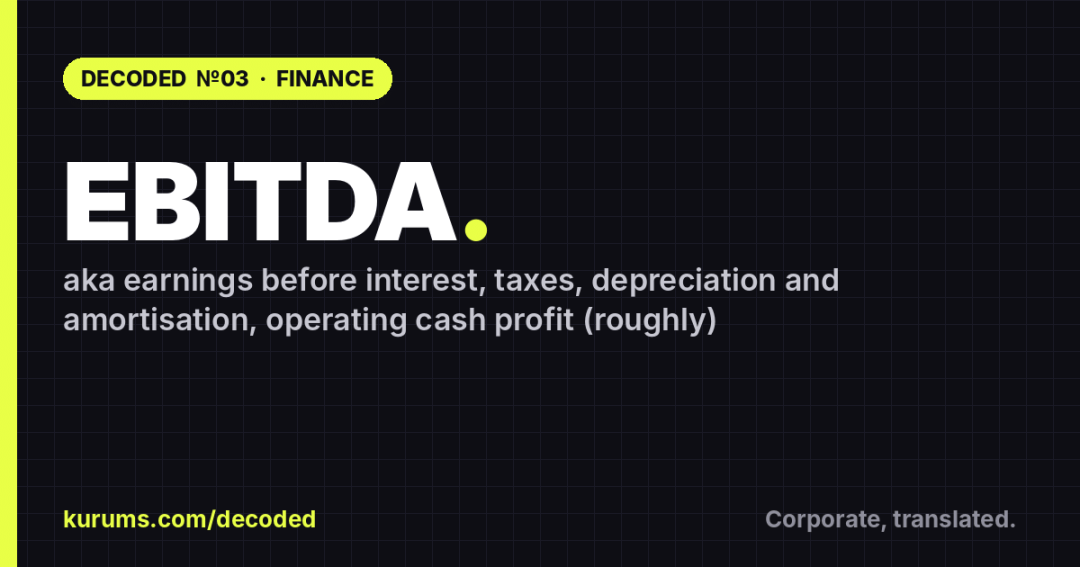
EBITDA.
aka earnings before interest, taxes, depreciation and amortisation, operating cash profit (roughly)
Profit before the accountants and the bank take their cut.
What it actually means
EBITDA is a company’s profit before subtracting interest payments, taxes, depreciation and amortisation. It is a rough measure of how much cash the core business generates from simply operating.
Say it “ee-bit-dah”. Each letter is a cost that gets added back: Interest (what the company pays on its debt), Taxes, Depreciation (the slow write-down of physical things like machines) and Amortisation (the same, for things you cannot touch, like software licences).
Why strip them out? Because they depend on how a company is financed and where it is taxed, not on whether the actual business works. Two coffee chains with identical shops will show different net profits if one has a big loan and the other does not. EBITDA puts them side by side. That is why buyers, lenders and analysts love it, and why the price of a company is often quoted as a multiple of it: “they sold for 12 times EBITDA.”
Where you'll hear it
Revenue grew 18% and adjusted EBITDA came in at $42 million, a 24% margin, ahead of guidance.
Translation: the core business made more money per dollar of sales than we promised. Note the word “adjusted”. Always note that word.
You will hear it anywhere a company is being valued, lent to or compared: M&A, private equity, lending, earnings calls. You will almost never hear it from a tax authority, because EBITDA is not an official accounting number. Companies get to define it, which is where “adjusted EBITDA” and a long list of add-backs come in.
The pop-culture version
Say a tour brings in $10 million in ticket sales and costs $6 million to put on: crew, catering, production. The $4 million left is EBITDA. It tells you whether the show itself makes money.
What it ignores: the interest on the loan that paid for the stage, the tax bill, and the fact that the tour bus and the lighting rig lose value every month. Those are real, and the artist’s actual take-home is lower. But if you want to know whether the tour is a good business, EBITDA is the number you look at first.
The famous warning: EBITDA is not cash. A company can post great EBITDA and still miss payroll if its customers pay late or its debt payments are enormous. Treat it as “how good is the engine”, not “how much is in the tank”.
Say it like you mean it
“EBITDA margin is 24%, so the core business is healthy; the net loss is from the debt we took on last year.”
Separates operating performance from financing, which is exactly what EBITDA is for.“We’re EBITDA-positive, so we’re profitable.”
Not necessarily. Interest, tax and depreciation are real costs. EBITDA-positive companies go bankrupt every year.Investor-speak worth knowing: a “multiple” is price divided by EBITDA. If a company with $5 million EBITDA sells for $50 million, that is “10x”. The multiple is the market’s opinion of how good the engine is and how long it will run.
The full breakdown with worked examples, sector benchmarks and the add-backs that turn EBITDA into fiction.
Decoded next
Decoded by the Kurums editorial team. Kurums Decoded translates the language of business for people who are new to it. Definitions are kept short on purpose; the serious version above goes deep. Nothing here is financial, legal or career advice.
Discover more from Kurums | Business Intelligence
Subscribe to get the latest posts sent to your email.