Buyer's guide · Marketing
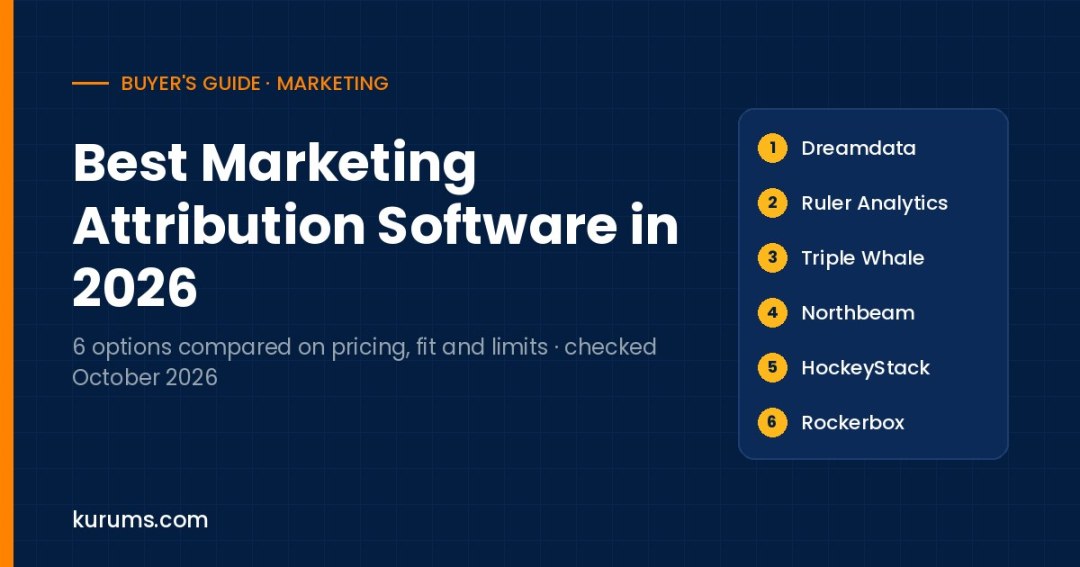
We compared six marketing attribution platforms on published pricing, free plans or trials, attribution models, MMM and incrementality support, primary buyer and data sources, and the main limitation to check first.
- B2B team starting out: Dreamdata — Free plan at $0 a month with 5 seats, company identification and B2B web analytics before any commercial commitment.
- Lead-gen business with calls and forms: Ruler Analytics — Published plans from $400 a month on monthly billing, with call, form and chat tracking tied to CRM revenue.
- Shopify brand on a budget: Triple Whale — Free plan with 10 users and first and last click attribution; paid plans add multi-touch models priced by GMV tier.
- Scaling DTC brand with heavy ad spend: Northbeam — Starter shown at $1,500 and Professional at $3,500 per month, with plan eligibility set by ad spend.
- Enterprise needing MTA plus MMM: Rockerbox — Combines multi-touch attribution, marketing mix modeling and managed incrementality testing; now part of DoubleVerify.
Marketing attribution software connects ad clicks, impressions, website visits, form fills, calls and CRM deals to show which channels and campaigns produce revenue. Instead of trusting each ad platform's own reporting, which often double-counts conversions, attribution tools build a single journey per customer or account and apply rules or models to distribute credit. Many now add marketing mix modeling for budget planning and incrementality testing for causal proof. Buyers fall into two broad groups: B2B companies with long, account-based sales cycles that end in a CRM opportunity, and ecommerce or direct-to-consumer brands that need daily, order-level reporting to manage paid social and search budgets. Lead-generation businesses that close deals by phone sit between the two and need call tracking.
We assessed each platform on six fields: published pricing, free plan or trial, attribution models, MMM and incrementality support, primary buyer and data sources, and the main limitation. Products are listed in practical buyer order, starting with tools that publish prices or offer free plans and ending with quote-led enterprise platforms; the order is not a quality ranking. All prices and plan details were checked on official vendor pricing and product pages on 12 October 2026. Where a vendor does not publish a number we say quote-based. Attribution pricing often depends on traffic, ad spend or revenue, so confirm your tier before signing.
Marketing Attribution Software compared at a glance
| Platform | Pricing | Best for | Link |
|---|---|---|---|
| 1. Dreamdata | Free plan $0/month; Activation and Attribution plans custom-priced | B2B account-based attribution | Site → |
| 2. Ruler Analytics | From $400/mo monthly or $360/mo annual (up to 10k visits); indicative pricing | Lead-gen with calls and forms | Site → |
| 3. Triple Whale | Free plan; Foundation and Automate priced by annual GMV tier; Enterprise custom | Shopify ecommerce brands | Site → |
| 4. Northbeam | Starter shown at $1,500; Professional $3,500 per month; Growth and Enterprise quote | High-spend DTC media buyers | Site → |
| 5. HockeyStack | Quote-based; custom-built plans, startup pricing available | B2B SaaS revenue teams | Site → |
| 6. Rockerbox | Quote-based; demo required | Enterprise unified measurement | Site → |
Pricing checked 12 October 2026 on each vendor's official pricing or product pages. Prices are list prices in USD unless stated; "Quote-based" means the vendor does not publish a price. Order follows buyer fit and pricing transparency, not a quality score. Confirm billing basis, minimums and taxes with the vendor before you buy. Methodology is described below.
The 6 options in detail
Dreamdata
Best for B2B account-based attributionBest for: B2B marketing teams that want account-level journeys tied to pipeline and revenue, starting on a free plan.
| Attribute | Dreamdata |
|---|---|
| Published pricing | Free plan at $0/month; Activation and Attribution packages are custom-priced |
| Free plan or trial | Free plan with 5 seats and 2 months of user history; guided free trial for paid packages |
| Attribution models | AI and custom attribution models on paid packages; account-based customer journeys |
| MMM and incrementality | No MMM listed; focuses on multi-touch journeys, revenue and content analytics |
| Primary buyer and data | B2B teams; CRM, ad platforms and website data unified by account, with offline conversion syncs |
| Main limitation | Free plan has short history and no full attribution models, so evaluation needs the paid trial |
- Dreamdata says its company identification can identify up to 80% of companies, which helps attribute anonymous B2B visits to accounts.
- Audience Hub syncs audiences to major ad platforms daily and offline conversion syncs send pipeline data back for bidding.
- The free plan keeps only two months of user history and leaves attribution models to custom-priced packages.
Our take: Dreamdata is built for B2B companies where a deal involves many people from one account over months. It organizes every touchpoint, from ads and web sessions to CRM activities, under the account and ties it to pipeline and revenue. Teams can define their own rules for stages and attribution, then ask Dreamdata AI plain-English questions about channel and campaign performance. The free plan is useful for setting up tracking, company identification and engagement scoring, but full attribution and activation sit in custom packages with onboarding and a dedicated CSM. In a guided trial, connect your CRM and two ad platforms and check whether opportunity-level attribution matches what sales sees. Compared with HockeyStack, Dreamdata offers an easier free entry point; compared with Ruler Analytics, it is more account-centric and less focused on calls and form leads. Ecommerce brands should look at Triple Whale or Northbeam instead.
Ruler Analytics
Best for lead-gen with calls and formsBest for: Lead-generation and service businesses that close deals offline and need calls, forms and chats tied to CRM revenue.
| Attribute | Ruler Analytics |
|---|---|
| Published pricing | Small $400/month monthly or $360 annual; Medium $668 or $601; Large $1,326 or $1,193; Advanced from $2,000; GBP and EUR also listed |
| Free plan or trial | No free trial listed; plans start with a demo booking |
| Attribution models | Multi-touch attribution on all plans; data-driven and impression attribution from Medium |
| MMM and incrementality | Marketing mix modelling and AI analyst agent on the Advanced plan |
| Primary buyer and data | Marketers in agencies, lead gen, professional services and ecommerce; call, form and live chat tracking |
| Main limitation | Prices are labelled indicative and scale with monthly website visits |
- Published traffic-based tiers make Ruler one of the few attribution vendors you can budget for before a sales call.
- Offline revenue can be pushed back to ad platforms, linking closed CRM deals to the campaigns that generated the first call or form.
- Monthly website visits drive the tier, so a traffic spike from a content win can move you into a more expensive plan.
Our take: Ruler Analytics fits businesses where the conversion happens on the phone, through a form or in live chat, and the revenue appears later in a CRM. Its first-party data platform tracks those touchpoints, matches them to marketing sources and sends revenue back to ad platforms and BI tools. Plans are tiered by website traffic, from up to 10,000 monthly visits on Small to 100,000 and above on Advanced, and the pricing page shows monthly and annual rates in GBP, EUR and USD. Every tier includes a dedicated customer success manager and onboarding. In a demo, test a call-tracking number on one campaign and confirm how a won deal appears in the attribution report. Compared with Dreamdata, Ruler is less account-centric but stronger on calls; compared with Rockerbox, it offers MMM at a published price point on its Advanced plan.
Triple Whale
Best for Shopify ecommerce brandsBest for: Shopify and DTC ecommerce brands that want pixel-based attribution, dashboards and AI agents with a free starting point.
| Attribute | Triple Whale |
|---|---|
| Published pricing | Free; Foundation and Automate priced by annual GMV tier via a slider; Enterprise custom |
| Free plan or trial | Free plan with 10 users and 12 months of data retention, no credit card required |
| Attribution models | First and last click on Free; multi-touch attribution with all models and 1 to 28 day plus lifetime windows on Foundation |
| MMM and incrementality | Compass unifies MTA, MMM and incrementality on Enterprise; add-on for other plans |
| Primary buyer and data | Ecommerce brands; Triple Pixel, post-purchase surveys and ad platform data |
| Main limitation | Paid plans are 12-month subscriptions and the tier rises automatically as GMV grows |
- The free plan includes the Triple Pixel and a light post-purchase survey, enough to compare platform-reported and first-party results.
- Annual prepaid billing locks your GMV tier for the year, and monthly billing is also available on a 12-month term.
- Dollar prices appear only through the GMV slider, and growth moves you automatically to a higher tier with notice.
Our take: Triple Whale is a measurement and analytics platform built for ecommerce, especially Shopify brands. The Triple Pixel collects first-party events, and dashboards combine store revenue with ad spend so a founder or growth lead can see blended performance daily. The Free plan offers first and last click attribution with a lifetime lookback window; Foundation adds multi-touch attribution with every model and lookback window. Automate layers on automations, creative tools and the full AI model library, and Enterprise adds Compass, which brings MTA, MMM and incrementality into one view. Before upgrading, run the Free plan for a few weeks to confirm pixel coverage and survey response rates. Ask how the GMV tier is calculated and what happens mid-contract if revenue jumps. Compared with Northbeam, Triple Whale has a lower entry point and broader analytics; Northbeam is aimed more at brands with large, multi-channel ad budgets.
Northbeam
Best for high-spend DTC media buyersBest for: Direct-to-consumer brands spending heavily on paid media that need daily multi-touch data and media strategy support.
| Attribute | Northbeam |
|---|---|
| Published pricing | Starter shown at $1,500 (month-to-month, usage-based); Professional $3,500 per month; Growth and Enterprise by quote |
| Free plan or trial | No free trial listed; plans include partner ad credits, which are not a trial |
| Attribution models | Multi-touch attribution with Clicks plus Deterministic Views on Starter and above |
| MMM and incrementality | Incrementality optional from Professional; MMM Plus optional on Enterprise |
| Primary buyer and data | DTC and ecommerce brands; plan eligibility set by ad spend, price by pageview volume |
| Main limitation | Northbeam calls the listed rates initial estimates; final price depends on data volume |
- Professional adds unlimited users, data exports, any ecommerce platform and a dedicated media strategist.
- Starter is month-to-month for Shopify brands, so you can test fit before an annual Professional or Enterprise term.
- Entry pricing sits well above self-serve tools, and the page's spend thresholds for each plan are not fully consistent.
Our take: Northbeam targets ecommerce brands that already spend significant budgets across Meta, Google, TikTok and other channels and need a neutral daily view of what drives orders. Its multi-touch model combines clicks with deterministic views, and dashboards can be customized by channel, campaign and creative. Starter is a month-to-month, usage-based plan for Shopify brands, Professional runs on an annual term from $3,500 a month and Enterprise adds dedicated success, hourly data and optional MMM Plus. Plan eligibility depends on ad spend, while the monthly price depends on pageview volume, so ask for a written estimate using your own traffic. In a demo, compare a recent week of Northbeam data with platform-reported ROAS to see where credit moves. Compared with Triple Whale, Northbeam is more expensive at entry but includes more media buying guidance; compared with Rockerbox, it is more focused on DTC brands.
HockeyStack
Best for B2B SaaS revenue teamsBest for: B2B SaaS marketing and RevOps teams that want full-funnel attribution plus AI recommendations for sales and marketing.
| Attribute | HockeyStack |
|---|---|
| Published pricing | Quote-based; custom-built plans with startup pricing available |
| Free plan or trial | No free trial listed; demo on request |
| Attribution models | Multi-touch attribution from anonymous first touch to closed-won, side-by-side model comparison |
| MMM and incrementality | Lift reports compare exposed and unexposed accounts; no MMM listed on the site |
| Primary buyer and data | B2B SaaS GTM teams; CRM (Salesforce, HubSpot), marketing automation, ads, web and warehouse data |
| Main limitation | No published prices, so cost comparison requires a sales process |
- Tracking is cookieless by default, and identity resolution merges records across sources into account-level views.
- Attribution data syncs back into source tools, so CRM and ad platforms receive the same credit model.
- Pricing is entirely custom, which makes early budget comparison with Dreamdata or Ruler harder.
Our take: HockeyStack positions itself as a revenue data platform for B2B go-to-market teams, combining marketing, product and sales data in one model. Multi-touch attribution covers the journey from the first anonymous visit to a closed deal, and you can compare models side by side to see how credit shifts. Lift reports compare accounts exposed to a program with those that were not, a lighter-weight alternative to formal incrementality tests. AI features use the underlying data layer to suggest next steps for each segment and help sales leaders focus on accounts likely to close. Pricing is custom, with startup pricing available, so prepare your data sources and volumes before the call. In a demo, ask to see a closed-won deal traced back through every touch. Compared with Dreamdata, HockeyStack leans more into sales-side AI; compared with Ruler, it is better suited to SaaS than call-driven lead gen.
Rockerbox
Best for enterprise unified measurementBest for: Larger advertisers that want multi-touch attribution, marketing mix modeling and incrementality testing from one vendor.
| Attribute | Rockerbox |
|---|---|
| Published pricing | Quote-based; no prices published on the site |
| Free plan or trial | No free trial listed; demo on request |
| Attribution models | De-duplicated, user-level multi-touch attribution with customizable models and funnel analysis |
| MMM and incrementality | MMM with forecasting and fully managed incrementality testing; tests can calibrate MTA and MMM |
| Primary buyer and data | Larger consumer brands; 100+ integrations on a SOC 2 certified data foundation |
| Main limitation | Quote-only pricing and a heavier setup than self-serve ecommerce tools |
- DoubleVerify agreed to acquire Rockerbox for $85 million in cash in February 2025, linking media quality and performance measurement.
- Incrementality test results can be used to calibrate the MTA model and as priors for MMM, so the three methods stay consistent.
- There is no self-serve entry point, and smaller brands may find the scope larger than they need.
Our take: Rockerbox brings the three main measurement methods together. Its data foundation centralizes spend, performance and conversion data and can export to a warehouse. Multi-touch attribution gives daily, campaign-level detail with customizable models and channel overlap reports; marketing mix modeling estimates long-term channel contribution and supports budget scenarios; and a managed incrementality service designs and analyzes control-group tests. The value is in using each method to check the others, which suits brands with large, diverse media plans including offline and streaming channels. Since 2025 Rockerbox has been part of DoubleVerify, and its site promotes a link between DV media quality and Rockerbox performance data. In a demo, ask how long MMM takes to produce a first model and what the incrementality service costs. Compared with Northbeam or Triple Whale, Rockerbox is broader but less self-serve; B2B teams should look first at Dreamdata or HockeyStack.
How to choose marketing attribution software
Match the tool to your sales motion
Attribution products split by business model. B2B tools such as Dreamdata and HockeyStack group activity by account and end at a CRM opportunity. Ecommerce tools such as Triple Whale and Northbeam work at order level, update daily and focus on paid social and search. Lead-generation businesses that close by phone need call and form tracking, which is Ruler Analytics' focus. Choosing a tool built for another motion usually means fighting its data model, so start by writing down where a conversion is recorded and how long a typical buying journey lasts.
Audit your data sources first
Attribution is only as good as the data it receives. List your ad platforms, website analytics, marketing automation, CRM, call tracking and store platform, and check whether UTMs and naming conventions are consistent. Ask each vendor which sources are native connectors and which require custom work. For B2B, confirm how the tool matches anonymous visitors to accounts. For ecommerce, check how the pixel handles browser privacy limits. Fixing tagging before the trial avoids blaming the software for gaps in your own setup.
Understand models and their limits
First and last click, linear, time-decay, position-based and data-driven models each tell a different story. Good tools let you compare models side by side so you can see where credit moves rather than accepting one answer. Remember that multi-touch attribution measures correlation along tracked paths; it cannot see untracked influence such as word of mouth. Treat model output as a decision aid, and look for tools that show the underlying touchpoints so analysts can check results.
Decide whether you need MMM or incrementality
Marketing mix modeling uses aggregate spend and outcome data to estimate channel contribution, including offline and upper-funnel media, and helps with budget planning. Incrementality testing uses control groups to prove causal lift. Larger advertisers often need both alongside MTA. Rockerbox, Triple Whale Compass, Ruler's Advanced plan and Northbeam add-ons cover these to different degrees. If you spend mostly on a few digital channels, MTA alone may be enough for now.
Plan for activation and ownership
Attribution only pays back if someone changes budgets because of it. Check whether the tool can send conversions or audiences back to ad platforms, sync data to your CRM or warehouse and produce reports executives will trust. Agree who owns the tool, who maintains tracking and how often budget decisions will be reviewed. Vendors that include onboarding, a customer success manager or media strategists can speed adoption for small teams without a dedicated analyst.
How marketing attribution software pricing works
Attribution vendors price on a volume metric tied to your business size. Ruler Analytics publishes tiers by monthly website visits, starting at $400 a month on monthly billing for up to 10,000 visits and $360 a month on annual billing. Triple Whale prices its paid plans by annual GMV tier and moves you up automatically as revenue grows. Northbeam sets plan eligibility by ad spend and calculates monthly price from pageview volume, with Starter shown at $1,500 and Professional at $3,500 per month. B2B platforms such as Dreamdata and HockeyStack quote custom packages based on tracked users, data sources and services.
Free plans and starter tiers are useful for testing tracking quality, not for judging full attribution. Dreamdata's free plan covers web analytics, company identification and engagement scoring with two months of history, and Triple Whale's free plan offers first and last click attribution for 10 users. Paid plans unlock multi-touch models, longer history, activation and support. Add-ons are common: incrementality testing, MMM, extra AI credits or data warehouse exports can carry separate fees. Contract terms also differ: Triple Whale's paid plans are 12-month subscriptions, Northbeam Professional and Enterprise run on annual terms, and Ruler offers 10 percent off annual deals.
When comparing quotes, model the next 12 to 24 months of traffic, spend or revenue, because moving up a tier can change cost sharply. Ask what happens if you exceed a limit mid-term and whether onboarding and a success manager are included or extra.
Kurums Match: which one fits you?
Pick the situation closest to yours. Each answer jumps to the matching card above.
I run B2B marketing and want to start without a contractAccount-based sales cycle
Dreamdata → Dreamdata has a free plan with 5 seats and company identification, with a guided trial for full attribution.
Most of our leads come from phone calls and formsOffline conversions
Ruler Analytics → Ruler Analytics tracks calls, forms and chats, ties them to CRM revenue and publishes traffic-based pricing.
I own a Shopify store and want better ROAS dataSmall to mid ecommerce
Triple Whale → Triple Whale's free plan adds a first-party pixel and first and last click attribution with no credit card.
We spend heavily on paid social and search for a DTC brandLarge media budget
Northbeam → Northbeam focuses on daily multi-touch data for high-spend brands and adds a media strategist on Professional.
I need MTA, MMM and lift tests in one placeEnterprise measurement program
Rockerbox → Rockerbox combines all three methods and uses test results to calibrate its attribution and mix models.
Buying tip
Before signing, pick one recent campaign with known results and ask each shortlisted vendor to show how their model credits it. Large differences reveal tracking gaps and model assumptions far better than a generic demo dashboard.
Marketing Attribution Software: frequently asked questions
What is multi-touch attribution?
Multi-touch attribution assigns credit for a conversion across several marketing touchpoints instead of giving it all to the first or last click. Models include linear, time-decay, position-based and data-driven approaches. It helps you see how channels work together, for example how paid social introduces a buyer and search closes the sale. It relies on tracked interactions, so it should be combined with judgment or testing for untracked influence.
What is the difference between attribution and marketing mix modeling?
Attribution follows individual users or accounts through tracked touchpoints and is useful for daily, campaign-level decisions. Marketing mix modeling uses aggregate spend and outcome data over time to estimate each channel's contribution, including offline media and seasonality, and is better for annual budget planning. Many larger advertisers use both, and some vendors such as Rockerbox and Triple Whale Compass combine them with incrementality tests.
Which attribution tools have a free plan?
As checked on 12 October 2026, Dreamdata offers a free plan at $0 a month with 5 seats and two months of user history, and Triple Whale offers a free plan with 10 users, 12 months of data retention and first and last click attribution. Ruler Analytics, Northbeam, HockeyStack and Rockerbox start with a demo rather than a free plan.
How much does marketing attribution software cost?
Published entry points range from Ruler Analytics at $400 a month on monthly billing to Northbeam Professional at $3,500 a month. Triple Whale prices paid plans by GMV tier, and Dreamdata, HockeyStack and Rockerbox quote custom packages. Your actual cost depends on traffic, ad spend or revenue, plus add-ons such as MMM or incrementality testing, so request a quote using your own volumes.
Can attribution software work with cookie and privacy limits?
Most modern tools combine first-party tracking, server-side events and CRM or order data to reduce reliance on third-party cookies. HockeyStack says it tracks cookieless by default, and Dreamdata combines cookie and cookieless tracking. Coverage will never be complete, which is why many teams pair attribution with marketing mix modeling or incrementality tests to check results against aggregate outcomes.
How long does it take to get useful attribution data?
Expect a few weeks to install tracking, connect ad platforms and the CRM or store, and clean up UTM conventions. Useful trends usually need at least one full sales cycle of data, which for B2B can mean several months. Ecommerce brands with short purchase cycles see patterns faster. Vendor onboarding, which Ruler and Dreamdata include on paid plans, can shorten setup considerably.
Related comparisons
Last updated 13 October 2026 · Pricing checked 12 October 2026.
Disclosure: Kurums is reader-supported through advertising. We currently have no affiliate, sponsorship or partnership relationship with any product compared on this page; if that changes, this page will say so and affected links will carry sponsored attributes.
Discover more from Kurums | Business Intelligence
Subscribe to get the latest posts sent to your email.