
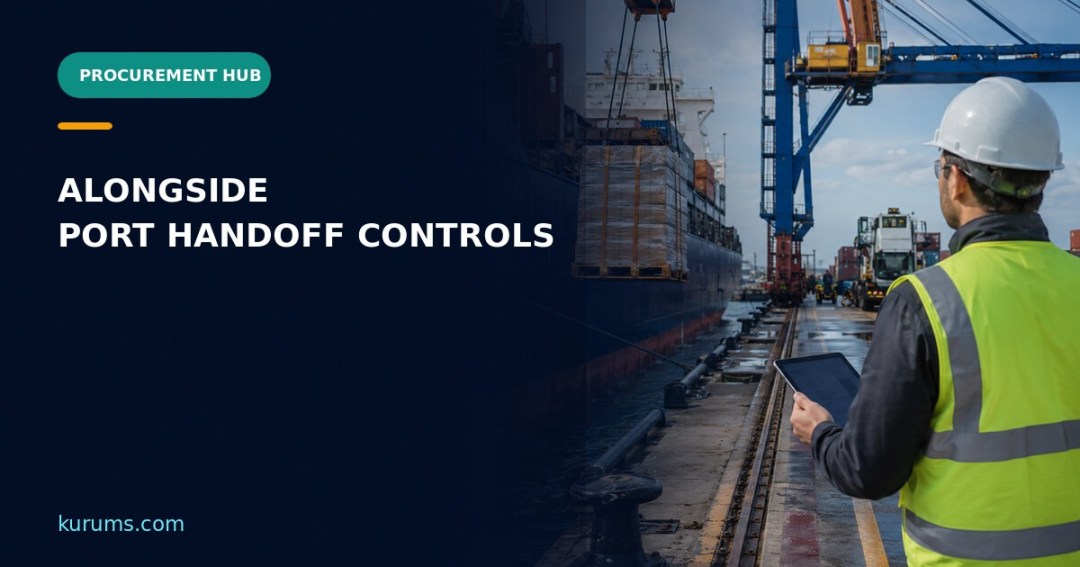
ALONGSIDE means placing cargo beside a vessel or at the ship’s side ready for loading. It is an operational location, not a complete delivery or risk rule. Procurement should name the terminal and berth, define readiness and loading responsibility, allocate handling and waiting cost, and separate the alongside milestone from title, risk and final delivery.
- State the exact port, terminal, berth, gate, warehouse or ship-side location behind the word alongside.
- Define when cargo is ready, who provides equipment, who loads, and when the handoff is evidenced.
- Separate alongside cost and physical custody from Incoterms delivery, title, risk, insurance and import obligations.
- Control berth changes, weather, congestion, waiting, demurrage, damage and terminal acceptance with event records.
Alongside Is a Physical Location
The SSDER glossary describes ALONGSIDE as the vessel’s side or a delivery position where goods are placed at the berth ready for loading. That phrase can be useful in a marine specification, but it does not identify a unique terminal, a safe berth, a time of readiness or a transfer of risk. A buyer needs more precision before comparing quotations.
Use alongside as one event in the movement timeline: cargo released from the supplier, delivered to the terminal, accepted at gate, positioned alongside, loaded aboard and discharged. Keep those events separate from the selected Incoterm and the legal delivery point in the contract.
Name Port, Terminal and Berth Conditions
A port may have several terminals, berths, gates, warehouses and cargo-handling rules. The RFQ should state the intended location, opening hours, draft, crane or shore gear, road access, security, dangerous-goods restrictions, cargo dimensions, storage limits and alternative berth process. A carrier that prices “alongside” at one terminal may be pricing a different physical service from another bidder.
Define who books the berth, tenders readiness, supplies cargo, provides stevedores, handles customs, checks weather and approves a substitute. If the cargo must be placed at the vessel’s side before a laycan or tide window, the schedule and evidence should be visible to procurement and operations.
Allocate Loading, Waiting and Damage Risk
The contract should identify the equipment and labour required to move cargo alongside, the condition of the quay, temporary storage, lashing, survey, packaging protection and responsibility for damage before loading. Waiting may arise from cargo readiness, terminal congestion, weather, berth change or vessel readiness; each cause needs a clock and evidence.
Separate port handling, wharfage, stevedoring, pilotage, storage, demurrage and inland delivery from the base freight. If a seller quotes a term that includes delivery alongside, ask whether unloading from the truck, terminal receipt, quay placement and vessel loading are included or separately charged.
Align the Milestone with Trade Terms
Incoterms rules allocate responsibilities and risk at defined places or events; “alongside” alone does not replace a named Incoterm. For a sea sale, the commercial parties may use a rule that delivers on board, while their internal operation still tracks a truck at the quay. The dashboard should show both the physical event and the legal milestone.
The transport document, terminal receipt, survey and photographs should identify cargo unit, seal, condition, time, berth and responsible party. A substitution from quay delivery to a port warehouse or direct loading is a change to be priced and approved, not silently absorbed into the same word.
Worked Example: Two Bids, Two Meanings of Alongside
Supplier A quotes delivery alongside at Terminal 1, including truck delivery but excluding crane handling. Supplier B quotes Terminal 2 with crane and stevedore included but charges storage after four hours. The buyer compares only the headline price and later pays waiting, crane and quay charges that were not in the business case.
The corrected RFQ defines terminal, berth, cargo-ready time, equipment, included labour, storage, weather, waiting and evidence. The comparison uses a common event timeline and total port cost. The chosen supplier is the one that can meet the cargo and schedule with a transparent handoff, not the lowest undefined alongside rate.
Metrics and Governance
For alongside delivery procurement controls, measure both service and evidence quality. Useful indicators include first-pass acceptance, exception rate, response time, unplanned cost, document completeness, damage or discrepancy rate, and the percentage of shipments that follow the approved process. A dashboard should distinguish a supplier failure from a carrier, terminal, broker or internal master-data failure.
Review the metric trend with procurement, logistics, finance, quality and the responsible specialist. Use a monthly exception sample to test whether the control worked in a real transaction, not just whether a field was filled. Repeated exceptions should change the sourcing strategy, contract, lane design or supplier development plan.
Keep the control proportionate to risk. High-value, regulated, time-critical or safety-sensitive cargo needs stronger evidence and faster escalation than a routine shipment. Record the decision owner, approval date, source documents and follow-up action so the next buyer can understand the operating history.
Supplier and Carrier Questions
- Which ALONGSIDE or related glossary condition is assumed in your quotation, procedure or service description?
- Which party owns each data field, physical handoff, inspection, document and exception?
- What evidence will be available before release, loading, movement, receipt, invoice approval or claim?
- What changes require advance notice, requalification, a revised price or a new risk decision?
- How will the supplier report incidents, delays, mismatches and corrective actions, and within what response time?
Implementation Sequence
Implement the control in a small, representative lane first. Capture the baseline process, test the required data and evidence, run a real transaction, and review every exception with the people who performed the work. Do not declare the control effective only because a supplier signed a procedure.
After the first three shipments or operating cycles, update the purchase-order clause, work instruction, scorecard and training. Scale the control to other suppliers only when the evidence is repeatable and the owner can explain what happens when the normal path fails.
Common Mistakes to Avoid
- Treating alongside as a current Incoterms rule or automatic risk-transfer point.
- Leaving terminal, berth, gate, handling, storage and alternative-location assumptions unstated.
- Comparing offers without separating quay, crane, stevedore, waiting and demurrage charges.
- Failing to record cargo condition and custody before the vessel loading event.
- Allowing a port or berth change without rechecking schedule, cost, safety and insurance.
Procurement Implementation Checklist
- Name port, terminal, berth, gate, warehouse and operating windows.
- Define cargo-ready, terminal-accepted, alongside, aboard and delivery milestones.
- Allocate equipment, stevedore, lashing, survey, storage and waiting responsibilities.
- Separate physical custody from Incoterms, title, risk, insurance and customs duties.
- Retain gate, berth, survey, photo, timesheet, seal and invoice evidence.
- Track waiting, damage, port cost, berth changes and on-time loading.
Frequently Asked Questions
What does alongside mean?
It means at or beside the vessel, usually at the quay or berth and ready for loading. The exact location and event must be defined in the contract.
Does alongside transfer risk?
Not by itself. Risk and delivery depend on the contract and selected trade term, while alongside is an operational milestone.
Who pays crane and stevedoring charges?
The quotation and contract should state whether they are included, excluded or triggered by a defined event.
What evidence proves an alongside handoff?
A terminal or stevedore receipt, timestamp, cargo ID, condition record, survey or photograph and the related gate or berth record.
Can alongside be used for container cargo?
It can describe a port-side position, but the booking should specify container, terminal, handling, storage and loading responsibilities clearly.
Related Kurums Guides
- Center of Gravity Controls
- Cargo Manifest Controls
- Shipping Documents for Procurement
- Freight Measurement and Pricing
- Cargo Insurance and Claims
- Freight Contracts and Parties
Standards and Authoritative Sources
- ICC — Incoterms 2020
- IMO — Facilitation of International Maritime Traffic
- IMO — Cargo Securing and Packing
- BIMCO — Contractual Clauses
Glossary terms covered: ALONGSIDE, port side, delivery place, berth, loading, handoff, risk event
Kurums.com · Procurement, sourcing and business operations
Discover more from Kurums | Business Intelligence
Subscribe to get the latest posts sent to your email.