
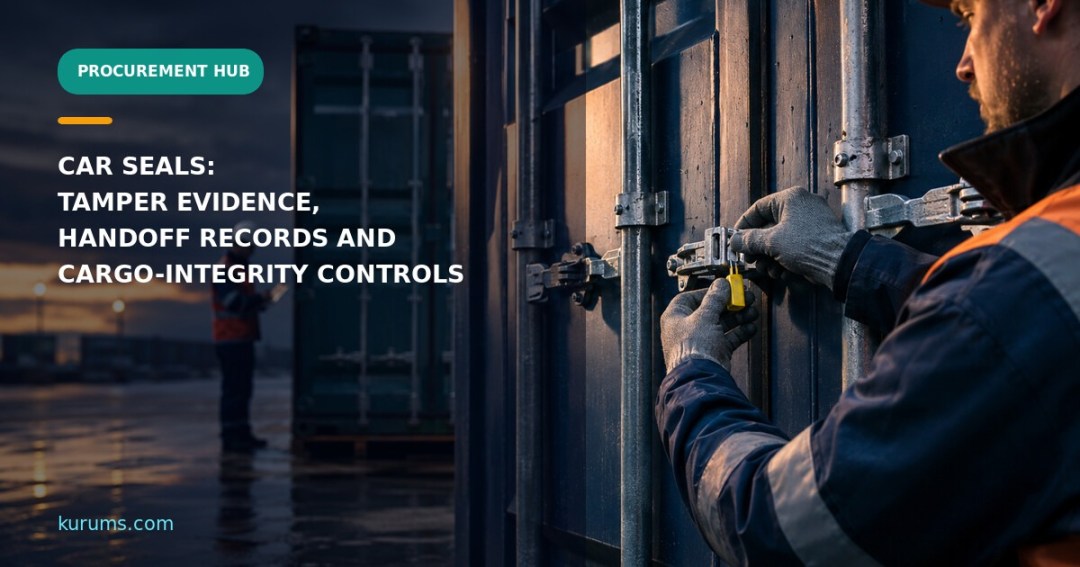
A CAR SEAL is a numbered device used to show whether a container, trailer or other transport unit was opened or tampered with after closure. It is evidence, not an absolute security guarantee. Procurement should specify the seal class, number control, application, inspection, handoff, replacement, breach response and retention record for every movement.
- Specify the security level, construction, marking, uniqueness and inspection requirements for the route and commodity.
- Link the seal number and condition to the container, shipment, person, timestamp, location and document record.
- Treat a broken, missing, duplicated or mismatched seal as an exception requiring controlled examination and notice.
- Audit seal suppliers and carriers for issuance, custody, inventory, destruction and incident-response discipline.
What a Car Seal Proves—and Does Not Prove
The SSDER glossary defines a car seal as a numbered seal placed on the doors of a container, railcar or other transport unit. In procurement, it is a tamper-evident control that supports chain of custody. A seal number can show that the unit presented at a handoff is not the same as the unit originally closed, but an intact seal does not prove that the contents are complete, authentic or undamaged.
Use the seal alongside packing controls, secure loading, access restrictions, photographs, weight, manifest, inspection and transport-document records. The objective is to make an unauthorised opening visible and to reduce the time needed to establish where the exception occurred—not to treat the seal as a substitute for physical security or inventory reconciliation.
Select the Right Seal and Supplier
The specification should cover the unit type, route, cargo risk, customs or security programme, application method, visible marking, serial uniqueness, resistance to removal, material, colour, barcode or QR needs and environmental exposure. U.S. CBP guidance for high-security seals references ISO/PAS 17712, but a buyer should verify the current applicable rule, programme and destination requirements before copying a standard into a global contract.
Qualify the seal supplier as a security-control provider. Inspect manufacturing controls, serial allocation, duplicate prevention, lot traceability, stock reconciliation, authorised distributors, rejected units and destruction. A cheap seal with uncontrolled numbers can create more evidence risk than a higher-priced device with reliable custody and audit records.
Record Application and Every Handoff
At application, record container or trailer ID, seal number, old seal if replaced, date, time, location, person, equipment condition, door or lock status, shipment reference and photographs where proportionate. At each handoff, the receiver should inspect the number, condition, lock points and signs of interference before signing custody.
The record must distinguish a planned reseal from a breach. If customs opens a unit, the authority or carrier should document the reason, original and replacement seal, inspection result and new custody owner. A system that stores only the current seal number loses the history needed for a claim, investigation or security audit.
Respond to a Seal Exception
A broken, missing, duplicated or mismatched seal should pause normal release according to the risk level. Notify the security, logistics, customs, carrier, buyer and insurer contacts defined in the procedure. Establish the last verified point, protect the unit, control access and decide whether an authorised joint examination, survey, recount, weight check or reseal is required.
The response should preserve evidence: photographs before opening, seal fragments, gate records, CCTV request, statements, documents, inventory differences and replacement details. Avoid silently applying a new seal and continuing. That may restore physical security but destroys the chronology and can weaken a claim or customs explanation.
Worked Example: A Number Mismatch at Delivery
A container arrives with an intact seal, but the number does not match the shipping instruction. The receiving team assumes the carrier changed it during transit and accepts the unit. Two days later a shortage is found, and no one can establish who authorised the replacement or whether the doors were examined.
The corrected process treats the mismatch as an exception before unloading. The team checks the original application record, carrier and customs events, replacement reason, photographs and handoff signatures. A controlled examination and recount are completed with the relevant parties, and the supplier scorecard records the root cause rather than only the final shortage.
Metrics and Governance
For car seal cargo security procurement, measure both service and evidence quality. Useful indicators include first-pass acceptance, exception rate, response time, unplanned cost, document completeness, damage or discrepancy rate, and the percentage of shipments that follow the approved process. A dashboard should distinguish a supplier failure from a carrier, terminal, broker or internal master-data failure.
Review the metric trend with procurement, logistics, finance, quality and the responsible specialist. Use a monthly exception sample to test whether the control worked in a real transaction, not just whether a field was filled. Repeated exceptions should change the sourcing strategy, contract, lane design or supplier development plan.
Keep the control proportionate to risk. High-value, regulated, time-critical or safety-sensitive cargo needs stronger evidence and faster escalation than a routine shipment. Record the decision owner, approval date, source documents and follow-up action so the next buyer can understand the operating history.
Supplier and Carrier Questions
- Which CAR SEAL or related glossary condition is assumed in your quotation, procedure or service description?
- Which party owns each data field, physical handoff, inspection, document and exception?
- What evidence will be available before release, loading, movement, receipt, invoice approval or claim?
- What changes require advance notice, requalification, a revised price or a new risk decision?
- How will the supplier report incidents, delays, mismatches and corrective actions, and within what response time?
Implementation Sequence
Implement the control in a small, representative lane first. Capture the baseline process, test the required data and evidence, run a real transaction, and review every exception with the people who performed the work. Do not declare the control effective only because a supplier signed a procedure.
After the first three shipments or operating cycles, update the purchase-order clause, work instruction, scorecard and training. Scale the control to other suppliers only when the evidence is repeatable and the owner can explain what happens when the normal path fails.
Common Mistakes to Avoid
- Treating an intact seal as proof of quantity, quality, authenticity or absence of theft.
- Buying seals without controlling serial uniqueness, authorised issuance, inventory and destruction.
- Recording only the current seal number and losing the application or replacement history.
- Replacing a broken or mismatched seal quietly without preserving photographs, notices and examination evidence.
- Using a security standard or customs-programme requirement without checking the route and current authority rules.
Procurement Implementation Checklist
- Define unit, route, commodity risk, seal class, marking, serial and inspection requirements.
- Qualify supplier controls for serial allocation, duplicates, lots, stock, rejects and destruction.
- Record seal application against shipment, equipment, person, time, location and condition.
- Inspect and sign the seal number and condition at every custody handoff.
- Set breach, customs-opening, reseal, examination, notice and claim procedures.
- Retain original/new numbers, photographs, gate records, statements, inventory and root cause.
Frequently Asked Questions
What is a car seal?
It is a numbered tamper-evident device used to secure and monitor a container, trailer, railcar or similar transport unit.
Does an intact seal prove the cargo is complete?
No. It supports custody evidence but must be combined with packing, weight, inspection and inventory controls.
What should a seal record contain?
Record unit ID, seal number, application or replacement event, person, time, location, condition, shipment reference and supporting evidence.
What should happen if a seal is broken?
Pause or control release, notify the defined parties, preserve the scene, establish the last verified point and document examination and resealing.
Are all seals required to meet ISO/PAS 17712?
Requirements depend on the route, programme, authority and contract. Confirm the current applicable specification rather than applying a global assumption.
Related Kurums Guides
- Freight Rates and Surcharges
- Freight Contracts and Parties
- Freight Network Design
- Cargo Security Hardware
- Billed Weight and VGM
- Waiting-Time and Arrival Controls
Standards and Authoritative Sources
- U.S. CBP — Containerized Cargo Sealing Policy
- U.S. CBP — Seal requirements for manufacturers
- U.S. CBP — CTPAT minimum security criteria
- U.S. CBP — Cargo security
Glossary terms covered: CAR SEAL, container seal, ISO/PAS 17712, seal number, tamper evidence, custody, CTPAT, claim
Kurums.com · Procurement, sourcing and business operations
Discover more from Kurums | Business Intelligence
Subscribe to get the latest posts sent to your email.