
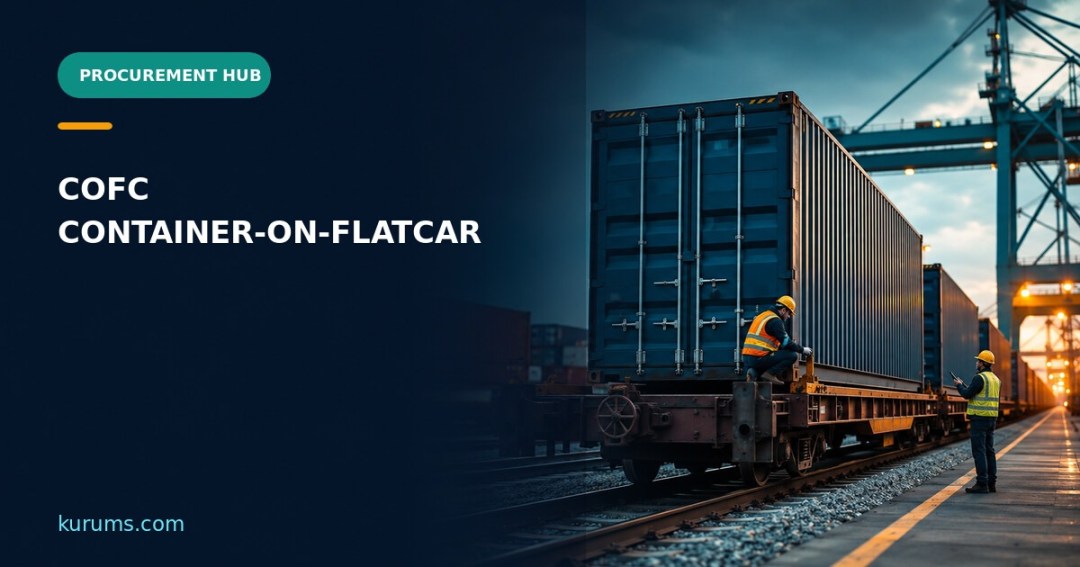
COFC means Container On Flat Car: an intermodal movement in which a freight container travels on a rail flatcar. Procurement should specify container and flatcar compatibility, lift and terminal processes, drayage, interchange, schedule, securing, damage evidence, visibility and total cost across the rail handoff.
- Treat COFC as an end-to-end intermodal service, not simply a low rail line-haul rate.
- Define container, chassis, flatcar, lift, terminal, drayage and interchange responsibilities.
- Match cargo dimensions, weight, securing, equipment condition and route restrictions before award.
- Reconcile rail events, terminal handoffs, accessorials, damage and delivery proof to one shipment ID.
COFC Connects Several Procurement Interfaces
The SSDER glossary expands COFC as Container On Flat Car. The container can move by truck to a rail terminal, be lifted onto a flatcar, travel through one or more railroads and then return to a drayage carrier for final delivery. The buyer is purchasing the handoffs as much as the line-haul movement.
The RFQ should state origin and destination, container type, weight, dimensions, commodity, temperature, hazardous status, service frequency, cut-offs, transit, terminal, chassis and delivery appointment. Require bidders to identify every party and event that can create cost or custody risk.
Validate Equipment and Loading Fit
Confirm that the container meets the cargo’s dimensions, payload, floor, ventilation, security and condition needs and that the flatcar accepts the intended container configuration. For oversize or heavy loads, obtain engineering or railroad approval before booking. The loading plan should cover centre of gravity, weight distribution, twistlocks, blocking and bracing.
A COFC price can be invalid if the origin terminal lacks the right lift, the destination has a different chassis pool or the container misses a cut-off. Ask for terminal operating windows, inspection rules, empty-return instructions and what happens when equipment is unavailable.
Control Drayage and Interchange
Drayage is often where an apparent rail saving is lost. Define appointment, free time, chassis, fuel, pre-pull, storage, redelivery, scale, detention and empty-return responsibility. The carrier should show arrival, lift, gate, interchange, rail departure, rail arrival and delivery proof.
At interchange, record equipment ID, seal, condition, photos, damage code, time, location and responsible party. Use a single shipment ID that links the booking, container, rail waybill, terminal events, drayage order and invoice.
Schedule and Disruption Governance
Rail schedules include terminal and classification-yard variability. State planned transit, service days, cut-offs, free time, notification and recovery options. If a train is missed, the provider should explain whether the cargo moves on the next service, transfers to truck or waits at the terminal, with the cost and approval path visible.
The contract should protect the cargo during dwell, weather, power loss, equipment shortage and interchange disruption. Define who may re-route, who pays for premium recovery and how emissions or service commitments change when the mode changes.
Worked Example: Rail Saving, Terminal Loss
A buyer chooses COFC because the rail rate is lower than truck. The shipper misses the terminal cut-off, the drayage carrier pays a pre-pull, the box waits for the next train and the destination chassis is unavailable. The total cost exceeds the original truck option and the delivery promise is missed.
The corrected model includes cut-off probability, drayage, chassis, lift, storage, terminal dwell and recovery. The contract defines readiness evidence and a decision tree for truck substitution. Procurement can compare a reliable COFC service with truck using total landed cost and service risk.
Metrics and Governance
For COFC intermodal procurement controls, measure both service and evidence quality. Useful indicators include first-pass acceptance, exception rate, response time, unplanned cost, document completeness, damage or discrepancy rate, and the percentage of shipments that follow the approved process. A dashboard should distinguish a supplier failure from a carrier, terminal, broker or internal master-data failure.
Review the metric trend with procurement, logistics, finance, quality and the responsible specialist. Use a monthly exception sample to test whether the control worked in a real transaction, not just whether a field was filled. Repeated exceptions should change the sourcing strategy, contract, lane design or supplier development plan.
Keep the control proportionate to risk. High-value, regulated, time-critical or safety-sensitive cargo needs stronger evidence and faster escalation than a routine shipment. Record the decision owner, approval date, source documents and follow-up action so the next buyer can understand the operating history.
Supplier and Carrier Questions
- Which COFC or related glossary condition is assumed in your quotation, procedure or service description?
- Which party owns each data field, physical handoff, inspection, document and exception?
- What evidence will be available before release, loading, movement, receipt, invoice approval or claim?
- What changes require advance notice, requalification, a revised price or a new risk decision?
- How will the supplier report incidents, delays, mismatches and corrective actions, and within what response time?
Implementation Sequence
Implement the control in a small, representative lane first. Capture the baseline process, test the required data and evidence, run a real transaction, and review every exception with the people who performed the work. Do not declare the control effective only because a supplier signed a procedure.
After the first three shipments or operating cycles, update the purchase-order clause, work instruction, scorecard and training. Scale the control to other suppliers only when the evidence is repeatable and the owner can explain what happens when the normal path fails.
Common Mistakes to Avoid
- Comparing COFC only with a rail line-haul rate.
- Skipping container, flatcar, payload, lift, chassis and terminal-fit checks.
- Leaving drayage appointments, free time, pre-pull and empty return outside the award.
- Failing to record equipment condition and seal at each interchange.
- Changing to truck during a disruption without cost, service, emissions and approval evidence.
Procurement Implementation Checklist
- Define door-to-door COFC scope, nodes, parties, mode and service calendar.
- Validate container, payload, flatcar, lift, securing and terminal compatibility.
- Set drayage, chassis, appointment, free-time, storage and empty-return rules.
- Capture equipment, seal, condition, gate, lift, rail and delivery events.
- Define missed-cut-off, disruption, re-route and truck-substitution authority.
- Measure total cost, dwell, damage, schedule reliability and recovery performance.
Frequently Asked Questions
What does COFC mean?
COFC means Container On Flat Car: a container transported by rail on a flatcar as part of an intermodal movement.
Is COFC the same as TOFC?
No. COFC uses a container on a rail flatcar; TOFC carries a road trailer on a flatcar. Equipment and handling requirements differ.
Who controls the container at the rail terminal?
The contract should define terminal, railroad, drayage and shipper responsibilities for custody, lift, inspection, storage and release.
What costs are commonly missed?
Drayage, chassis, lift, pre-pull, storage, detention, empty return, scale, terminal and disruption recovery can be material.
When is truck substitution allowed?
Use a defined disruption decision with service, cost, customer, security and emissions review and the required approval.
Related Kurums Guides
- Cargo Manifest Controls
- Aggregate Shipment Controls
- Ambient Temperature Controls
- Center of Gravity Controls
- Container Types and Load Securing
- Freight Network Design
Standards and Authoritative Sources
- FRA — Intermodal Freight
- AAR — Rail Intermodal
- FHWA — Freight Management and Operations
- IMO — CTU Code
Glossary terms covered: COFC, CONTAINER ON FLAT CAR, intermodal, flatcar, lift, drayage, interchange
Kurums.com · Procurement, sourcing and business operations
Discover more from Kurums | Business Intelligence
Subscribe to get the latest posts sent to your email.