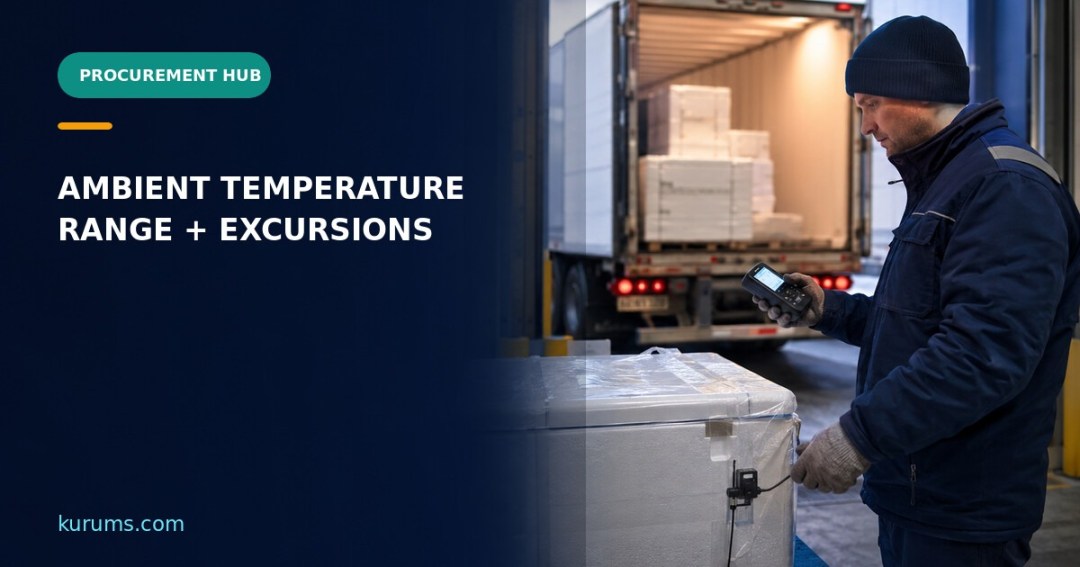
AMBIENT TEMPERATURE is the surrounding air temperature rather than the product’s internal temperature. Procurement should define the required operating range, the product and packaging response, monitoring method, handoff evidence and excursion decision instead of treating a vague “room temperature” instruction as a complete specification.
- Separate ambient-air, vehicle-compartment, package and product-core temperatures in the specification.
- Define the acceptable range, duration, seasonal scenario, sensor position, calibration and data-retention rule.
- Match packaging, ventilation, pre-cooling, insulation or active refrigeration to the actual risk.
- Set hold, investigation, disposition and customer-notification rules before a temperature excursion occurs.
Ambient Is Not the Product Temperature
The SSDER glossary defines AMBIENT TEMPERATURE as the surrounding atmospheric temperature of a container. That value can differ materially from the temperature inside a package, tank, pallet or vehicle compartment. A product may remain cold after a short warm exposure, or a load may be hot at its core while the surrounding air appears acceptable.
A procurement specification should state which temperature is controlled and why. “Ambient 15–25°C” may be suitable for a warehouse or a general industrial component, but a food, pharmaceutical, chemical or battery shipment may need a product profile, thermal qualification and a different release decision. Do not infer a legal requirement from the glossary term alone.
Define the Operating Envelope
Record minimum and maximum temperature, allowed duration outside the target, humidity or light sensitivity where relevant, loading and unloading conditions, route season, dwell points and the required product condition at receipt. State whether the range applies continuously or only during a defined phase such as storage, line haul or final delivery.
The carrier and supplier need written instructions for pre-cooling, insulation, ventilation, active refrigeration and protection from direct sun or freezing surfaces. FDA sanitary-transport rules illustrate the principle for temperature-controlled food: the shipper specifies an operating temperature and the parties retain records. Other products require their own quality and regulatory basis.
Choose Monitoring That Answers the Risk
Select a thermometer, data logger, telematics feed, indicator or validated combination based on the decision to be made. Define accuracy, calibration, placement, sampling interval, alarm threshold, time zone, battery, data export and chain of custody. A sensor near a trailer door may show a different condition from a pallet centre; the placement must be justified.
Require a reading at loading and unloading, and continuous or periodic data during the route when the consequence of an excursion warrants it. The receiver should check the device ID, seal, time, condition and data completeness before accepting the shipment. Missing data is an exception, not evidence that the range was maintained.
Govern Excursions and Release
An excursion decision should consider temperature, duration, product sensitivity, packaging, stage of production, route and qualified technical advice. Set a hold status, protect the product, preserve the data, notify the owner and record the decision. Avoid an automatic release based only on a single peak or an automatic rejection without a product-specific assessment.
Contracts should allocate the cost of monitoring, calibration, re-icing, rework, testing, disposal, delay and claim. The supplier and carrier must report alarms and failed equipment within a defined time. Procurement should trend excursions by lane, season, carrier, packaging and handoff rather than only by product.
Worked Example: A “Room Temperature” Shipment
A supplier ships a sensitive adhesive labelled “room temperature.” The truck waits in summer sun, the ambient logger records 34°C for four hours and the product’s technical sheet allows only 15–25°C for storage. The receiver sees no visible damage and is unsure whether to release the batch.
The corrected order defines the operating range, maximum excursion, packaging, sensor location, logger requirement and quality release owner. The batch is held, data and lot records are reviewed, and the supplier funds the agreed test or replacement. Future quotes include seasonal transport and packaging cost instead of a generic room-temperature assumption.
Metrics and Governance
For ambient temperature transport procurement controls, measure both service and evidence quality. Useful indicators include first-pass acceptance, exception rate, response time, unplanned cost, document completeness, damage or discrepancy rate, and the percentage of shipments that follow the approved process. A dashboard should distinguish a supplier failure from a carrier, terminal, broker or internal master-data failure.
Review the metric trend with procurement, logistics, finance, quality and the responsible specialist. Use a monthly exception sample to test whether the control worked in a real transaction, not just whether a field was filled. Repeated exceptions should change the sourcing strategy, contract, lane design or supplier development plan.
Keep the control proportionate to risk. High-value, regulated, time-critical or safety-sensitive cargo needs stronger evidence and faster escalation than a routine shipment. Record the decision owner, approval date, source documents and follow-up action so the next buyer can understand the operating history.
Supplier and Carrier Questions
- Which AMBIENT TEMPERATURE or related glossary condition is assumed in your quotation, procedure or service description?
- Which party owns each data field, physical handoff, inspection, document and exception?
- What evidence will be available before release, loading, movement, receipt, invoice approval or claim?
- What changes require advance notice, requalification, a revised price or a new risk decision?
- How will the supplier report incidents, delays, mismatches and corrective actions, and within what response time?
Implementation Sequence
Implement the control in a small, representative lane first. Capture the baseline process, test the required data and evidence, run a real transaction, and review every exception with the people who performed the work. Do not declare the control effective only because a supplier signed a procedure.
After the first three shipments or operating cycles, update the purchase-order clause, work instruction, scorecard and training. Scale the control to other suppliers only when the evidence is repeatable and the owner can explain what happens when the normal path fails.
Common Mistakes to Avoid
- Using ambient, vehicle, package and product temperatures as interchangeable values.
- Specifying “room temperature” without range, duration, season, handoff and release criteria.
- Placing a logger where it cannot represent the product or the worst-case load position.
- Releasing or rejecting a batch without preserving data and obtaining qualified product advice.
- Ignoring pre-cooling, sun exposure, dwell, freezing, humidity and packaging changes.
Procurement Implementation Checklist
- Define controlled temperature, range, duration, route phase and product rationale.
- Specify packaging, insulation, ventilation, refrigeration and pre-cooling needs.
- Set sensor placement, accuracy, calibration, interval, alarms and data retention.
- Record loading, handoff, unloading, seal, device and product-lot evidence.
- Create hold, investigation, testing, disposition and notification workflows.
- Measure excursions, missing data, delay, claims and seasonal performance.
Frequently Asked Questions
What is ambient temperature?
It is the temperature of the surrounding air or environment. It is not automatically the temperature of the product, package or vehicle interior.
Is ambient temperature enough for a temperature-sensitive product?
Usually not. Define the product range, packaging, monitoring and release method that match the product’s stability and the route.
Where should a temperature sensor be placed?
Place it where it represents the risk being controlled, considering airflow, doors, sun, pallet centre and product sensitivity. Document the rationale.
What should happen after an excursion?
Hold and protect the shipment, preserve data, notify the owner, assess product impact and document release, rework, replacement or disposal.
Does FDA's rule apply to every shipment?
No. The cited sanitary-transport rule applies to its covered food operations. Other goods require their own product, customer and regulatory requirements.
Related Kurums Guides
- Center of Gravity Controls
- Cargo Manifest Controls
- Shipping Documents for Procurement
- Freight Measurement and Pricing
- Cargo Insurance and Claims
- Freight Contracts and Parties
Standards and Authoritative Sources
- 21 CFR § 1.908 — Transportation Operations
- FDA — Sanitary Transportation of Human and Animal Food
- IATA — Temperature-Controlled Transport
- WHO — Model Guidance for the Storage and Transport of Time- and Temperature-Sensitive Pharmaceutical Products
Glossary terms covered: AMBIENT TEMPERATURE, operating range, temperature excursion, monitoring, pre-cooling, packaging, release
Kurums.com · Procurement, sourcing and business operations
Discover more from Kurums | Business Intelligence
Subscribe to get the latest posts sent to your email.