
Taste Note - Amazon Investing Best Sellers
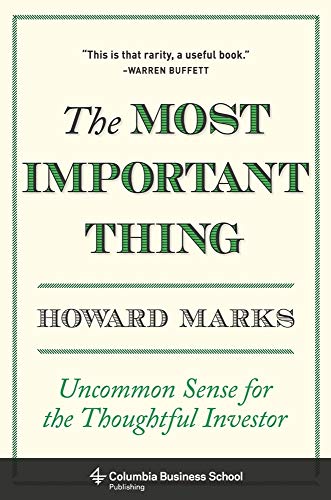
The Most Important Thing: Second-Level Thinking for Risk and Cycles
A Kurums Book Taste review of The Most Important Thing for finance leaders who want Graham's discipline updated with a working investor's scar tissue.
Why this book fits Kurums
Marks built Oaktree on distressed debt - the corner of finance where being wrong is immediately expensive - and this book distills four decades of his client memos into the judgment layer that sits above any valuation technique: how to think about risk you cannot see, cycles you cannot time, and consensus you should not join.
For the Kurums Finance audience it is the natural successor to The Intelligent Investor on the shelf: Graham supplies the foundation, Marks supplies the weather report - what margin of safety feels like in practice when the cycle turns and everyone around you is still celebrating.
What the book argues
The opening chapters establish second-level thinking: first-level thinking says 'it's a good company, buy it'; second-level thinking asks what is already in the price, how the consensus could be wrong, and what you know that others do not. Since markets are pendulums of psychology swinging between greed and fear, superior results require holding a non-consensus view that turns out to be right - which is uncomfortable by definition, because being early and being wrong feel identical for a long time.
The risk trilogy is the book's core: risk is not volatility but the probability of permanent loss; it is highest exactly when it feels lowest (high prices are the main source of risk, and the most dangerous phrase is 'this time it's different'); and risk control is invisible in good times - you can only tell who swam naked when the tide goes out. Marks's insistence that great investing is more about controlling the downside than capturing the upside reads like treasury policy written by a poet.
The cycle chapters apply it: nothing goes in one direction forever, success carries the seeds of failure, and the three stages of a bull market (a few see improvement, most see improvement, everyone believes things improve forever) map onto credit conditions, capex booms, and M&A waves alike. The closing essays on patient opportunism - waiting for the fat pitch rather than swinging constantly - and on the role of luck complete a book that is less a method than a temperament, honestly transmitted.
Key ideas, translated to your desk
Think about what's in the price
A good asset at the wrong price is a bad investment, and vice versa. Before any commitment - acquisition, capex, hire - ask what the current price already assumes.
Risk peaks when it feels absent
Comfort is the signal to tighten standards, not loosen them. Build counter-cyclical discipline into credit limits, covenants, and buffers while the sun is out.
Wait for the fat pitch
You do not have to transact. Patient opportunism - holding standards until the environment serves up an obvious mispricing - outperforms constant activity in investing and in corporate development alike.
Use it at work
- Add a what's-in-the-price memo to every investment and M&A proposal: the assumptions the asking price implies.
- Write cycle-aware credit policy: tighten customer limits and covenant headroom as conditions get euphoric, not after they crack.
- Run the naked-swimmer test on your own balance sheet: what breaks if liquidity disappears for two quarters?
- Keep a decision journal scoring process separately from outcome - Marks's luck chapters are the argument for it.
Read it if
- You allocate capital and want judgment literature, not technique.
- Your board mistakes calm markets for low risk.
- You finished The Intelligent Investor and want the practitioner's sequel.
You can skip it if
- You want models and screens - there is not a single formula here.
- Memo-compilation structure (with repetition) tests your patience.
- You need macro forecasts; Marks's entire point is that you cannot have them.
Discover more from Kurums | Business Intelligence
Subscribe to get the latest posts sent to your email.