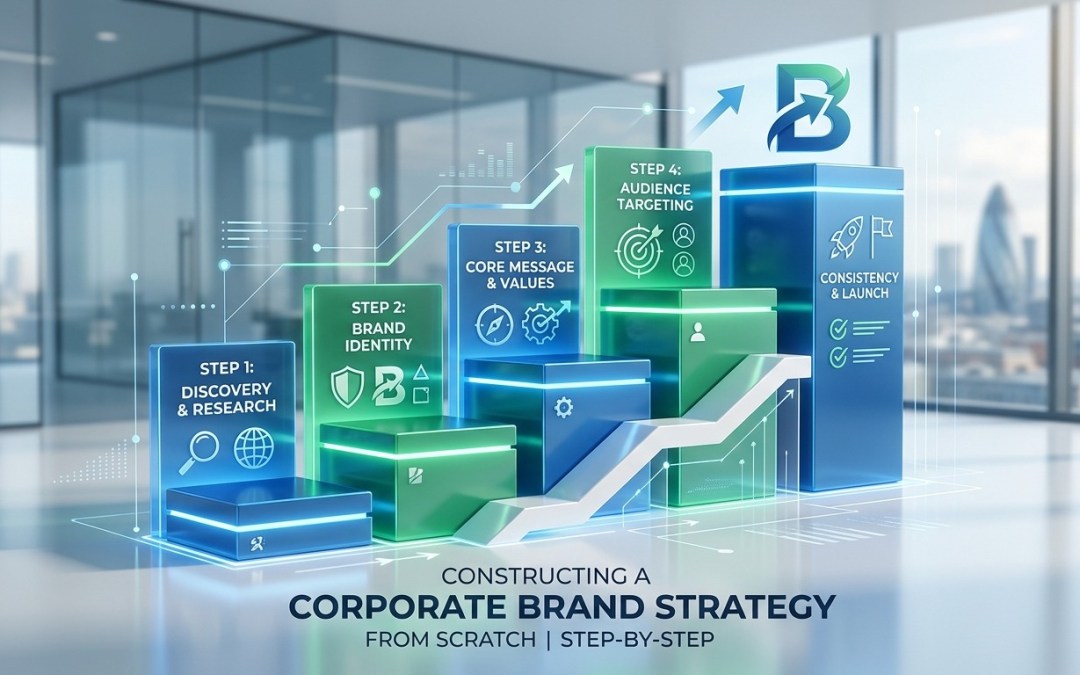
Executive Summary: The Strategic Imperative of Corporate Brand Strategy
In today’s hyper-commoditized and radically transparent global marketplace, a robust corporate brand strategy is no longer merely a function of marketing; it is the central organizing principle of the modern enterprise. This comprehensive guide provides C-level executives with a definitive, highly technical framework for constructing a corporate brand strategy from scratch step by step. We navigate through deep market discovery, precise architectural positioning, omni-channel identity development, and scalable execution roadmaps. By synthesizing historical context, data-driven diagnostic analytics, real-world failure case analyses, and emerging technological trends, this document serves as a master blueprint for transforming intangible brand equity into measurable market capitalization.
The contemporary business ecosystem is defined by unprecedented volatility, complex stakeholder expectations, and rapid technological disruption. In this environment, a product or service advantage is inherently transient. What endures is the enterprise’s cognitive footprint in the minds of investors, employees, and customers. A meticulously engineered corporate brand strategy acts as an enterprise’s ultimate defensive moat and its most potent offensive weapon. It aligns internal culture, dictates external market positioning, mitigates reputational risk, and significantly lowers the cost of capital and customer acquisition. Building this strategy from the ground up requires absolute rigorous discipline, steering clear of superficial aesthetics to focus instead on structural, behavioral, and operational alignment.
1. The Historical Context and Evolution of Corporate Brand Strategy
To understand how to build a brand strategy from scratch step by step today, executives must contextualize its historical evolution. The conceptualization of the “brand” has undergone a radical epistemological shift over the past century, mirroring broader macroeconomic and technological transitions.
From Industrial Trademarks to Intangible Assets
In the post-industrial era of the mid-20th century, branding was largely product-centric. Fast-moving consumer goods (FMCG) pioneers utilized brands primarily as trademarks—visual identifiers designed to signal consistent quality and protect against counterfeiting. The corporate brand was often hidden behind a “House of Brands” architecture, where individual products held the spotlight. The strategic focus was entirely on functional differentiation and mass-market broadcast advertising.
During the 1980s and 1990s, the paradigm shifted toward brand equity. Academics and practitioners began quantifying the financial value of a brand. The realization that a corporate brand strategy could command price premiums and secure customer loyalty led to the elevation of the brand from a tactical marketing asset to a strategic boardroom imperative. Corporate brands started to emerge from the shadows, recognizing that an overarching enterprise reputation could endorse and elevate its entire portfolio of offerings.
The Modern Era: Purpose-Driven Stakeholder Capitalism
Today, the landscape has fundamentally evolved. The proliferation of digital touchpoints, the democratization of information, and the rise of ESG (Environmental, Social, and Governance) mandates have forced corporate brand strategy to become porous and radically transparent. A modern corporate brand is a dynamic ecosystem. It is no longer dictated top-down by corporations but co-created in real-time with global stakeholders. The current methodology for how to build a brand strategy from scratch step by step requires a multidisciplinary approach, integrating organizational psychology, behavioral economics, data science, and systemic operational design.
2. Phase 1: Deep Market Discovery and Diagnostic Analytics
The most critical point of failure in constructing a corporate brand strategy from scratch is relying on executive intuition rather than empirical data. Phase 1 demands an aggressive, unbiased audit of the internal organization, the external market, and the competitive landscape. This phase is not about finding validation for existing assumptions; it is about uncovering systemic dissonances and unexploited market white space.
Internal Stakeholder Alignment and Cultural Audits
A corporate brand is fundamentally an outward projection of internal culture. Therefore, the diagnostic process must begin inward. C-suite consensus is often an illusion masking deep operational silos. Utilizing qualitative depth interviews (QDIs) with the executive board, alongside quantitative cultural surveys deployed across the broader employee base, reveals gaps between perceived brand values and actual organizational behaviors. If the strategic ambition of the corporate brand strategy outpaces the operational reality of the workforce, the resulting brand positioning will be interpreted by the market as inauthentic.
Pro Tip: Implement NLP Sentiment Analysis
When conducting internal surveys or analyzing customer feedback during the discovery phase, utilize Natural Language Processing (NLP) tools. Traditional Likert scales often miss emotional nuances. NLP can ingest thousands of open-ended employee reviews (e.g., Glassdoor data) and customer service transcripts to map the true cognitive resonance and dissonance associated with your enterprise.
Competitive Benchmarking and Market Topology
Understanding the competitive topology requires looking beyond direct market-share rivals to include asymmetric competitors and substitute technologies. The objective is to identify the “Sea of Sameness”—the generic category conventions and corporate jargon that plague your industry—so that your strategy can actively subvert them.
| Discovery Pillar | Traditional Approach | Advanced Data-Driven Approach | C-Suite Outcome |
|---|---|---|---|
| Audience Insight | Demographic segmentation (Age, Title, Geography). | Psychographic & Behavioral mapping (Pain points, Digital footprints). | Actionable alignment of brand messaging with actual buyer intent. |
| Competitor Audit | Visual comparisons and feature-by-feature matrices. | Semantic analysis of competitor messaging and share-of-voice mapping. | Identification of strategic white-space and uncontested positioning. |
| Brand Valuation | Estimated based on historical marketing spend. | ISO 10668 compliant methodologies (Income, Market, Cost approaches). | Quantifiable baseline to measure the ROI of the new strategy. |
3. Phase 2: Architecting Precise Brand Positioning
Once diagnostic data is synthesized, the organization must architect its core strategic positioning. This is the intellectual foundation of the corporate brand strategy. It defines why the organization exists, where it is going, how it behaves, and why it matters to the market. This architecture must be engineered with absolute precision, as it will cascade down into every departmental KPI.
The PVMV Framework: Purpose, Vision, Mission, and Values
The PVMV framework is not an exercise in corporate poetry; it is a mechanism for strategic governance. When building a brand strategy from scratch step by step, executives must distinctively separate these four elements:
- Purpose (The Why): The ultimate philosophical reason the corporation exists beyond generating shareholder returns. It must address a fundamental human or societal need.
- Vision (The Where): The aspirational future state of the world that the company intends to help create. It is the North Star.
- Mission (The What): The concrete, actionable objective the company executes daily to move toward the Vision.
- Values (The How): The non-negotiable behavioral guardrails that govern decision-making, hiring, and operational protocols.
Warning: The Trap of Generic Differentiation
A common failure in corporate brand strategy is the adoption of “table-stakes” attributes as core differentiators. Claiming your brand stands for “Trust,” “Innovation,” or “Customer-Centricity” offers zero competitive advantage. These are the entry tickets to the market, not unique positioning pillars. Your positioning must force a choice; if the opposite of your core value is not a viable strategy for another company, then your value is generic.
Corporate Brand Architecture Strategy
A critical C-level decision is determining the structural relationship between the corporate brand and its subsidiary products, services, or acquired entities. The primary models include:
- Branded House (Monolithic): The corporate brand is the sole dominant identifier (e.g., Google, BMW). This maximizes marketing efficiency and brand equity consolidation but exposes the entire enterprise to localized reputational contagion.
- House of Brands (Pluralistic): The corporate brand is invisible to the consumer, acting only as a holding company for distinct, autonomous product brands (e.g., Procter & Gamble, Unilever). This insulates the corporate entity from product-level crises but requires massive capital to maintain multiple brand equities.
- Endorsed Architecture: A hybrid approach where product brands have their own identities but rely on the corporate brand for credibility and quality assurance (e.g., Marriott Bonvoy, Kellogg’s).
Selecting the optimal architecture requires a deep analysis of M&A (Mergers and Acquisitions) trajectories, target audience overlap, and the financial elasticity of the marketing budget.
4. Phase 3: The Identity System – Visual, Verbal, and Experiential
Positioning is an abstract construct until it is codified into an identity system. However, in a robust corporate brand strategy, “identity” extends far beyond graphic design. It is a comprehensive sensory and experiential matrix that governs every interaction a stakeholder has with the enterprise.
Visual and Semantic Architecture
The visual identity—logomarks, typography, color systems, and spatial design—must be translated from the strategic positioning using neuromarketing principles. For instance, a B2B cybersecurity firm aiming to project impenetrable reliability will leverage high-contrast, structural typography and a restricted, cool-spectrum color palette to subconsciously trigger feelings of security and institutional weight.
Equally critical is the Verbal Identity. A corporate brand must have a codified lexicon. This involves creating a messaging matrix that establishes the brand’s archetype (e.g., The Sage, The Creator, The Ruler) and translates it into a specific tone of voice. This tone must be highly adaptable—capable of speaking to institutional investors in an annual report with authoritative gravitas, while simultaneously engaging prospective talent on LinkedIn with dynamic, visionary rhetoric.
Experiential Branding: Integrating EX and CX
The most elegant visual and verbal identity will fail if it is completely decoupled from the actual experience of dealing with the company. The corporate brand strategy must bridge Employee Experience (EX) and Customer Experience (CX).
If a corporate brand promises “Frictionless Innovation” to the market, but its internal employees are bogged down by archaic, bureaucratic procurement software, the cognitive dissonance will bleed into the customer experience. Brand strategy must therefore influence IT infrastructure, HR onboarding processes, and supply chain logistics. Every touchpoint is a proof point of the brand promise.
5. Phase 4: Developing a Scalable Execution Roadmap
Execution is where most conceptual strategies disintegrate. Transitioning a corporate brand strategy from a boardroom presentation to a globally operationalized reality requires militant governance, phased rollouts, and deeply integrated change management protocols.
Internal Launch Prioritization
A fatal mistake is launching a new brand to the external market before the internal organization has internalized it. Employees are the ultimate brand vectors. The internal rollout must precede the external launch by months. This involves town halls, immersive brand training, and the realignment of employee incentive structures to reward behaviors that support the new brand values. If the sales team is not structurally incentivized to sell the “new” vision, they will default to legacy pitches.
Brand Governance and Technological Infrastructure
To ensure long-term architectural fidelity, enterprises must establish a Brand Steering Committee—a cross-functional group of senior leaders (CMO, CHRO, CIO) responsible for arbitrating brand disputes and overseeing compliance. Furthermore, scalable execution requires enterprise-grade technological infrastructure, specifically a centralized Digital Asset Management (DAM) system. This ensures that every global office, external agency, and channel partner has immediate access to the single source of truth for all brand assets, mitigating the risk of fragmentation.
The C-Suite Execution Checklist
- Establish the Brand Council: Appoint cross-functional executives to govern brand implementation and review quarterly compliance.
- Internal Cultural Rollout: Execute employee immersion programs and align HR performance metrics with the new brand values.
- Audit All Touchpoints: Conduct a comprehensive sweep of legacy materials—from legal contracts and invoices to digital platforms and physical office signage.
- Deploy Enterprise DAM: Integrate a cloud-based Digital Asset Management system to control global brand asset distribution.
- Staggered GTM Strategy: Plan a phased Go-To-Market rollout, prioritizing high-visibility flagship channels before migrating secondary assets.
- Establish Measurement KPIs: Define the dashboard metrics (e.g., Net Promoter Score, Brand Equity Index, Share of Voice, Employee Retention) to track strategy ROI.
6. Real-World Application Scenarios and Failure-Case Analysis
Abstract frameworks must be tested against the unforgiving reality of the market. Analyzing both triumph and disaster provides crucial heuristic value for executives learning how to build a brand strategy from scratch step by step.
Success Scenario: The B2B Tech Metamorphosis
Consider the trajectory of a legacy data-storage hardware company attempting to pivot to cloud-based AI infrastructure. The market viewed them as a commoditized, archaic hardware vendor. Their corporate brand strategy overhaul began not with a logo change, but with a structural repositioning. They adopted a “Creator” archetype, redefining their purpose around “Unleashing the velocity of human data.”
Crucially, they executed an aggressive internal alignment phase. They divested hardware-centric divisions that contradicted the new positioning, upskilled their salesforce to become strategic digital transformation consultants, and completely revamped their visual identity to reflect fluid, dynamic software aesthetics rather than rigid hardware boxes. Because the operational reality shifted in tandem with the brand promise, the market rewarded them with a SaaS-level valuation multiple within 24 months.
Failure Case Analysis: The “Lip-Service” Purpose Trap
Conversely, let us examine a highly publicized failure within the retail banking sector. Attempting to capture younger, values-driven demographics, a multinational bank launched a massive corporate rebranding campaign centered around the purpose of “Financial Democratization and Local Community Empowerment.” They spent hundreds of millions on an external rollout featuring emotional advertisements and a modernized visual identity.
However, they neglected Phase 1 (Diagnostic Audits) and Phase 4 (Execution Alignment). Operationally, the bank simultaneously increased overdraft fees for low-income accounts and closed branches in rural communities—actions directly antithetical to their new brand promise. The market instantly recognized the hypocrisy. Activist groups utilized social media to highlight the dissonance, resulting in a severe reputational crisis, massive PR backlash, and ultimately, the resignation of the CMO. The failure was not in the marketing aesthetic, but in the total disconnect between the corporate brand strategy and the systemic operational reality of the enterprise.
7. Future Trends in Corporate Brand Strategy
A resilient corporate brand strategy must not only solve today’s market challenges but anticipate the disruptions of tomorrow. C-level executives must incorporate emerging macroeconomic and technological vectors into their strategic blueprints.
AI-Driven Dynamic Branding
The integration of Generative AI and advanced machine learning algorithms is fundamentally altering how brand identity is deployed. We are moving toward an era of hyper-personalization, where the visual and verbal manifestations of a corporate brand adapt in real-time to the individual preferences of the user interacting with it. The challenge for future corporate brand strategy will be maintaining core architectural consistency and psychological resonance while allowing the surface-level identity to become fluid and highly contextualized.
ESG as the Core Strategic Pillar
Environmental, Social, and Governance criteria have permanently migrated from the silo of Corporate Social Responsibility (CSR) into the very nucleus of corporate brand strategy. Institutional investors, regulatory bodies, and consumers now demand radical transparency regarding carbon footprints, supply chain ethics, and board diversity. Future brand strategies must be built with quantifiable ESG metrics embedded into their core value propositions. A corporate brand that cannot empirically prove its positive systemic impact will face severe capital starvation and talent attrition.
The Shift to Spatial Computing and Web3
As digital interactions migrate from 2D screens into 3D spatial computing environments and decentralized Web3 ecosystems, the concept of experiential branding will evolve exponentially. Corporate brands will need to define their spatial identities—how they look, sound, and behave in immersive virtual environments. Furthermore, blockchain technologies will enable new forms of brand loyalty and community ownership, shifting the brand relationship from a transactional dynamic to a shared-equity partnership with key stakeholders.
Conclusion
Mastering how to build a corporate brand strategy from scratch step by step is an arduous, multidimensional undertaking that requires unwavering commitment from the highest echelons of leadership. It is not an exercise in aesthetics, but a rigorous discipline of aligning an organization’s deepest operational truths with its most compelling market opportunities. By moving methodically through deep diagnostic discovery, engineering a precise architectural positioning, forging a resonant identity system, and implementing a militant execution roadmap, executives can forge a corporate brand that transcends market volatility. In an era where products can be replicated and features can be reverse-engineered, a structurally sound, authentic corporate brand remains the ultimate, inimitable competitive advantage.
Discover more from Kurums | Business Intelligence
Subscribe to get the latest posts sent to your email.