
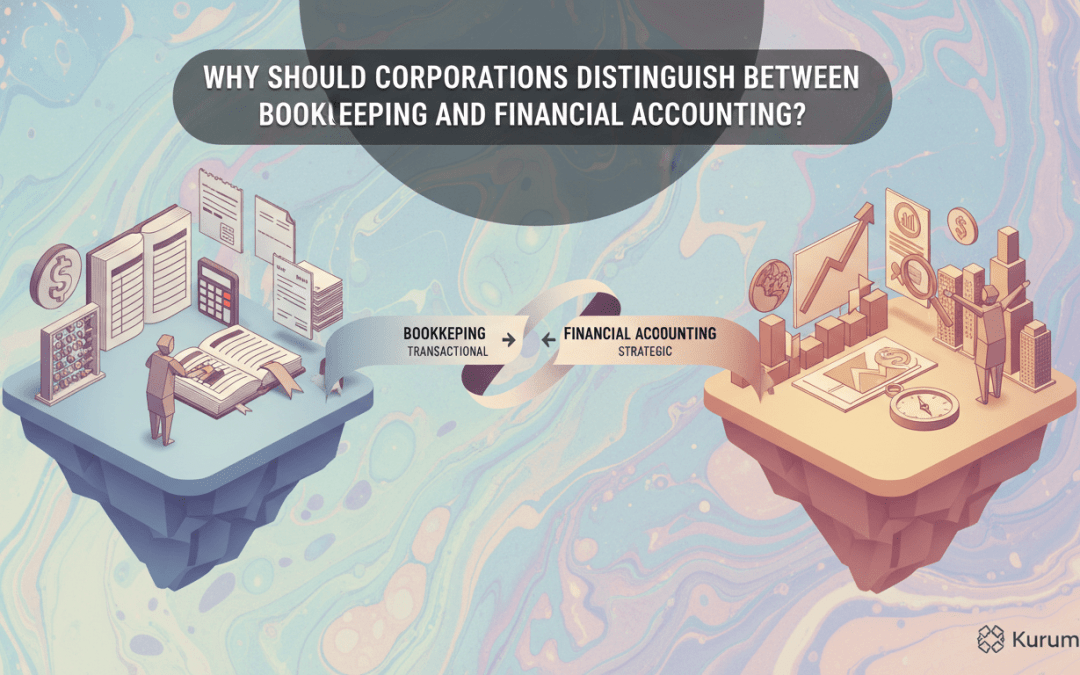
Is your organization merely recording historical events, or is it utilizing data to forecast the next fiscal decade? The tension between mechanical data entry and analytical decision support defines the boundary between a standard clerk and a strategic financial officer. In high-stakes corporate environments, mistaking these two functions results in significant revenue leakage and regulatory risks. While every accountant is technically a bookkeeper, not every bookkeeper possesses the analytical depth of a financial accountant. For the modern corporation, understanding this nuance is not just about semantics—it is about survival in an increasingly complex global economy.
The Fundamental Dichotomy: Data Recording vs. Information Intelligence
At its most basic level, bookkeeping is the administrative function of tracking every dollar that enters or leaves an organization. It is the “what” and “when” of corporate finance. Financial accounting, conversely, is the “why” and “how.” It transforms a mountain of raw data into a coherent narrative that tells the story of a company’s health, viability, and future potential.
Think about it this way: a bookkeeper builds the bricks, but the financial accountant designs the skyscraper. Without high-quality bricks, the building collapses. But without a blueprint, you simply have a pile of materials. In a corporate setting, the bookkeeper manages the ledger, while the financial accountant manages the vision.
The Bookkeeper’s Domain: Ensuring the Integrity of the Ledger
The primary objective of bookkeeping is to maintain an accurate and complete record of financial transactions. This includes everything from payroll processing and invoicing to recording bank statements and managing accounts payable/receivable. In the corporate world, this is often handled by a team of specialists or sophisticated software overseen by a comptroller.
Core Responsibilities of Corporate Bookkeeping
- Recording daily financial transactions with 100% accuracy.
- Maintaining a balanced general ledger through double-entry systems.
- Managing the “Chart of Accounts” to ensure proper categorization.
- Processing payroll and ensuring timely payments to vendors.
- Reconciling bank accounts to identify discrepancies immediately.
But here is the catch. Even the most perfect ledger is useless if it isn’t translated into something actionable. This is where the transition from data entry to financial reporting begins to happen.
Financial Accounting: The Strategic Engine of the C-Suite
Financial accounting takes the data compiled by the bookkeeper and subjects it to rigorous analysis. Accountants use standardized frameworks, such as Generally Accepted Accounting Principles (GAAP) or International Financial Reporting Standards (IFRS), to ensure that the data is comparable, transparent, and legally compliant.
Why does this matter to a CEO or CFO? Because financial accounting provides the “Macro View.” It allows leadership to see patterns that are invisible at the transaction level. For example, a bookkeeper sees 5,000 separate shipping invoices; a financial accountant sees a 12% increase in logistics costs that is eroding the net profit margin.
Direct Comparison: Bookkeeping vs. Financial Accounting
To truly understand why corporations must distinguish between these roles, let’s look at a side-by-side comparison of their operational scopes.
| Feature | Bookkeeping | Financial Accounting |
|---|---|---|
| Primary Focus | Recording and classifying transactions. | Summarizing, analyzing, and reporting. |
| Nature of Work | Transactional and clerical. | Analytical and strategic. |
| Key Deliverable | General Ledger and Trial Balance. | Financial Statements (P&L, Balance Sheet). |
| Compliance Level | Accuracy and internal consistency. | Statutory and regulatory standards (GAAP/IFRS). |
| Time Horizon | Immediate and daily. | Past performance and future forecasting. |
The Hidden Cost of Conflation: Why Using a Clerk for Strategy Fails
Many mid-sized corporations make the mistake of assuming that if their “books are clean,” their “finances are managed.” This is a dangerous fallacy. A bookkeeper can tell you that you spent $2 million on marketing last quarter. Only a financial accountant can tell you whether that $2 million generated a sufficient Return on Assets (ROA) to justify the expenditure to your board of directors.
When you ask a bookkeeper to perform accounting duties, you risk “reporting myopia.” You might be perfectly compliant in your data entry while simultaneously walking into a liquidity crisis because no one was performing a Cash Flow Analysis or calculating Debt-to-Equity ratios.
How Data Entry Practices Impact Strategic Reporting
The quality of your C-level reports is directly proportional to the quality of your initial data entry. This is the “Garbage In, Garbage Out” (GIGO) principle of corporate finance. If a bookkeeper misclassifies a capital expenditure as an operating expense, the resulting financial statement will be fundamentally flawed.
For example, if a major equipment purchase is recorded incorrectly, your EBITDA (Earnings Before Interest, Taxes, Depreciation, and Amortization) will be artificially lowered, making the company look less profitable than it actually is. This can tank a company’s valuation during a merger or acquisition (M&A) process. In this scenario, the bookkeeper made a simple entry error, but the accountant failed to catch and adjust it, leading to a multi-million dollar valuation loss.
The Analytical Bridge: Adjusting Entries and Closing the Books
One of the most technical distinctions between these two fields is the process of “closing the books.” While a bookkeeper manages the daily flow, the accountant handles the month-end or year-end adjustments. These include:
Critical Accounting Adjustments
- Accruals: Recognizing revenue earned but not yet billed, or expenses incurred but not yet paid.
- Depreciation and Amortization: Spreading the cost of long-term assets over their useful life to reflect true economic usage.
- Bad Debt Provisions: Estimating the portion of receivables that may never be collected to maintain a conservative balance sheet.
- Inventory Valuation: Adjusting for shrinkage, obsolescence, or FIFO/LIFO valuation changes.
These adjustments are not “clerical.” They require professional judgment and a deep understanding of the industry’s regulatory environment. Without these, a corporation’s financial health is merely a guess, not a calculation.
Corporate Governance and Investor Relations
For public companies or those seeking private equity, the distinction is even more critical. Investors do not look at ledgers; they look at audited financial statements. A bookkeeper’s work is internal; an accountant’s work is public-facing.
Financial accounting ensures that the corporation speaks the “universal language of business.” If an investor in London wants to compare your performance with a competitor in New York, they rely on the fact that financial accountants have standardized the data according to IFRS or GAAP. If your firm relies only on bookkeeping, your data lacks the credibility required for high-level capital injections.
Technological Synergy: ERPs and the Future of Finance
We are entering an era where the line between bookkeeping and accounting is being blurred by technology—but not in the way you might think. Automated systems like SAP, Oracle, and NetSuite are essentially taking over 90% of traditional bookkeeping tasks.
Does this make accountants obsolete? Quite the opposite. As the “mechanical” part of bookkeeping becomes automated, the “analytical” part of financial accounting becomes more valuable. The modern corporation needs professionals who can audit the AI, interpret the algorithmic outputs, and turn data into “Strategic Foresight.”
| Process | Automation Level | Human Requirement |
|---|---|---|
| Invoice Processing | High (OCR/AI) | Exception handling only. |
| Bank Reconciliation | High (Auto-matching) | Verification of outliers. |
| Tax Planning | Low (Rules-based) | Strategic high-level expertise. |
| Risk Assessment | Moderate (Predictive) | Crucial for decision making. |
Risk Mitigation: The Regulatory and Audit Perspective
In the aftermath of scandals like Enron or Wirecard, the spotlight on corporate financial transparency has never been brighter. Bookkeepers are responsible for the accuracy of the records, but financial accountants are responsible for the truthfulness and fairness of the presentation.
If your corporation faces an external audit, the auditors aren’t just looking for receipts. They are looking for the “internal controls” that only a financial accountant can design. They want to see that there is a separation of duties, that reconciliations are reviewed by a second party, and that the financial statements accurately reflect the company’s obligations.
Strategic Decision Support: Beyond the Balance Sheet
The final reason why corporations must distinguish between these roles is the need for “What-If” analysis. A bookkeeper deals in “What Is.” A financial accountant deals in “What If.”
Want to expand into the European market? A bookkeeper will record the costs of the new office. A financial accountant will model the currency risk, analyze the tax implications of a foreign subsidiary, and calculate the “Break-Even Point” for the new venture. This level of insight is what separates companies that scale from companies that stagnate.
Why Corporations Fail When These Roles Are Blurred
- Lack of Internal Controls: Without an accountant’s oversight, simple bookkeeping errors can mask embezzlement or theft.
- Inaccurate Valuation: Investors lose confidence when financial statements require frequent restatements.
- Compliance Penalties: Missing a regulatory filing deadline or failing a GAAP audit can lead to massive fines.
- Poor Cash Flow Management: Recording sales is easy; managing the timing of cash inflows to meet obligations requires accounting expertise.
- Operational Inefficiency: Without data analysis, companies continue to fund underperforming departments simply because the “books look okay.”
Conclusion: Building a Robust Financial Ecosystem
The distinction between bookkeeping and financial accounting is not merely a matter of job titles; it is a structural necessity for any corporation aiming for long-term growth. Bookkeeping provides the essential foundation of raw data, while financial accounting provides the strategic intelligence required to navigate complex global markets.
If your organization is currently treating these two functions as one, you are flying blind with a very precise speedometer. You might know exactly how fast you are going, but you have no idea where the road is leading. To thrive, you must invest in both: the meticulous accuracy of professional bookkeeping and the visionary analysis of financial accounting.
Are you ready to elevate your corporate finance from simple recording to strategic intelligence? Start by auditing your current financial workflow. Ensure that your data entry is automated, your compliance is handled by experts, and your C-level decisions are backed by rigorous financial analysis. The future of your corporation depends on the clarity of your vision—don’t let a lack of accounting depth cloud your perspective.
Discover more from Kurums | Business Intelligence
Subscribe to get the latest posts sent to your email.