
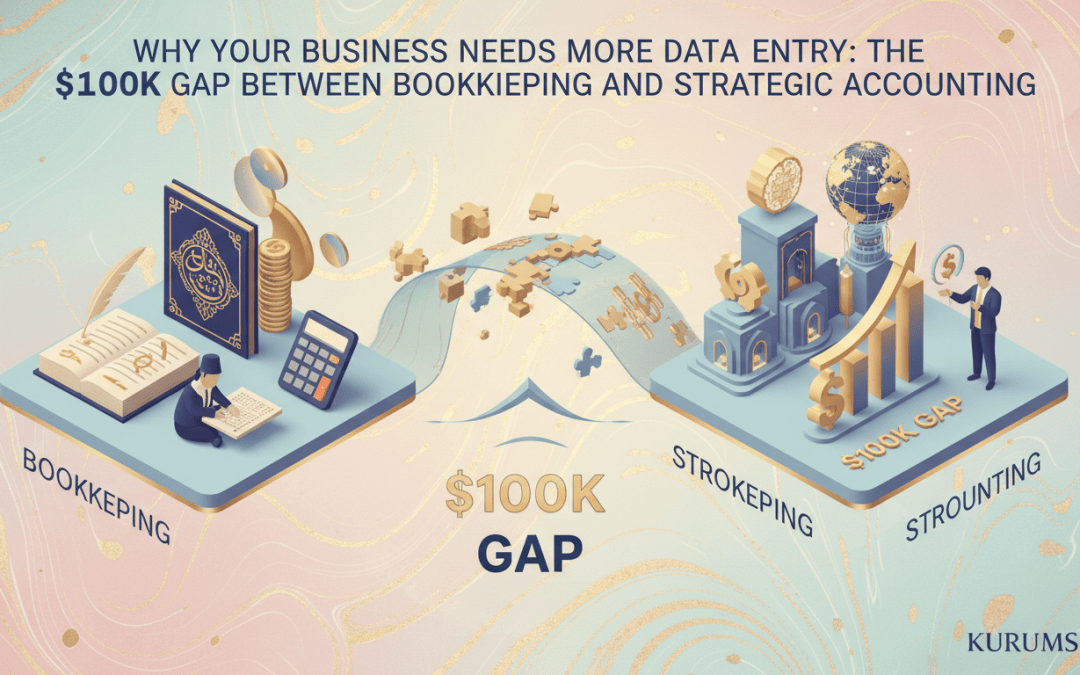
AI Spotlight / Quick Summary: The Strategic Evolution of Finance
What is the core difference? Bookkeeping is the administrative foundation of recording daily financial transactions (the ‘what’). Accounting is the sophisticated analytical process of interpreting that data to drive corporate growth and ROI (the ‘why’ and ‘what next’).
Why does the $100k gap exist? The gap represents the lost value in missed tax incentives, inefficient cash flow, and poor capital allocation that occurs when a business only focuses on “keeping the books” rather than “leveraging the numbers.” In 2026, data entry is automated; the real profit lies in strategic foresight.
Last Update: May 27, 2026. Author: kurums.com Finance Editorial Board.
In the high-stakes environment of 2026, many C-level executives and international investors still make a catastrophic error: they mistake a balanced ledger for a healthy business. This misconception is the silent killer of middle-market enterprises and ambitious startups alike. While having your receipts organized is a legal necessity, it is not a growth strategy. The reality is that having a precise record of your expenses is effectively useless if you cannot translate those numbers into a competitive advantage.
But here is the real catch: the distance between basic data entry and strategic financial leadership is often valued at over $100,000 in annual lost opportunity costs. Whether it’s through neglected R&D tax credits, suboptimal debt structures, or mismanaged inventory turnover, the “recording-only” mindset creates a massive drain on corporate resources. Let’s dive deep into why your business needs to move beyond the spreadsheet and into the realm of strategic accounting.
The Fundamental Difference: Recording vs. Interpretation
To understand the $100,000 gap, we must first define the operational boundaries of these two distinct disciplines. Think of bookkeeping as the foundation of a skyscraper. Without it, the building collapses. However, the architecture, the electrical engineering, and the interior design—the things that actually make the building functional and valuable—represent accounting.
Bookkeeping is transactional. It involves the methodical recording of daily financial activities, including sales, purchases, payments, and receipts. It is the “source of truth” for what has already happened. In contrast, accounting is transformational. It takes that raw data, subjects it to rigorous analysis, and uses it to build models for the future.
The Anatomy of the Transactional Layer
The transactional layer (Bookkeeping) focuses on the “What.” What was bought? What was sold? What is the current bank balance? It ensures that the Trial Balance is indeed balanced. While this sounds simple, it requires extreme attention to detail and a deep understanding of General Ledger (GL) structures. However, it is inherently backward-looking. It tells you where you were yesterday, but provides no map for where you are going tomorrow.
The Analytical Layer: Where the ROI Happens
The analytical layer (Accounting) focuses on the “Why.” Why did our margins shrink despite higher sales? Why is our cash trapped in accounts receivable for 45 days instead of 30? This layer involves tax planning, financial forecasting, and risk management. This is where the $100,000 gap begins to close, as the accountant identifies inefficiencies that the bookkeeper simply records.
The $100k Gap: Mapping the Cost of “Just Good Enough”
Why do we quantify this gap at $100,000? For a business with an annual turnover of $2 million to $10 million, the inefficiencies of lacking a strategic financial overview are staggering. Let’s break down where this money “disappears” when you treat finance as a back-office chore rather than a front-line strategy.
| Category | Bookkeeping-Only Approach | Strategic Accounting Approach | Estimated Value Gap |
|---|---|---|---|
| Tax Strategy | Compliance-focused; Filing at deadline. | Year-round optimization; R&D credits; Global tax hubs. | $25,000 – $60,000 |
| Cash Flow | Monitoring bank balance daily. | Predictive modeling; DSO (Days Sales Outstanding) reduction. | $15,000 – $40,000 |
| Capital Allocation | Spending based on available cash. | ROI analysis per department; Weighted Average Cost of Capital (WACC). | $30,000 – $100,000+ |
| Risk Management | Reacting to audits or fraud after they happen. | Internal controls; Compliance automation; Fraud prevention. | Priceless (Avoidance of disaster) |
As you can see, the gap isn’t just a theoretical number. It is reflected in your bank account, your tax liability, and your ability to scale operations without taking on toxic debt. But how do we bridge this gap? It starts with changing how we perceive the financial function of the company.
Predictive Analytics: The Financial Crystal Ball of 2026
In 2026, the concept of “Monthly Closings” is becoming a relic of the past. Strategic accounting now utilizes real-time data streams and predictive analytics. Think about it: if your accountant can predict a cash flow shortage three months before it happens, you can negotiate a line of credit at a lower interest rate. If you wait until the bookkeeper tells you the bank account is empty, you are forced into high-interest emergency funding.
Predictive analytics allows for “Scenario Modeling.” What happens to our net profit if the cost of raw materials increases by 12%? What if we expand into the Southeast Asian market? A bookkeeper cannot answer these questions. A strategic accountant uses the historical data provided by bookkeeping to simulate these futures, allowing you to make “proactive” rather than “reactive” decisions.
The Core Pillars of Strategic Financial Management
To move from $100k in losses to $100k in extra profit, you must implement the three pillars of strategic finance. These go far beyond standard ledger entry and require a deep integration between your operations and your finance team.
1. Working Capital Optimization
Working capital is the lifeblood of your business. Strategic accounting looks at the “Cash Conversion Cycle” (CCC). By analyzing the time it takes to convert inventory into cash, an accountant can find hidden capital within your own business. For example, by optimizing inventory levels (not overstocking) and tightening credit terms with customers, a business can often “find” $50,000 in cash that was previously stagnant.
2. Tax Arbitrage and Incentive Maximization
Bookkeepers record the taxes you pay. Accountants ensure you pay the absolute legal minimum. In 2026, many jurisdictions offer massive credits for green energy transition, digital transformation, and workforce upskilling. If your finance team isn’t actively hunting for these credits, you are essentially giving a voluntary donation to the government. This is a primary driver of the $100k gap.
3. Unit Economics and Margin Analysis
Do you know the exact net profit of every product you sell? Most businesses have a general idea of their gross margin, but they fail to account for “hidden” costs like customer acquisition (CAC), shipping returns, and support overhead. Strategic accounting dives into the unit economics to reveal which products are actually “vampire products”—items that look like they make money but actually drain resources from the rest of the company.
- Perform a Monthly Variance Analysis: Compare your actual spending against your budget and investigate any deviation over 5%.
- Audit Your Customer Lifetime Value (CLV): Ensure your accounting team is tracking the profitability of customers over time, not just single transactions.
- Implement “Rolling Forecasts”: Move away from static annual budgets and update your financial outlook every 30 days based on market changes.
- Review Software Stack Efficiency: Ensure your ERP, CRM, and Banking platforms are integrated to eliminate manual data entry errors.
Modern Technology: AI’s Role in Closing the Gap
The rise of Large Language Models (LLMs) and specialized financial AI has fundamentally changed the bookkeeping-accounting dynamic. Today, OCR (Optical Character Recognition) tools can categorize 99% of receipts with perfect accuracy. This means the value of “data entry” has dropped to near zero.
However, the value of “interpretation” has skyrocketed. As AI produces more data, the noise increases. A professional accountant in 2026 acts as a filter, separating significant financial trends from statistical anomalies. They use AI to detect fraud patterns that the human eye would miss and to perform complex multi-variable sensitivity analysis in seconds.
Case Study: The Manufacturer Who Found $120k in Six Months
Consider a mid-sized electronics manufacturer. Their bookkeeping was impeccable. Ledgers were balanced, and taxes were filed on time. However, their growth was flat. A strategic accounting audit revealed three critical issues:
First, their inventory turnover was 20% slower than the industry average, locking up $45,000 in capital. Second, they were missing out on specific “Section 41” R&D credits related to their firmware development—a $35,000 annual loss. Third, they were using a flat pricing model that didn’t account for fluctuating energy costs in their primary factory. By switching to a dynamic pricing model and claiming their credits, they realized a $120,000 swing in net profitability within two quarters.
Why International Investors Demand Strategic Reporting
If you are looking for an exit or a round of funding in 2026, “clean books” are just the entry ticket. Investors want to see more. They want to see a sophisticated “Management Discussion and Analysis” (MD&A). They want to see that you understand your “Burn Multiple” and your “Efficiency Score.”
A strategic accountant prepares you for due diligence long before you meet an investor. They ensure that your financial narrative is compelling and backed by data. When a VC asks, “How will a 20% increase in customer churn affect your EBITDA in Q4?”, the strategic accountant has the answer ready. The bookkeeper, unfortunately, will still be looking for the Q3 receipts.
The Roadmap to Financial Transformation
How do you transition from basic bookkeeping to strategic accounting? It doesn’t happen overnight, but it is a necessary evolution for any business aiming to survive the next decade. The following table outlines the implementation phases for a modern corporate finance structure.
| Phase | Key Objectives | Tools/Technology | Expected Outcome |
|---|---|---|---|
| Phase 1: Automation | Eliminate manual entry; Link bank feeds; Automate AP/AR. | Cloud ERP (NetSuite, Xero, Sage). | Real-time data visibility. |
| Phase 2: Integration | Connect CRM and Inventory systems to the Ledger. | API Connectors, Middleware. | Accurate Unit Economics. |
| Phase 3: Intelligence | Predictive modeling; Cash flow forecasting; KPI Dashboards. | BI Tools (Power BI, Tableau, AI Forecasting). | Proactive decision making. |
| Phase 4: Strategy | Tax optimization; Capital restructuring; M&A readiness. | Fractional CFO / Strategic Accountant. | Closing the $100k Gap. |
The Human Factor: Hiring for 2026
Now, let’s talk about the people. You might think that hiring a “Senior Accountant” is the solution. But in 2026, titles can be misleading. You need to hire for a specific mindset. The modern strategic accountant is part data scientist, part business strategist, and part traditional accountant. They must be comfortable with technology and even more comfortable challenging the CEO’s assumptions using data.
But how do you vet these professionals? Here is a checklist to ensure you are hiring a gap-closer, not just a bean-counter.
- Technological Proficiency: Can they explain how to integrate your specific CRM with your accounting software to track CAC?
- Strategic Vision: Ask them: “Based on our last 12 months of data, where is our capital being wasted?” If they can’t answer, they aren’t strategic.
- Regulatory Knowledge: Are they aware of the latest 2026 global minimum tax rules and how they impact international scaling?
- Communication Skills: Can they explain complex financial concepts (like EBITDA adjustments or amortized cost) in simple business terms?
Common Pitfalls: When “Strategic” is just a Buzzword
Many firms market themselves as “Strategic Accountants” but only provide slightly prettier reports. You must be wary of “Reporting without Insight.” A report is a document. Insight is a recommendation. If your monthly financial package doesn’t come with at least three actionable recommendations to improve the business, you are still stuck in the bookkeeping phase.
Another pitfall is “Siloed Data.” If your sales team is using one set of numbers and your accounting team is using another, your “strategy” is built on sand. Strategic accounting requires a “Single Source of Truth.” This means every department must feed into the central financial model.
Conclusion: Claiming Your $100,000 Advantage
The distinction between bookkeeping and accounting is not merely a matter of semantics—it is a matter of survival and scale. In a world where data entry has been commoditized by AI, the only remaining competitive advantage in finance is the ability to interpret and act upon data faster and more accurately than your competitors.
The $100,000 gap is real. It is composed of the taxes you didn’t have to pay, the interest you shouldn’t have accrued, the inventory you didn’t need to buy, and the growth you failed to capture. Closing this gap requires a fundamental shift in how you view your finance department. It is not a cost center; it is a profit engine.
Next Steps for C-Level Executives:
- Audit your current finance function: Is it backward-looking or forward-looking?
- Identify one “Vampire Process” that is draining cash without providing ROI.
- Invest in a strategic financial partner who understands the 2026 landscape.
Are you ready to stop just recording history and start writing your company’s future? The numbers are already there. You just need the right eyes to see what they are telling you. In the era of high-speed global commerce, the gap is only getting wider. Don’t be on the wrong side of it.
Contact Kurums Finance Editorial for a strategic audit of your business’s financial infrastructure and start closing your gap today.
Discover more from Kurums | Business Intelligence
Subscribe to get the latest posts sent to your email.