
Procurement and purchasing software for businesses
Procure-to-pay and purchasing software for requisitions, approvals, purchase orders, catalogues, receiving and invoice matching, from lightweight purchasing tools to full source-to-pay suites. Every company below is listed free by our editors, A–Z — no one pays for a position, and you can request a listing by email.
All procurement solutions
Editor-compiled · A to Z · request a listingBasware
Finnish procure-to-pay and accounts payable automation provider with e-invoicing network.
Coupa
Business spend management platform covering procurement, invoicing, expenses and supplier management.
Ivalua
Configurable source-to-pay platform from France for complex, multi-entity procurement.
JAGGAER
Source-to-pay suite used in manufacturing, higher education and the public sector.
Levelpath
Procurement platform unifying intake, sourcing, contracts and supplier management.
Oracle Procurement
Procurement applications within Oracle Fusion Cloud ERP for requisitions, sourcing and contracts.
Precoro
Purchasing software for requisitions, purchase orders, budgets and three-way matching.
Procurify
Canadian purchasing and spend control software for mid-market organisations.
SAP Ariba Procurement
Procure-to-pay suite and supplier network, commonly paired with SAP ERP environments.
Tradogram
Cloud procurement software for small and mid-sized buyers, including supplier bidding.
Unimarket
New Zealand source-to-pay software with eProcurement, marketplace and supplier onboarding.
Zip
Intake-to-procure platform that routes purchase requests through approvals and existing systems.
Zycus
Source-to-pay suite from India covering eProcurement, invoices, contracts and sourcing.
Not on this list yet? Getting listed is free. Email [email protected] with your name, website and a one-line description and our editors will review it. How to get listed · Listing policy.
Prefer to start free? See Free Purchase Order Software · Free Spend Analysis Templates & Tools — verified free plans, scored by Kurums.
What does procurement software actually do?
Procurement software controls how money leaves the business before an invoice arrives. An employee raises a requisition, it is routed for approval based on amount, budget and category, a purchase order is sent to the supplier, goods or services are received, and the invoice is matched to the order and receipt before payment. That sequence is usually called procure-to-pay, or P2P.
Around this core sit features such as punch-out catalogues from approved suppliers, budget checks, contract-linked pricing, supplier onboarding and spend reporting. The aim is to make the compliant route the easiest one, so employees buy from agreed suppliers at agreed prices instead of using cards and invoices nobody approved.
For finance, the payoff is committed-spend visibility: knowing what has been ordered but not yet invoiced, which makes accruals, forecasts and budget control far more reliable.
Do you need a full source-to-pay suite, a purchasing tool or an intake layer?
Scope decisions drive cost and implementation time more than any feature comparison.
| Option | What it covers | Typical fit |
|---|---|---|
| Source-to-pay suite | Sourcing, contracts, supplier management, P2P and invoicing in one platform | Large or multi-entity organisations with dedicated procurement teams |
| Purchasing / P2P tool | Requisitions, approvals, POs, receiving, matching and budgets | Mid-sized companies needing spend control without a large project |
| Intake and orchestration layer | A single front door for requests, routed to legal, security, finance and existing systems | Companies whose ERP handles POs but whose request process is chaotic |
Also check what your ERP already includes. Many ERPs have purchasing modules that are adequate for simple needs; the gap is often user experience and approval routing rather than the transaction itself.
The choice is not permanent, but switching later is costly, because supplier records, catalogues and approval rules all have to be rebuilt.
What should you compare before you shortlist?
Test these with your own approval matrix and at least one real supplier catalogue.
| Criterion | What to ask |
|---|---|
| Approval workflows | Can rules combine amount, cost centre, category, entity and budget without custom code? |
| ERP integration | Is there a proven connector for your ERP, and which data syncs in which direction and how often? |
| Catalogues and punch-out | Are punch-out and hosted catalogues supported for your main suppliers? |
| Matching and invoices | Does it support two- and three-way matching, tolerances and non-PO invoices? |
| Multi-entity and currency | Can it handle several legal entities, currencies and tax regimes in one instance? |
| User experience | Can an occasional requester raise a request in a couple of minutes without training? |
| Reporting | Can finance see committed spend, budget consumption and maverick spend by department? |
Ask to see the approval builder live, using your own thresholds and cost centres, rather than a pre-configured demo. How long it takes an administrator to change a rule tells you a lot about day-to-day ownership after go-live.
How is procurement software priced?
Lighter purchasing tools are generally sold on annual subscriptions by number of users, sometimes with separate tiers for requesters and approvers, or bands of purchase orders per month. Suites and enterprise platforms are more often priced on company revenue, spend under management or module count, with multi-year contracts and implementation delivered by the vendor or a partner.
Budget for more than licences: ERP integration, catalogue set-up, supplier enablement, data cleansing of the supplier master and change management often cost as much as the first year of subscription. Supplier networks may also charge suppliers transaction fees, which some will pass back through prices.
Clarify licence definitions early. Some vendors count every employee who can raise a request as a user, while others charge only for approvers and buyers, which changes the total cost dramatically in organisations where many people buy occasionally.
What usually goes wrong?
Employees route around the system. If requesting a purchase is slower than paying on a card or asking a supplier to invoice directly, people will do exactly that. A no-PO-no-pay policy, enforced by accounts payable, is usually what makes adoption stick, but it only works once the process is genuinely easy.
Approval chains become too long. Organisations replicate every paper sign-off in software, so low-value requests wait days for four approvers. Set thresholds so that small, budgeted purchases from preferred suppliers flow through quickly, and focus scrutiny where the risk is.
Finally, dirty supplier data undermines everything. Duplicate supplier records, outdated bank details and inconsistent categories break matching and reporting. Clean and deduplicate the supplier master before go-live, and define who owns it afterwards.
Implementation scope also creeps. Rolling out every module and entity at once is a common reason projects run late; a phased launch with one entity and core P2P first is usually safer.
Frequently asked questions
What is the difference between procurement and accounts payable software?
Procurement software manages spend before the invoice: requests, approvals and purchase orders. AP automation manages the invoice itself: capture, coding, approval and payment. Many P2P tools include both, but specialist AP tools can sit alongside an ERP's purchasing module.
What is three-way matching?
It compares the purchase order, the goods receipt and the supplier invoice before payment. If quantities or prices differ beyond an agreed tolerance, the invoice is held for review, which prevents paying for goods not ordered or not delivered.
How long does implementation take?
A purchasing tool for a single entity can go live within weeks. Source-to-pay suites across several countries and ERPs usually take many months, with supplier enablement and integration testing driving most of the timeline. Plan supplier communication early, because suppliers must also adapt to new purchase order formats and invoice rules.
Do we still need procurement software if our ERP has a purchasing module?
Not always. If the module handles your approvals well and requesters find it usable, it may be enough. Companies typically add a separate tool when the ERP is too complex for occasional users or cannot handle intake and multi-step reviews. The real test is whether requesters prefer it to email.
How this directory is compiled
Every company on this page was added by our editors from publicly available information: the product name, what it does in one line, and a link to the vendor's own site. No company paid to be listed in the free section, none was asked for approval, and inclusion here is not a recommendation — it is a starting point for a shortlist you should verify yourself.
No position on this page can be bought: the list is always alphabetical and every entry is free. Advertising on kurums.com appears only in clearly labelled ad units, separate from the listings, and has no influence on our editorial guides or on the Kurums Trust badges, which are earned against published criteria and are never for sale.
Pricing, feature and availability details change constantly in these categories, so we deliberately keep vendor descriptions here short and factual, and leave verified pricing to the dated editorial comparisons. Check the vendor’s own pricing page before you make a decision, and treat anything you read in a directory — including this one — as a list of candidates rather than an answer.
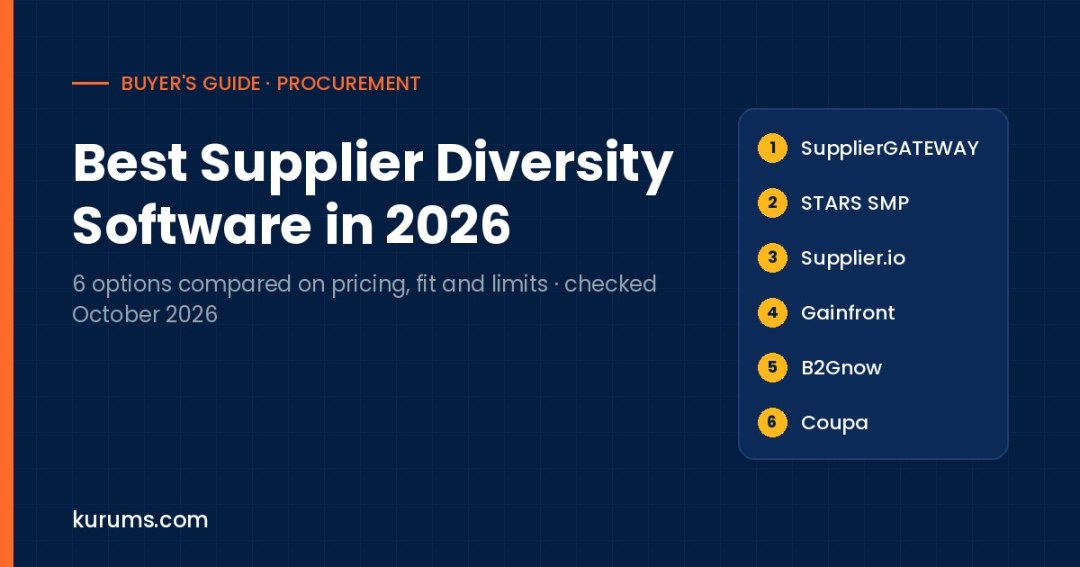
Best Supplier Diversity Software in 2026: Spend and Tier 2 Tools Compared
Six supplier diversity and small business spend platforms compared on pricing, certification data, Tier 2 reporting and fit, with a neutral note on the changing US policy context.
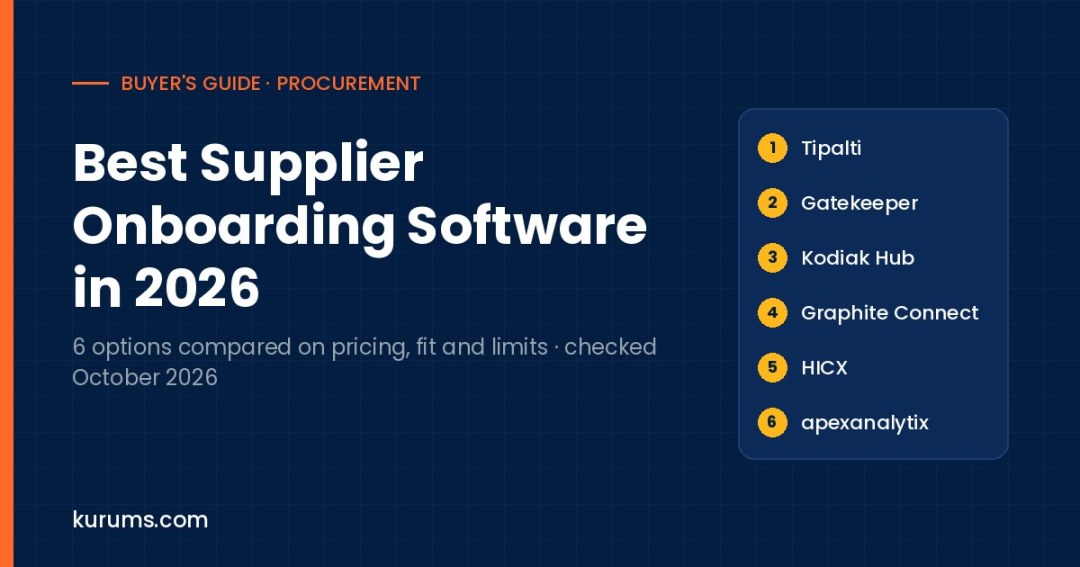
Best Supplier Onboarding Software in 2026: Portals and Validation Compared
Six supplier onboarding and supplier information management tools compared on pricing, portals, bank and tax validation and ERP sync, with prices checked in October 2026.
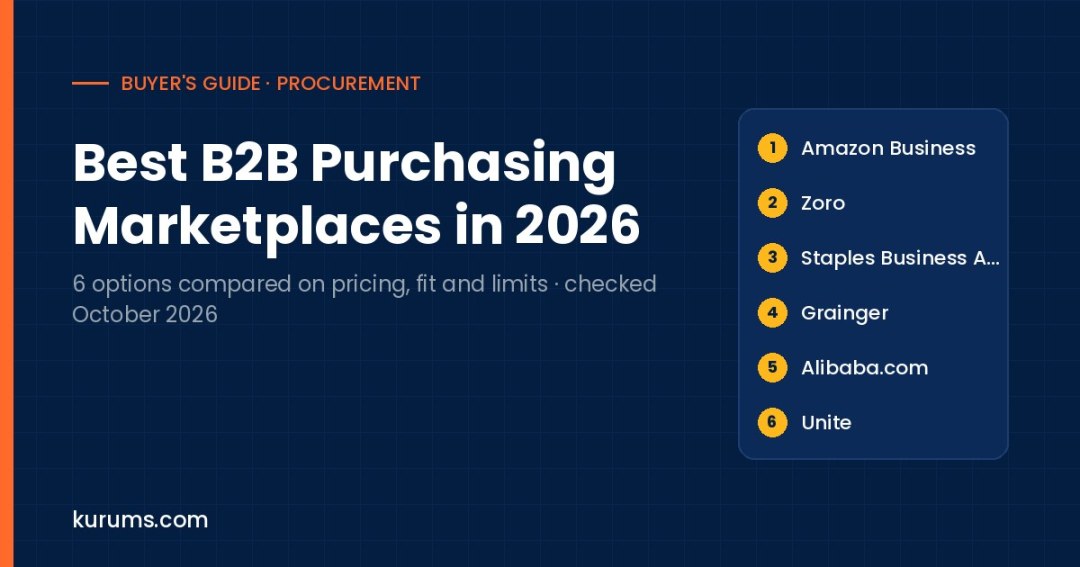
Best B2B Purchasing Marketplaces in 2026: Tail Spend Options Compared
Six business buying marketplaces and distributor platforms compared on membership fees, payment terms, eProcurement integration and catalog fit, with prices checked in October 2026.