
Accounts payable automation software for finance teams
Software that captures supplier invoices, codes and routes them for approval, matches them to purchase orders and pays suppliers, replacing manual data entry and email approval chains in the payables process. Sponsored listings are paid placements ordered by daily bid; every other company below is listed free by our editors.
Sponsored listings
Claim #1 · $5/dayPick your daily bid and 7, 15 or 30 days, pay once through iyzico, and you are live the moment the payment clears. No account to create first, no subscription, no stored card.
Today's board
Paid today · resets 00:00 UTC · all categoriesAll accounts payable automation solutions
Free listings · A to Z · sponsor yours from $5/dayAvidXchange
AP and payment automation for mid-market companies, with a strong focus on real estate and construction.
Basware
Finnish AP automation and e-invoicing network for large organisations handling high invoice volumes.
BILL
Bill capture, approvals and supplier payments for small and mid-sized businesses and accounting firms.
Coupa
Spend management platform covering procurement, invoicing and payments for larger organisations.
Esker
French provider of source-to-pay and order-to-cash automation, including invoice processing.
Medius
Swedish-origin AP automation and spend management with invoice capture, matching and approvals.
Ramp Bill Pay
Bill capture, approvals and supplier payments bundled into Ramp's spend management platform.
Rossum
Czech document processing platform used to capture and validate supplier invoices for AP teams.
Stampli
Invoice-centric AP automation that keeps approver communication attached to each invoice.
Tipalti
Payables automation with supplier onboarding, tax form collection and global mass payments.
Vic.ai
Invoice processing that predicts coding and approvals to reduce manual review in AP.
Yooz
Cloud purchase-to-pay automation with invoice capture and approvals for small and mid-sized firms.
Sell in this category? List your product — from $5/day, one payment, no account or stored card. How it works.
What does accounts payable automation actually do?
AP automation covers the journey of a supplier invoice from arrival to payment. Invoices arrive by email, supplier portal, e-invoicing network or paper; the software extracts header and line data, suggests general ledger coding, checks for duplicates, routes the invoice to the right approvers and, where purchase orders exist, matches invoice lines against the PO and goods receipt. Approved invoices sync to the accounting system and are scheduled for payment.
Most platforms also handle supplier onboarding: collecting bank details, tax forms and contacts, and verifying changes. That piece matters more than it looks, because fraudulent bank detail changes are one of the most common ways companies lose money through payables.
The best tools also give finance a live view of liabilities: which invoices are waiting for approval, which are approved but unpaid, and what cash will leave the business over the coming weeks. That visibility helps with cash planning, capturing early-payment discounts and answering supplier queries without digging through inboxes.
Do you need an AP point solution, a procure-to-pay suite or your ERP's own module?
The right scope depends on how much of your spend runs through purchase orders and how complex your approvals and entities are.
| Option | What you get | Typical fit |
|---|---|---|
| AP point solution | Invoice capture, coding, approvals and payments, connected to your existing accounting system. | Companies with mostly non-PO invoices that want quick wins without changing purchasing. |
| Procure-to-pay suite | Requisitions, purchase orders, receiving, invoicing and payments in one flow with supplier portals. | Larger organisations where most spend should be pre-approved through POs and catalogues. |
| ERP-native AP module | Invoice workflows built into the ERP, often extended with a capture add-on. | Teams on a modern ERP that prefer one vendor and have the in-house skills to configure it. |
| Spend platform with bill pay | Bill payments alongside corporate cards and reimbursements in one tool. | Smaller companies that want cards, expenses and supplier payments managed together. |
If fewer than a third of your invoices have a PO, a three-way matching engine will sit mostly idle. Fix purchasing discipline first, or buy for the invoices you actually receive.
What should you compare before you shortlist?
Send each vendor a sample of your real invoices, including the awkward ones, and judge them on these points.
| Criterion | What to ask |
|---|---|
| Capture accuracy | What share of our sample invoices were extracted correctly at line level, and how are exceptions shown to the team? |
| Matching logic | Does it support two- and three-way matching with tolerances, partial receipts and multiple POs per invoice? |
| Approval workflows | Can routing depend on amount, entity, department, cost centre and supplier, and can approvers act from mobile or email? |
| ERP sync | Is the integration two-way for suppliers, POs, coding values and payment status, and how are sync errors surfaced? |
| Payment options | Which rails are supported (local transfers, international wires, cheques, virtual cards) and in which currencies? |
| Supplier fraud controls | How are bank detail changes verified, and are duplicate invoices and suspicious suppliers flagged automatically? |
| E-invoicing compliance | Does it receive and send structured e-invoices in the formats required in the countries where you operate? |
How is AP automation priced?
Pricing usually combines a platform subscription with a volume element: a per-invoice fee, tiers by annual invoice count, or per-user licences for approvers and processors. Payment-led vendors may charge low software fees and earn instead from transaction fees on payments, foreign exchange margins or interchange on virtual cards paid to suppliers. Enterprise suites add implementation services and fees for connecting additional entities or ERPs.
Be explicit about who pays for what. Some vendors pass fees on to suppliers, which can cause friction with key partners, and FX margins on international payments are easy to overlook in a proposal.
Check contract terms on volume too: overage fees if invoice counts grow faster than forecast, minimum commitments, and whether archived invoices remain accessible, and exportable, if you switch providers.
What usually goes wrong?
Many projects start without a baseline. If you do not measure cycle time, cost per invoice and exception rates before go-live, it is hard to prove value later or spot where the new process is stalling.
Supplier master data is the usual culprit. Duplicate supplier records, outdated bank details and missing tax identifiers break matching and payment runs, so clean the vendor file before migration, not after.
Approval routing is often over-engineered. Replicating every exception from the old email process creates chains that stall invoices for weeks. Start with a small number of rules based on amount and cost centre, then add complexity only where the data shows it is needed.
Capture accuracy on the demo rarely matches production. Multi-page invoices, credit notes, foreign-language documents and supplier statements need human review, so plan staffing for the exception queue rather than assuming touchless processing from day one.
Finally, suppliers are forgotten. If you change payment methods or ask suppliers to submit through a portal, communicate early and keep a fallback channel; otherwise invoices go missing and relationships suffer.
Frequently asked questions
How many invoices a month justify AP automation?
There is no hard threshold, but teams processing a few hundred invoices a month with multiple approvers usually see clear time savings. Below that, the bill-pay features inside an accounting or spend platform may be enough. Complexity, such as multiple entities or currencies, matters as much as volume.
Can AP automation fully eliminate manual invoice entry?
It can remove most keying, but some invoices will always need review: unusual layouts, credit notes, invoices without PO references and new suppliers. Realistic goals focus on reducing touches per invoice and shortening approval time rather than reaching zero human involvement.
Does AP automation work with purchase orders?
Most platforms support two-way matching of invoice to PO and three-way matching including goods receipt, with configurable tolerances. The benefit depends on how consistently your organisation raises POs before buying. Where PO usage is low, coding suggestions and approval routing deliver more value.
How do these tools reduce payment fraud?
Common controls include verified supplier onboarding, alerts or call-back steps when bank details change, duplicate invoice detection and segregation of duties between who approves and who releases payment. They reduce risk but do not remove the need for clear internal procedures.
How this directory is compiled
Every company on this page was added by our editors from publicly available information: the product name, what it does in one line, and a link to the vendor's own site. No company paid to be listed in the free section, none was asked for approval, and inclusion here is not a recommendation — it is a starting point for a shortlist you should verify yourself.
The block at the top of the page is different and is labelled as such. Positions there are paid: a company chooses a daily bid and a number of days, pays once, and sits above the free listings for that period, ordered by bid. That is advertising, it is disclosed on every listing, and it has no influence on our editorial comparisons or on the Kurums Trust badges, which are earned against published criteria and are never for sale.
Pricing, feature and availability details change constantly in these categories, so we deliberately keep vendor descriptions here short and factual, and leave verified pricing to the dated editorial comparisons. Check the vendor’s own pricing page before you make a decision, and treat anything you read in a directory — including this one — as a list of candidates rather than an answer.
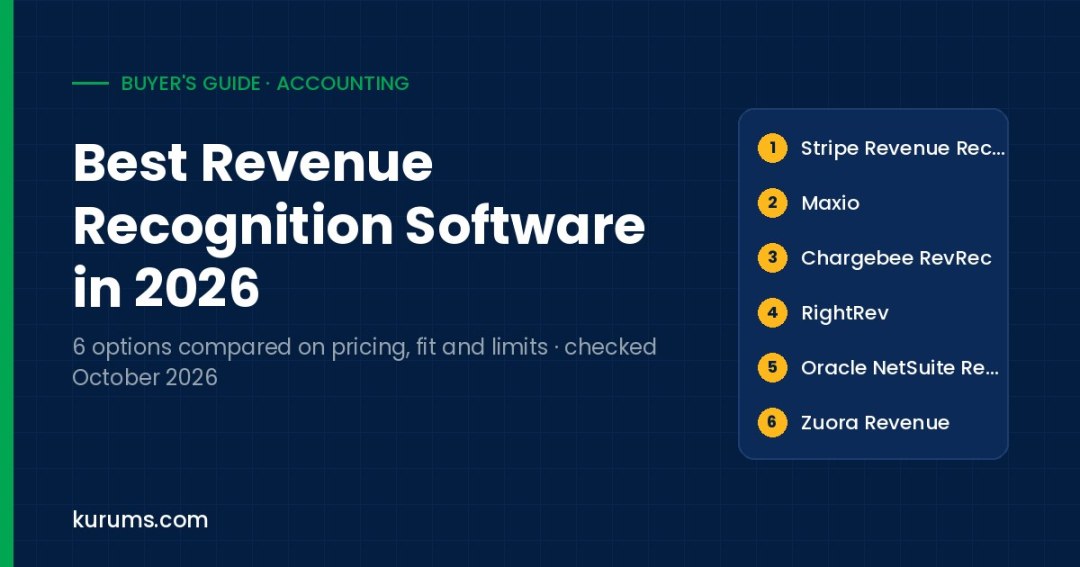
Best Revenue Recognition Software in 2026: ASC 606 Tools Compared
Six ASC 606 and IFRS 15 revenue recognition tools compared on published pricing, recognition logic, integrations and audit trails, from Stripe-native to enterprise subledgers.
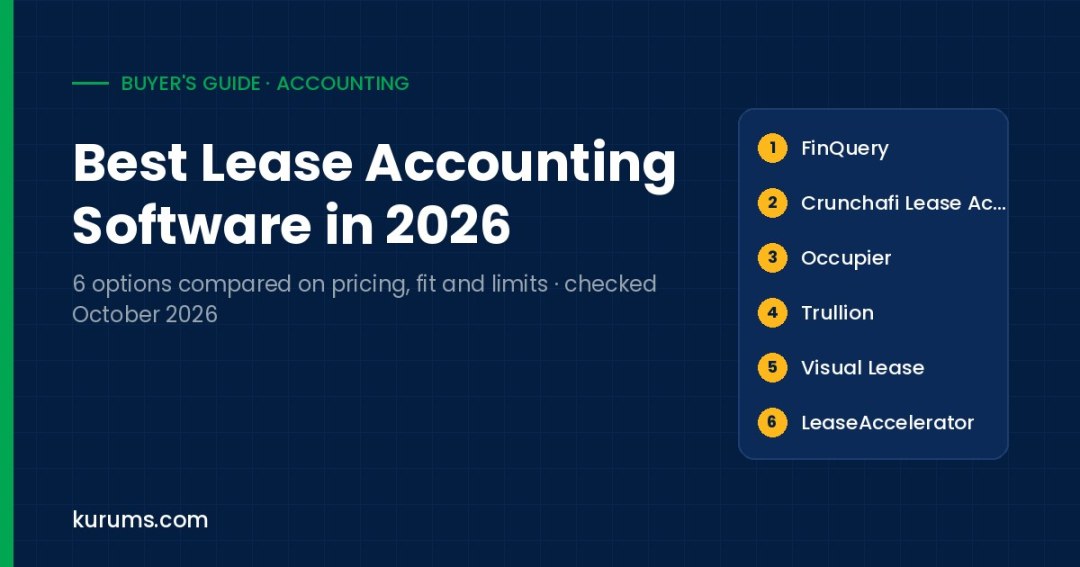
Best Lease Accounting Software in 2026: ASC 842 and IFRS 16 Compared
Six ASC 842, IFRS 16 and GASB 87 lease accounting tools compared on pricing model, free options, standards, ERP integration and audit controls.
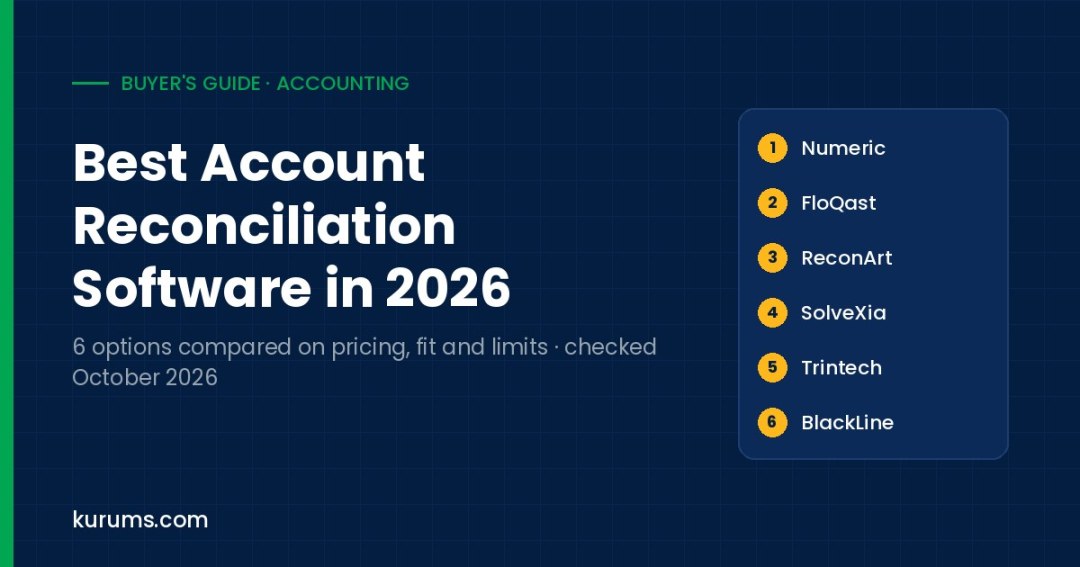
Best Account Reconciliation Software in 2026: Close Tools Compared
Six account reconciliation and close tools compared on pricing model, matching automation, ERP integrations and audit controls, from mid-market to global enterprise.