
HRIS and core HR software for growing and established organisations
HRIS and core HR platforms hold the employee record of truth: personal and job data, organisation structure, contracts, absence, documents, self-service and HR workflows, often linking to payroll, benefits and talent tools. Sponsored listings are paid placements ordered by daily bid; every other company below is listed free by our editors.
Sponsored listings
Claim #1 · $5/dayPick your daily bid and 7, 15 or 30 days, pay once through iyzico, and you are live the moment the payment clears. No account to create first, no subscription, no stored card.
Today's board
Paid today · resets 00:00 UTC · all categoriesAll HRIS and core HR solutions
Free listings · A to Z · sponsor yours from $5/dayBambooHR
Core HR software for small and mid-sized businesses, with hiring, onboarding and performance tools.
Cezanne HR
UK-based cloud HR software for mid-sized organisations with multi-country requirements.
Dayforce
Single-platform HR, payroll, workforce management and benefits for mid-sized and large employers.
Factorial
Spanish HR software for small and mid-sized businesses, covering time off, documents and performance.
HiBob
HR platform for mid-sized, multi-country companies, covering core HR, performance and compensation.
Oracle Fusion Cloud HCM
Cloud HCM suite with global HR, workforce management and talent modules for large enterprises.
Paycom
Single-database HR and payroll software for US employers of various sizes.
Paylocity
Cloud HR and payroll suite for US mid-sized employers, with engagement and workforce tools.
Personio
German all-in-one HR software for European small and mid-sized companies.
Rippling
Unified platform linking HR, payroll, IT device and app management around one employee record.
SAP SuccessFactors
Enterprise HCM suite covering core HR, payroll and talent management for multinational organisations.
UKG
HR, payroll and workforce management software, strong in shift-based and hourly workforces.
Workday HCM
Cloud human capital management suite for large and global enterprises, with finance options.
Zoho People
Cloud HR management software for employee records, attendance, leave and self-service.
Sell in this category? List your product — from $5/day, one payment, no account or stored card. How it works.
What does an HRIS actually do?
A human resources information system (HRIS) is the authoritative record of who works for you, in what role, on what terms and reporting to whom. Core HR features typically include employee profiles, organisation charts, contract and job history, absence and leave, document storage, e-signatures, employee and manager self-service, and approval workflows for changes such as promotions or transfers.
Its real job is to be the source that everything else reads from. Payroll, benefits, IT access, recruiting, learning and performance tools all depend on accurate starters, movers and leavers data. When the HRIS is wrong or late, errors show up everywhere else, from incorrect pay to former employees keeping system access.
Self-service is where most day-to-day value appears. Employees update their own details and request leave, managers approve changes and see their team's absence, and HR stops acting as a manual data-entry desk. The better platforms also keep an effective-dated history, so you can answer who was in which role, on what salary, on a given date.
Should you buy a full HCM suite or a core HRIS with best-of-breed tools?
This decision shapes cost, implementation effort and how HR works for years, so settle it before comparing vendors.
| Approach | Strengths | Typical fit |
|---|---|---|
| Enterprise HCM suite | Global data model, deep configuration, security roles and integrated talent and payroll modules | Large or multinational organisations with complex structures |
| All-in-one mid-market HR platform | Faster deployment, modern interface, core HR plus common modules in one subscription | Companies of roughly 50 to 2,000 employees with standard processes |
| Core HRIS plus best-of-breed tools | Choose the strongest recruiting, learning or performance tools and integrate them | Organisations with a specific area where depth matters more than one vendor |
| HR bundled with payroll provider | Single vendor for pay and records, simpler compliance for one country | Smaller employers operating mainly in one payroll jurisdiction |
Best-of-breed only works if you own the integrations. Budget for them and name an internal owner, or the promised flexibility turns into duplicated data.
Whichever route you take, decide early where payroll sits. For single-country employers a bundled HR and payroll product is often simplest; for multi-country employers, the HRIS usually feeds several local payroll providers, and the quality of those connections matters more than any core HR feature.
What should you compare before you shortlist?
Test vendors against your messiest real processes, not the demo script.
| Criterion | What to ask |
|---|---|
| Organisation modelling | Can it represent our legal entities, cost centres, matrix reporting and positions without workarounds? |
| Country coverage | Are local fields, leave types, documents and language support available for every country we employ in? |
| Payroll connection | Is payroll native, a certified integration or a file export, and how are mid-period changes handled? |
| Workflows and permissions | Can we configure approvals and field-level access ourselves, or does every change need the vendor? |
| Reporting | Can HR build headcount, turnover and absence reports with effective dating, without exports? |
| Integrations and API | Which identity, finance and talent systems have maintained connectors, and what are the API limits? |
| Implementation model | Who implements: the vendor, a partner or us, and what is included in the quoted scope? |
How is HRIS software priced?
Nearly all vendors charge per employee per month, billed annually. Mid-market platforms usually sell a core HR package with optional modules such as performance, compensation, recruiting or workforce management at additional per-employee rates. Enterprise suites often set minimum annual commitments, multi-year terms and substantial implementation fees, frequently delivered by consulting partners. Payroll, where offered, may be priced per country or per payslip.
Check how inactive records, contractors and seasonal workers are counted, because that can move the bill materially.
Negotiate price protection at renewal and agree how module prices change as you add countries or entities. Early discounts on core HR are common, and the real price often appears when you expand.
What usually goes wrong?
Data migration is underestimated almost every time. Legacy records carry inconsistent job titles, missing managers and historic contracts nobody has checked, and cleaning them takes far longer than configuring the software. Start data clean-up before the contract is signed.
Other common problems include replicating every old process instead of simplifying, launching without manager training so self-service goes unused, and treating integrations with payroll and identity management as a later phase. Leavers whose system access is not revoked, and pay errors after a promotion, are usually symptoms of integrations that were never finished. Clear ownership of HR data after go-live matters as much as the platform choice.
Finally, do not neglect reporting. If headcount, turnover and absence figures from the new system do not match finance's numbers, leadership will stop trusting the HRIS quickly. Agree definitions with finance before go-live and reconcile the first few months carefully.
Frequently asked questions
What is the difference between an HRIS, HCM and HRMS?
The terms overlap and vendors use them loosely. HRIS usually means the core employee record and administration, while HCM describes a broader suite adding talent management, workforce planning and often payroll. HRMS is commonly used as a synonym for either, so compare actual modules rather than labels.
At what company size do you need an HRIS?
Many organisations adopt one somewhere between 20 and 50 employees, when spreadsheets and shared folders stop being reliable for leave, documents and approvals. The trigger is usually compliance risk or manager workload rather than a specific headcount.
How long does HRIS implementation take?
Small-business platforms can be live in a few weeks. Mid-market deployments commonly take two to four months, and enterprise HCM programmes across several countries often run six to eighteen months. Data quality and decision-making speed drive the timeline more than the software.
Does an HRIS include payroll?
Some do natively, some integrate with a separate payroll provider, and some only export data. For multi-country employers, payroll is often handled by local or global payroll partners connected to the HRIS, so ask exactly how changes flow between the two. Ask to see an actual change, such as a mid-month salary increase, flow through end to end.
How this directory is compiled
Every company on this page was added by our editors from publicly available information: the product name, what it does in one line, and a link to the vendor's own site. No company paid to be listed in the free section, none was asked for approval, and inclusion here is not a recommendation — it is a starting point for a shortlist you should verify yourself.
The block at the top of the page is different and is labelled as such. Positions there are paid: a company chooses a daily bid and a number of days, pays once, and sits above the free listings for that period, ordered by bid. That is advertising, it is disclosed on every listing, and it has no influence on our editorial comparisons or on the Kurums Trust badges, which are earned against published criteria and are never for sale.
Pricing, feature and availability details change constantly in these categories, so we deliberately keep vendor descriptions here short and factual, and leave verified pricing to the dated editorial comparisons. Check the vendor’s own pricing page before you make a decision, and treat anything you read in a directory — including this one — as a list of candidates rather than an answer.
Best Workforce Planning Software in 2026: Pricing & Comparison
Buyer's guide · HR Best Workforce Planning Software in 2026: Pricing & Comparison We compared four workforce planning platforms on public pricing, scenario modelling, headcount tools and fit so you can shortlist two in ten minutes. By Kurums EditorialPricing checked...
Best Employee Experience Software in 2026: Pricing & Comparison
Buyer's guide · HR Best Employee Experience Software in 2026: Pricing & Comparison We compared four employee experience and engagement platforms on public pricing, free or trial options, survey and performance modules, and deployment model so HR and people teams can...
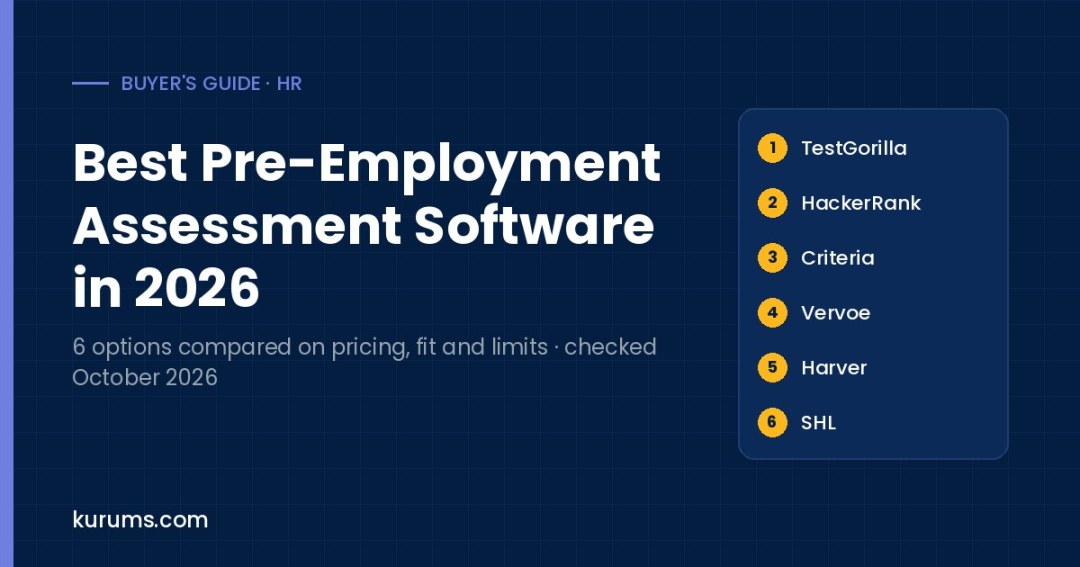
Best Pre-Employment Assessment Software in 2026: Skills Tests Compared
Six pre-employment assessment platforms compared on pricing, free plans and trials, test libraries, AI scoring and the hiring volumes they suit.