
Entity and board management software for company secretaries and governance teams
Entity management systems that keep subsidiary records, officers, shareholdings and filing deadlines in order, alongside board portals for secure meeting packs, minutes, approvals and director communication. Sponsored listings are paid placements ordered by daily bid; every other company below is listed free by our editors.
Sponsored listings
Claim #1 · $5/dayPick your daily bid and 7, 15 or 30 days, pay once through iyzico, and you are live the moment the payment clears. No account to create first, no subscription, no stored card.
Today's board
Paid today · resets 00:00 UTC · all categoriesAll entity and board management solutions
Free listings · A to Z · sponsor yours from $5/dayAdmincontrol
Nordic board portal and secure data room provider for boards, owners and transactions.
Athennian
Canadian entity management platform for legal, tax and finance teams managing corporate records and ownership.
Azeus Convene
Board portal for paperless meetings, resolutions and minutes, used by corporate and public-sector boards.
Board Intelligence
UK board portal and report-writing platform focused on improving the quality of board papers.
Boardable
Board management tool for non-profits and associations, covering meetings, documents, polls and member engagement.
BoardEffect
Board portal designed for non-profit, education, healthcare and public-sector boards and committees.
CSC Entity Management
Entity management software and services for tracking subsidiaries, officers, filings and registered agent obligations.
Diligent
Governance platform combining board portal, entity management and GRC tools for boards and company secretaries.
Harbor Compliance
US entity compliance software and services for registrations, annual reports and licence tracking across states.
iBabs
Dutch board and meeting management software for boards, councils and committees across Europe.
Nasdaq Boardvantage
Board portal from Nasdaq for meeting books, annotations, voting and secure director messaging.
OnBoard
Board management software for agendas, board books, minutes and approvals across corporate and non-profit boards.
Sherpany
Swiss meeting management software for boards and executive committees, covering preparation, decisions and follow-up.
Sell in this category? List your product — from $5/day, one payment, no account or stored card. How it works.
What do entity and board management tools actually do?
They solve two related governance problems. Entity management software is the system of record for your legal structure: every subsidiary, its registered address, directors and officers, share capital, ownership chain, statutory registers and filing calendar. It produces organisation charts, powers-of-attorney lists and the evidence banks, auditors and regulators ask for during onboarding or due diligence.
Board portals handle the meetings those entities hold. The company secretary builds an agenda, compiles the board pack, and publishes it to directors on a secure app where they can annotate, vote, sign resolutions and read minutes. Good portals replace emailed PDFs, which are a genuine security and version-control risk for price-sensitive material.
The link between the two is decision data. Minutes and resolutions approved on the portal should update the entity record, for example when a director is appointed, and filing deadlines should drive the meeting calendar. Groups with dozens of subsidiaries feel that connection most keenly.
Integrated governance suite or separate specialist tools?
Most buyers start from one pain point and discover the other later. Decide early whether you want one vendor for both jobs.
| Approach | Strengths | Typical fit |
|---|---|---|
| Integrated governance suite | One login and data model for entities, boards and sometimes GRC; fewer integrations to maintain | Listed or multinational groups with many subsidiaries and a central company secretarial team |
| Specialist board portal | Polished director experience, fast rollout, often strong local support and hosting | Single boards, non-profits and firms whose entity structure is simple |
| Specialist entity management | Deeper corporate records, ownership modelling and filing workflows, sometimes bundled with registered agent services | Legal and tax teams running complex multi-jurisdiction structures |
Suites reduce duplication but can be weaker in one half than a dedicated product. Specialists often integrate adequately if you define which system owns director and entity data, and stick to it.
Also consider who else touches the data. Tax teams need ownership percentages for transfer pricing and substance reviews, treasury needs authorised signatory lists for bank mandates, and finance needs the entity list for consolidation. A tool that can publish read-only views to those teams saves a surprising number of ad hoc requests.
What should you compare before you shortlist?
Involve at least one director and one member of the tax or legal team in demos, as their priorities differ sharply.
| Criterion | What to ask |
|---|---|
| Director experience | Can a busy non-executive open, annotate and approve a pack offline on a tablet without training? |
| Security and hosting | Where are board documents hosted, who at the vendor can access them, and can we choose the data region? |
| Entity data model | Does it handle our jurisdictions, share classes, indirect ownership and historical changes over time? |
| Compliance calendar | Are statutory filing deadlines pre-loaded for our countries, and who keeps them up to date? |
| Resolutions and signatures | Are written resolutions, electronic signatures and voting records acceptable under the laws of our main jurisdictions? |
| Reporting | Can we generate org charts, officer lists and registers on demand in formats banks and auditors accept? |
| Retention and exit | How are archived minutes preserved, and can we export complete records if we switch vendors? |
How is entity and board management software priced?
Board portals are usually sold as annual subscriptions priced by the number of boards, committees or named users, with administrators sometimes charged differently from directors. Non-profit and public-sector tiers are common, as are extra charges for modules such as board evaluations or questionnaires.
Entity management platforms more often price by number of entities under management, sometimes with user caps. Vendors that also act as registered agent or provide company secretarial services may bundle software with service fees, which makes like-for-like comparison harder. Data migration from spreadsheets or a legacy system is frequently a separate project fee.
Ask how prices move when you add entities through acquisitions, and whether dormant or dissolved companies still count towards the licence. For portals, check whether former directors lose access automatically and whether archived boards keep incurring fees.
What usually goes wrong?
Entity projects fail on data quality. Records are migrated from years-old spreadsheets with wrong appointment dates, missing share transfers and dissolved companies still marked active. The system then generates confidently wrong org charts. Verify records against official registers before go-live, starting with the entities that matter most to banks and regulators.
Board portals fail on adoption at the top. If the chair keeps asking for printed packs or directors forward papers to personal email, the security case collapses. Secure agreement from the chair and give directors hands-on onboarding, not a PDF manual.
Another common gap is local legal validity. Electronic resolutions, remote meetings and digital signatures are treated differently across jurisdictions and articles of association. Confirm what your constitutional documents allow before assuming every approval can move online.
Finally, split ownership causes drift. When legal, tax and the company secretary each keep their own version of director lists, the system of record loses authority. Name one owner for entity data and make every other team read from it.
Frequently asked questions
What is a board portal?
A board portal is a secure application where directors receive meeting agendas and papers, annotate documents, vote, sign resolutions and access minutes. It replaces emailed or printed board packs and keeps a controlled archive of what each director saw and when.
Do small companies need entity management software?
A company with one or two entities can usually manage records in its corporate register and a filing calendar. Dedicated software starts to pay off once you run several subsidiaries across jurisdictions, face frequent due diligence requests or have missed a statutory deadline.
Can one platform handle both boards and entities?
Some governance suites cover both, which avoids duplicate director data. Others specialise in one area. Choose based on which problem is costlier today and whether the suite is genuinely strong in the half you need most.
Are electronic board resolutions legally valid?
In many jurisdictions they are, provided your articles of association and local company law permit written or electronic resolutions and the signature method meets local requirements. Rules differ between countries, so confirm with your legal advisers for each jurisdiction where you hold entities.
How this directory is compiled
Every company on this page was added by our editors from publicly available information: the product name, what it does in one line, and a link to the vendor's own site. No company paid to be listed in the free section, none was asked for approval, and inclusion here is not a recommendation — it is a starting point for a shortlist you should verify yourself.
The block at the top of the page is different and is labelled as such. Positions there are paid: a company chooses a daily bid and a number of days, pays once, and sits above the free listings for that period, ordered by bid. That is advertising, it is disclosed on every listing, and it has no influence on our editorial comparisons or on the Kurums Trust badges, which are earned against published criteria and are never for sale.
Pricing, feature and availability details change constantly in these categories, so we deliberately keep vendor descriptions here short and factual, and leave verified pricing to the dated editorial comparisons. Check the vendor’s own pricing page before you make a decision, and treat anything you read in a directory — including this one — as a list of candidates rather than an answer.
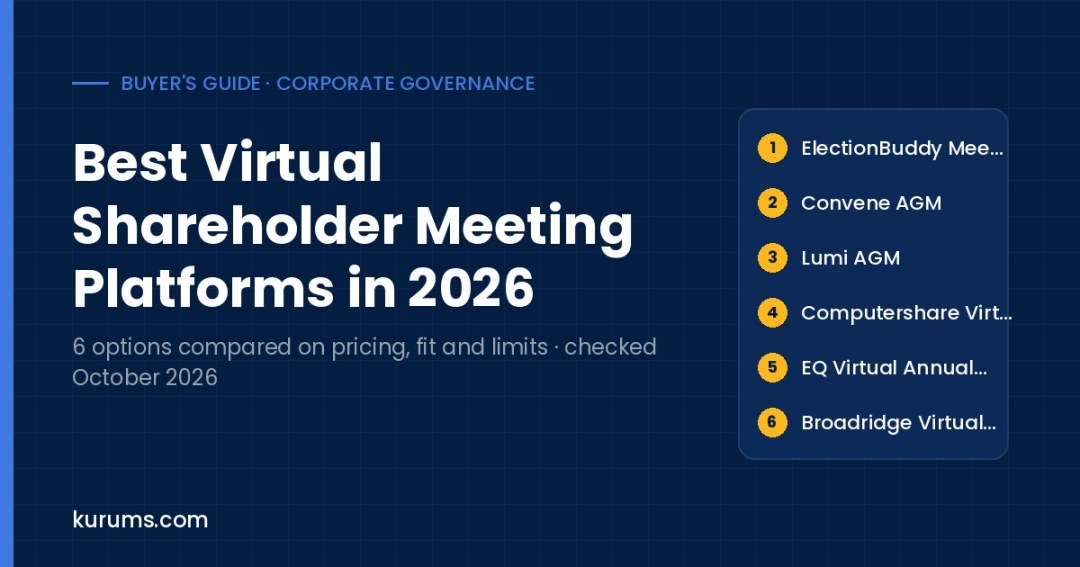
Best Virtual Shareholder Meeting Platforms in 2026: AGM Options Compared
Six platforms for virtual and hybrid shareholder meetings compared on pricing, voting, Q&A, registry integration and the size of company each one fits.
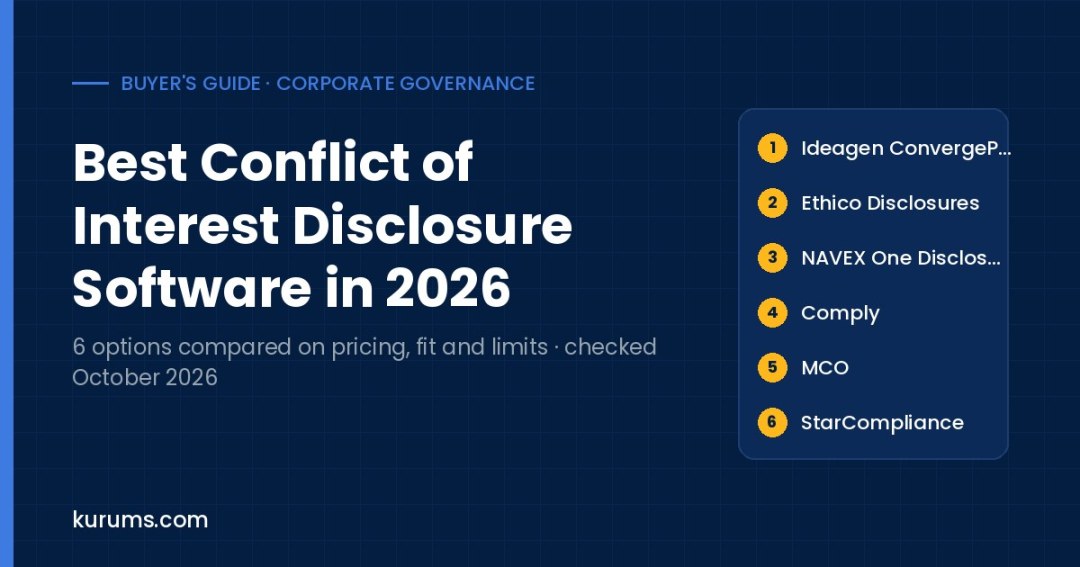
Best Conflict of Interest Disclosure Software in 2026: COI Tools Compared
Six conflict of interest disclosure tools compared on campaigns, review workflows, gifts and outside activity tracking, financial services modules and pricing model.
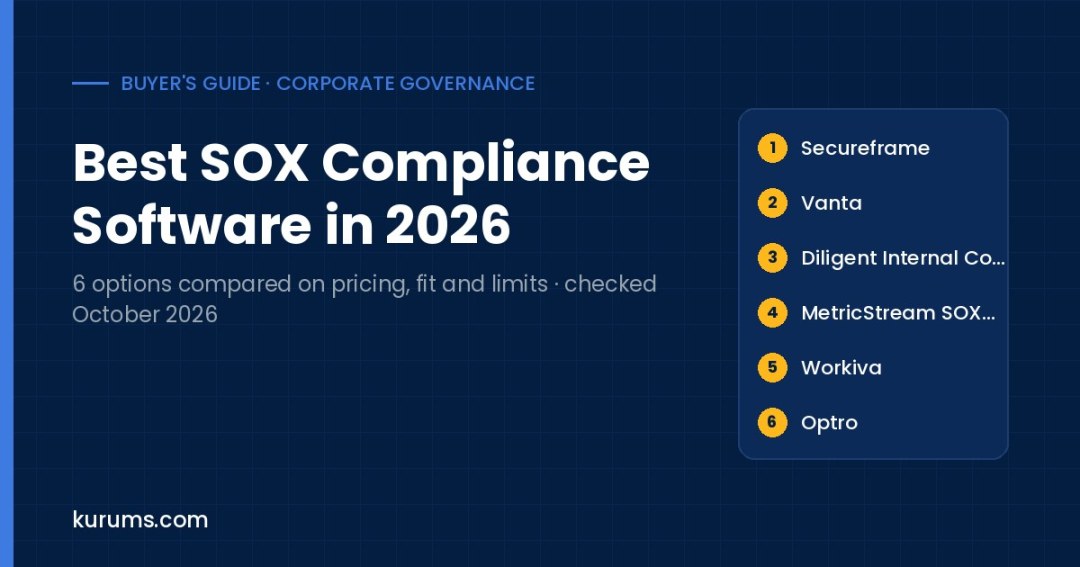
Best SOX Compliance Software in 2026: Internal Controls Tools Compared
Six SOX compliance platforms compared on scope, from ITGC automation for pre-IPO companies to full SOX 404 programs with AI-assisted testing for large issuers.