
Accounting software for small and mid-sized companies
Accounting platforms that run the general ledger, invoicing, bank reconciliation, reporting and month-end close for small and mid-sized companies, from cloud bookkeeping tools to mid-market financial suites. Sponsored listings are paid placements ordered by daily bid; every other company below is listed free by our editors.
Sponsored listings
Claim #1 · $5/dayPick your daily bid and 7, 15 or 30 days, pay once through iyzico, and you are live the moment the payment clears. No account to create first, no subscription, no stored card.
Today's board
Paid today · resets 00:00 UTC · all categoriesAll accounting software solutions
Free listings · A to Z · sponsor yours from $5/dayAcumatica
Cloud ERP with financials and industry editions, priced on resources rather than named users.
Exact Online
Dutch cloud accounting and business software for SMEs and accounting firms across Europe.
FreeAgent
UK-focused accounting for sole traders and small limited companies, including tax filing features.
FreshBooks
Invoicing-led accounting for freelancers and service businesses that bill time and projects.
Microsoft Dynamics 365 Business Central
Microsoft's SME ERP covering finance, purchasing, inventory and projects, usually sold through partners.
MYOB
Accounting, payroll and business management software for companies in Australia and New Zealand.
Odoo Accounting
Open-source accounting module that plugs into Odoo's modular ERP for sales, stock and projects.
Oracle NetSuite
Cloud ERP with core financials, multi-subsidiary accounting and operations modules for growing companies.
QuickBooks Online
Cloud bookkeeping, invoicing and reporting for small businesses and their accountants.
Sage Intacct
Cloud financial management with multi-entity consolidation and dimensional reporting for mid-sized companies.
Wave
Basic accounting and invoicing for very small businesses, with paid payments and payroll add-ons.
Xero
Cloud accounting with bank feeds, invoicing and a large app marketplace for small businesses.
Zoho Books
Online accounting with invoicing, inventory basics and tight links to the wider Zoho suite.
Sell in this category? List your product — from $5/day, one payment, no account or stored card. How it works.
What does accounting software actually do?
At its core, accounting software keeps the general ledger: every sale, purchase, payment and adjustment is posted as a double-entry transaction against a chart of accounts. Around that ledger sit the daily workflows — raising invoices, recording bills, matching bank feed lines, tracking VAT or sales tax — and the outputs that matter to owners, lenders and auditors: the profit and loss, balance sheet, cash flow statement and aged debtor and creditor reports.
The practical difference between products is less about whether they can do this and more about how much structure they impose. Small-business tools optimise for speed and simplicity; mid-market systems add dimensions (department, location, project), multi-entity consolidation, approval controls and audit trails that a growing finance team needs before it can close in days rather than weeks.
Increasingly, accounting platforms also act as the hub for adjacent finance tools. Payroll, expense management, accounts payable, e-commerce and CRM systems post into the ledger, so the quality of those connections matters as much as the core product. A ledger that is easy to use but poorly connected pushes work back into manual journals.
Do you need small-business accounting, a mid-market financial suite or a full ERP?
This is the decision that shapes everything else, including cost, implementation effort and who you will depend on for support.
| Option | What you get | Typical fit |
|---|---|---|
| Small-business accounting | Ledger, invoicing, bank feeds, basic reporting, large app ecosystem; self-serve setup. | One entity, a bookkeeper or external accountant, simple revenue and cost structure. |
| Mid-market financial suite | Dimensional ledger, multi-entity consolidation, approvals, stronger audit trail, close tooling. | Several entities or currencies, an in-house finance team, investor or lender reporting. |
| ERP with core financials | Accounting plus inventory, purchasing, manufacturing or projects in one database. | Companies whose operations, not just finance, have outgrown spreadsheets and point tools. |
Many companies move up a tier too early and spend a year configuring features they do not use. The better trigger is pain you can name: consolidation done in spreadsheets, a close that keeps slipping, or controls your auditor has flagged.
What should you compare before you shortlist?
Demos all look similar. These questions separate the products that fit from those that merely work.
| Criterion | What to ask |
|---|---|
| Local compliance | Does it handle your VAT or sales tax rules, e-invoicing mandates and statutory reports in every country you file in? |
| Multi-entity and currency | Can it consolidate entities, eliminate intercompany balances and revalue foreign currency without exports? |
| Reporting dimensions | Can you tag transactions by department, project or location and report on them without custom-field workarounds? |
| Bank and payment connections | Are feeds available for your actual banks, and how are failed or duplicated feed lines handled? |
| Close and controls | Are there period locks, approval workflows, role-based permissions and a full audit log of edits? |
| Integrations | Which payroll, CRM, expense and AP tools connect natively, and who maintains those connectors? |
| Accountant access | Can your external accountant or auditor work in the system directly, and at what licence cost? |
How is accounting software priced?
Small-business tools usually charge a flat monthly subscription per company, tiered by features or transaction limits, with payroll, payments and extra users as add-ons. Mid-market suites and ERPs typically combine an annual platform fee with per-user or per-module licences, and many are sold through resellers who add their own implementation fees. Payment processing is often a hidden revenue line for the vendor, so compare card and bank transfer fees alongside the subscription.
Watch for tier limits that bite later: caps on invoices, bills, tracked classes, users or entities can force an upgrade mid-year. Ask what happens to price at renewal, whether multi-year discounts lock in rates, and what data export you get if you leave. For partner-led products, clarify which support you get from the vendor and which is billed by the partner by the hour.
What usually goes wrong?
The most common failure is migrating a messy chart of accounts as-is. If the old ledger had duplicate accounts, inconsistent tagging and years of unreconciled balances, the new system inherits them and reporting stays unreliable. Clean up the chart and agree opening balances with your accountant before cutover.
The second is underestimating historical data. Decide early whether you bring over full transaction history or just opening balances and prior-year summaries; each choice affects comparatives, audit access and cost.
Third, integrations fail quietly. A payroll or e-commerce connector that posts summarised journals to the wrong accounts can distort margins for months. Test every integration with real data and reconcile it for at least one full period before switching off the old process.
Finally, ownership gets lost after go-live. Someone needs to own the chart of accounts, user permissions and integration monitoring; without a named owner, workarounds and new accounts creep back in within a year.
Frequently asked questions
When should a company move off QuickBooks or Xero?
Usually when it runs several legal entities that need consolidation, needs dimensional reporting that tracking categories cannot handle, or when the close relies on large spreadsheets outside the system. Transaction volume alone is rarely the trigger. Start by listing the reports you cannot produce today.
Is cloud accounting secure enough for audited companies?
Established cloud vendors generally offer role-based access, audit logs and data encryption, and auditors work with them routinely. Ask for the vendor's independent security reports and check how user permissions and period locks work. Most control failures come from shared logins and loose permissions, not the platform.
How long does implementation take?
A small-business tool can be live in days to a few weeks if the chart of accounts is clean. Mid-market suites commonly take two to four months, and an ERP with operational modules longer. Timelines slip mainly because of data clean-up and integration testing.
Do we still need an accountant if we use accounting software?
Software automates recording and reporting, but it does not replace judgement on revenue recognition, tax positions, accruals or year-end adjustments. Most small companies keep an external accountant for statutory accounts and tax, and give them direct access to the system.
How this directory is compiled
Every company on this page was added by our editors from publicly available information: the product name, what it does in one line, and a link to the vendor's own site. No company paid to be listed in the free section, none was asked for approval, and inclusion here is not a recommendation — it is a starting point for a shortlist you should verify yourself.
The block at the top of the page is different and is labelled as such. Positions there are paid: a company chooses a daily bid and a number of days, pays once, and sits above the free listings for that period, ordered by bid. That is advertising, it is disclosed on every listing, and it has no influence on our editorial comparisons or on the Kurums Trust badges, which are earned against published criteria and are never for sale.
Pricing, feature and availability details change constantly in these categories, so we deliberately keep vendor descriptions here short and factual, and leave verified pricing to the dated editorial comparisons. Check the vendor’s own pricing page before you make a decision, and treat anything you read in a directory — including this one — as a list of candidates rather than an answer.
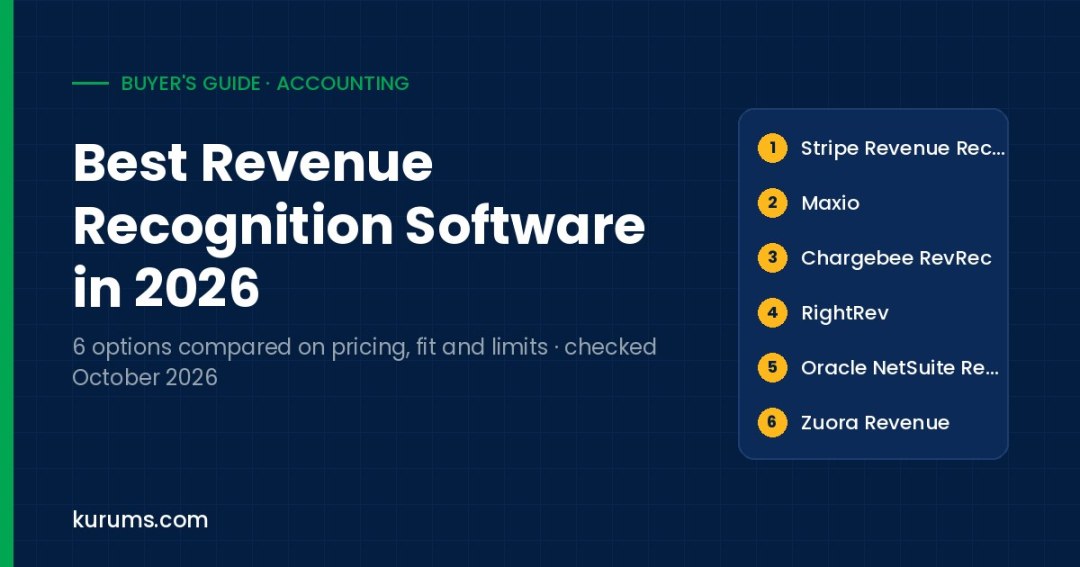
Best Revenue Recognition Software in 2026: ASC 606 Tools Compared
Six ASC 606 and IFRS 15 revenue recognition tools compared on published pricing, recognition logic, integrations and audit trails, from Stripe-native to enterprise subledgers.
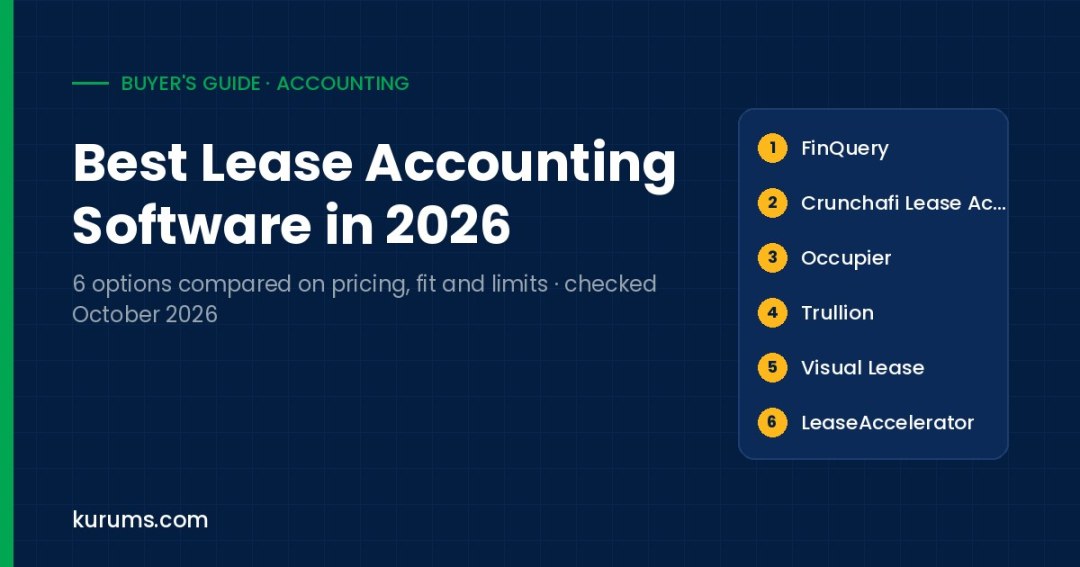
Best Lease Accounting Software in 2026: ASC 842 and IFRS 16 Compared
Six ASC 842, IFRS 16 and GASB 87 lease accounting tools compared on pricing model, free options, standards, ERP integration and audit controls.
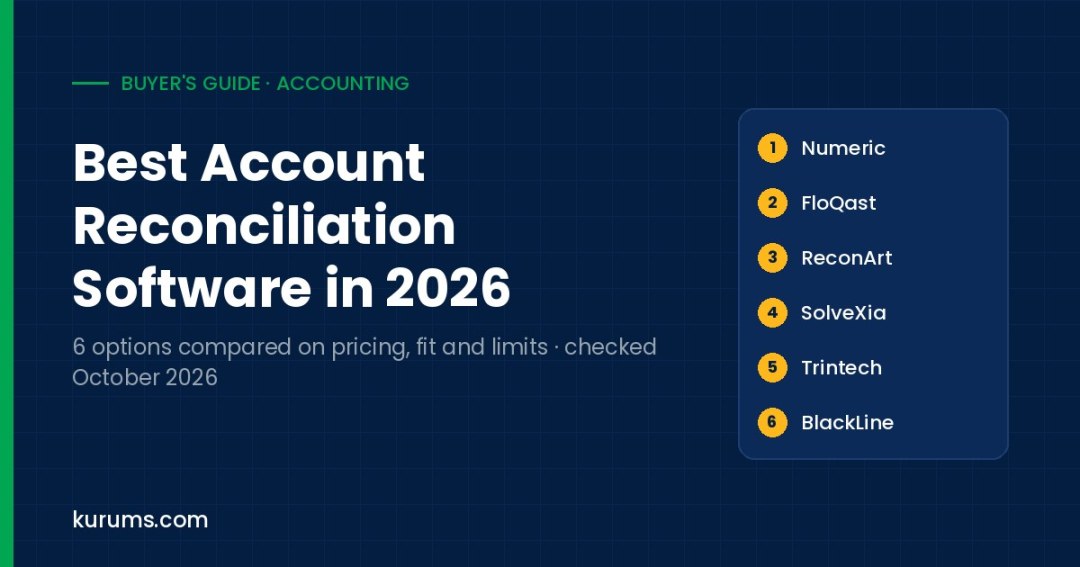
Best Account Reconciliation Software in 2026: Close Tools Compared
Six account reconciliation and close tools compared on pricing model, matching automation, ERP integrations and audit controls, from mid-market to global enterprise.