
Learning management systems for corporate training
Corporate learning management systems deliver, track and report on employee training, from compliance courses and onboarding to skills development, blended programmes and learning for customers or partners. Every company below is listed free by our editors, A–Z — no one pays for a position, and you can request a listing by email.
All learning management systems
Free listings · A to Z · sponsor yours from $5/day360Learning
French collaborative learning platform where internal experts create and share courses.
Absorb LMS
Cloud LMS for employee and extended-enterprise training with reporting and e-commerce options.
Constructor Learn
Swiss learning management system for courses, exams and certification in companies and universities.
Cornerstone
Learning and talent management suite for large organisations and regulated industries.
D2L Brightspace
Canadian learning platform serving corporate training as well as education institutions.
Degreed
Learning experience and skills platform aggregating content and tracking workforce skills.
Docebo
Enterprise learning platform for employee, customer and partner training at scale.
Eğitim365
Swiss-built LMS for universities running in-person and distance courses, online exams and video lessons.
iSpring Learn
Cloud LMS paired with iSpring authoring tools for fast corporate course creation.
Kallidus
UK-based learning and talent platform offering a corporate LMS, content and performance tools.
Learning Pool
UK learning technology provider offering an LMS, learning experience platform and content.
LearnUpon
Irish LMS for training employees, customers and partners from one platform.
Litmos
Corporate LMS with a ready-made course library for compliance and workplace training.
Moodle Workplace
Corporate edition of Moodle with multi-tenancy, automated programmes and certifications.
TalentLMS
Easy-to-deploy cloud LMS aimed at small and mid-sized businesses training staff.
Totara
Open-source-based enterprise learning platform delivered through a global partner network.
Not on this list yet? Getting listed is free. Email [email protected] with your name, website and a one-line description and our editors will review it. How to get listed · Listing policy.
Prefer to start free? See Free Onboarding & LMS Platforms — verified free plans, scored by Kurums.
What does a corporate LMS actually do?
A learning management system assigns training to the right people, delivers it, and records who completed what and when. Typical features include course hosting for SCORM, xAPI and video content, enrolment rules based on role or location, learning paths, classroom and virtual session scheduling, assessments, certificates with expiry dates, and reports for managers, HR and auditors.
For many organisations the LMS is first a compliance tool: proving that mandatory training on health and safety, data protection or anti-bribery was completed. Beyond that, companies use it for onboarding, product and sales training, leadership programmes and, increasingly, to train customers, partners or franchisees through separate portals.
A good LMS reduces administrative work rather than adding to it. When enrolment rules follow the HR record, new starters receive the right courses automatically, people who change role pick up new requirements, and expiring certifications trigger reminders without anyone maintaining a spreadsheet. That automation, more than the look of the learner interface, is what separates platforms in daily use.
Do you need an LMS, an LXP or a combined learning suite?
Vendors blur these labels, but the underlying models solve different problems.
| Platform type | Main purpose | Typical fit |
|---|---|---|
| Learning management system (LMS) | Assigning, tracking and proving completion of structured training | Compliance-heavy organisations and formal onboarding programmes |
| Learning experience platform (LXP) | Personalised discovery of content from many sources, often skills-based | Organisations focused on voluntary, self-directed development |
| Learning suite in HCM or talent platform | Training linked to performance, succession and the HR record | Companies standardising on one HR vendor |
| Extended-enterprise LMS | Multi-portal training for customers, partners or resellers, sometimes sold | Businesses where external training drives revenue or product adoption |
Most mid-sized organisations still need LMS fundamentals first. An LXP layered on top rarely fixes weak assignment rules or unreliable compliance reporting.
If you train external audiences, decide whether they belong in the same instance as employees. Separate portals simplify branding, data protection and licensing, but can double administration if content and reporting are not shared properly.
What should you compare before you shortlist?
Ask each vendor to run your real compliance and onboarding scenarios in the demo.
| Criterion | What to ask |
|---|---|
| Automation rules | Can enrolments, reminders and recertifications be triggered by job, location or hire date automatically? |
| Content standards | Which SCORM and xAPI versions are supported, and how does it handle video and third-party libraries? |
| Authoring | Is there a built-in course builder, or do we need a separate authoring tool? |
| Learner experience | Can frontline staff without corporate email or desktop access log in and learn on mobile? |
| Compliance reporting | Can we produce an audit-ready completion report by person, course and date in minutes? |
| HR integration | Does it sync users, managers and org structure from our HRIS automatically? |
| Multi-audience support | Can we run separate branded portals for subsidiaries, customers or partners from one instance? |
How are learning management systems priced?
The two dominant models are per registered user and per active user, usually billed annually in tiers. Per-active-user pricing suits organisations where only part of the workforce trains in a given month; per-registered-user pricing is more predictable for mandatory training that everyone completes. Extended-enterprise use for customers may be priced differently again. Off-the-shelf content libraries, authoring tools, integrations, extra portals and premium support are frequent add-ons, and open-source-based platforms may be cheaper to license but carry partner hosting and implementation costs.
Check what counts as active: a single login, a course launch or any activity.
Content licensing deserves separate scrutiny. Bundled course libraries look attractive in a proposal, but check how many titles are relevant to your industry and countries, whether they are available in your employees' languages, and what happens to completion records if you drop the library later.
What usually goes wrong?
Many LMS projects launch with an empty or outdated catalogue. The platform works, but there is little worth learning, so usage drops after the first compliance cycle. Plan content, owners and a review schedule alongside the technical rollout.
Other frequent problems include manual user management because the HRIS integration was deferred, legacy SCORM packages that do not track correctly, and reports that cannot answer the auditor's question. Frontline workers are often forgotten until launch, when shared devices and missing email addresses block access. Pilot with a real department, check completion data end to end, and make managers accountable for their team's training.
Finally, measure the right things. Completion rates show compliance, not capability. Agree with the business in advance which outcomes a programme should influence, such as time to competence for new hires or fewer safety incidents, and review them alongside the LMS reports.
Frequently asked questions
What is the difference between a corporate LMS and an academic LMS?
Academic platforms are organised around courses, terms, grading and student cohorts. Corporate LMSs focus on automated assignment by role, compliance tracking, certification expiry and integration with HR systems. Some vendors serve both markets with different editions.
Can we use our existing training content in a new LMS?
Usually, if it is in a standard format such as SCORM, xAPI, video or PDF. Test a sample of your oldest packages early, because older content sometimes fails to report completion correctly and may need republishing from the original authoring tool. Keep the original source files wherever possible, since they are far easier to update than exported packages.
How long does it take to implement an LMS?
A small-business LMS can be running within a few weeks. Mid-sized and enterprise implementations with HRIS integration, single sign-on, content migration and multiple portals typically take two to six months. Content readiness is often the limiting factor.
Do we need an LMS if we already have an HR suite?
Check the HR suite's learning module first. It may be sufficient for basic compliance and onboarding, but dedicated LMSs usually offer stronger authoring, content handling, external audiences and reporting, which matter if training is central to your operations. A short pilot on the existing module often settles the question quickly.
How this directory is compiled
Every company on this page was added by our editors from publicly available information: the product name, what it does in one line, and a link to the vendor's own site. No company paid to be listed in the free section, none was asked for approval, and inclusion here is not a recommendation — it is a starting point for a shortlist you should verify yourself.
No position on this page can be bought: the list is always alphabetical and every entry is free. Advertising on kurums.com appears only in clearly labelled ad units, separate from the listings, and has no influence on our editorial guides or on the Kurums Trust badges, which are earned against published criteria and are never for sale.
Pricing, feature and availability details change constantly in these categories, so we deliberately keep vendor descriptions here short and factual, and leave verified pricing to the dated editorial comparisons. Check the vendor’s own pricing page before you make a decision, and treat anything you read in a directory — including this one — as a list of candidates rather than an answer.
Best Workforce Planning Software in 2026: Pricing & Comparison
Buyer's guide · HR Best Workforce Planning Software in 2026: Pricing & Comparison We compared four workforce planning platforms on public pricing, scenario modelling, headcount tools and fit so you can shortlist two in ten minutes. By Kurums EditorialPricing checked...
Best Employee Experience Software in 2026: Pricing & Comparison
Buyer's guide · HR Best Employee Experience Software in 2026: Pricing & Comparison We compared four employee experience and engagement platforms on public pricing, free or trial options, survey and performance modules, and deployment model so HR and people teams can...
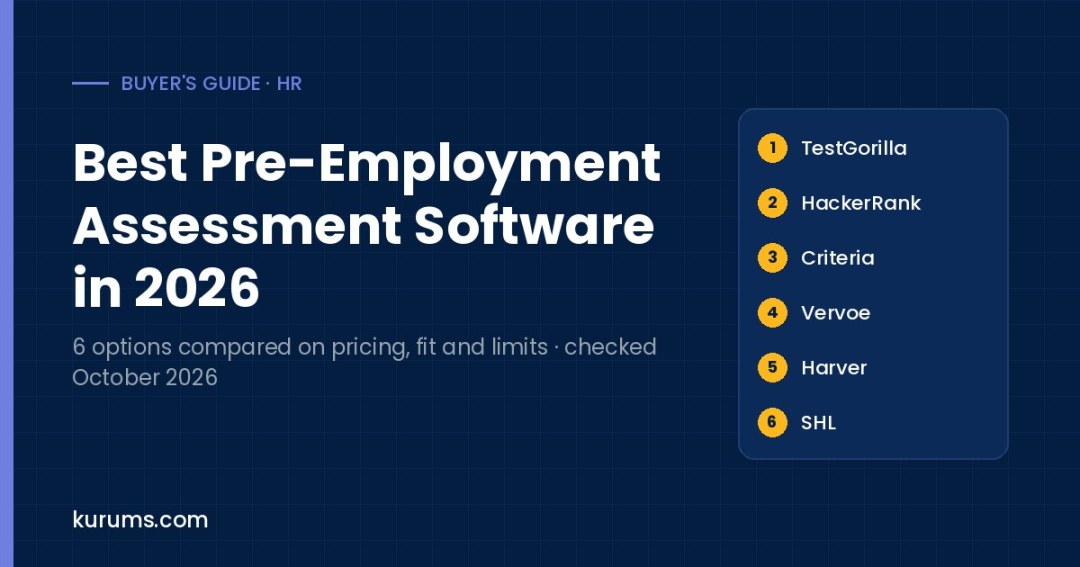
Best Pre-Employment Assessment Software in 2026: Skills Tests Compared
Six pre-employment assessment platforms compared on pricing, free plans and trials, test libraries, AI scoring and the hiring volumes they suit.