
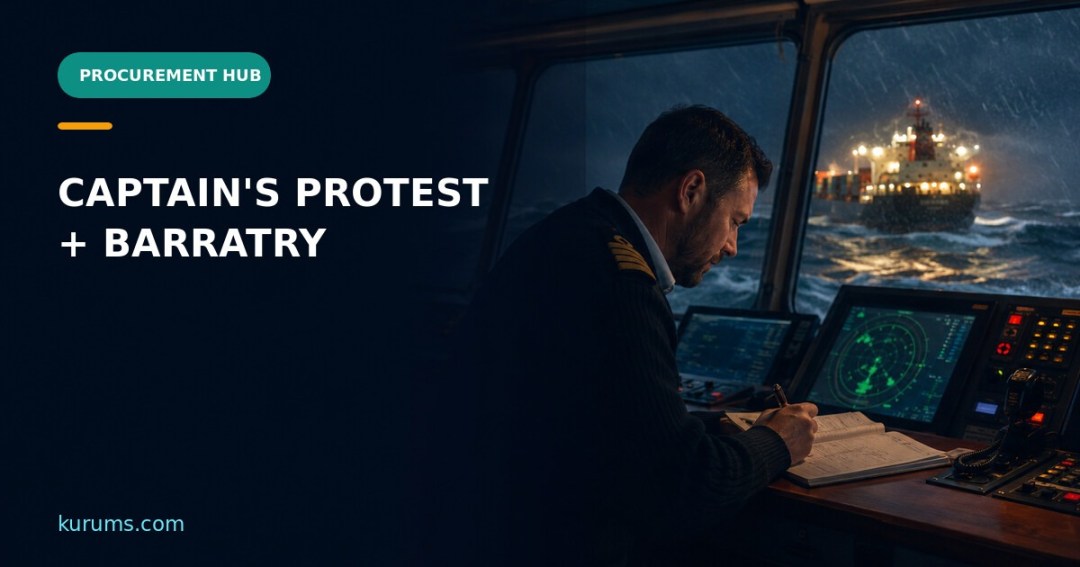
A captain’s protest is a contemporaneous statement about heavy weather or another event; barratry concerns unlawful or improper acts by the master or crew. Procurement should preserve the vessel, cargo, weather, custody, notice and survey evidence without treating either term as a finding of liability.
- Use a captain’s protest as one evidence item in an incident chronology, not as automatic proof of cause or defence.
- Escalate suspected barratry or misconduct through legal, insurance, security and safety channels immediately.
- Preserve originals, vessel identifiers, VDR or AIS data, weather, photographs, surveys and cargo records.
- Separate commercial claim handling from marine-safety investigation and law-enforcement obligations.
Why the Glossary Terms Need Context
The SSDER glossary describes CAPTAIN’S PROTEST as a statement recorded because of bad weather or similar conditions and BARRATRY as unlawful or improper conduct by the master or crew. These are signals in an incident file, not conclusions that a cargo loss was unavoidable or that misconduct occurred.
Procurement’s role is to trigger the right evidence and escalation. The master, flag state, insurer, class, carrier, port and authorities may each have defined roles; the buyer should not rewrite the incident while trying to close a freight invoice.
Capture the Incident Chronology
Record vessel name and IMO number, voyage, cargo, booking, bill of lading, loading and discharge condition, weather, route, port calls, notices, deviations, alarms, photographs, surveys, VDR or AIS preservation, crew statements and mitigation. Time-stamp every event and keep the source file.
IMO casualty-investigation guidance emphasises identifying the ship, flag, owners, cargo, location, consequences, weather and evidence contacts. A procurement incident card can translate that discipline into a repeatable first response.
Handle Protest, Survey and Notice in Parallel
Request the captain’s protest or equivalent vessel statement when relevant, but do not wait for it before issuing a protective claim notice, arranging a survey or securing cargo evidence. State what is known, what is being investigated and what rights are reserved.
A survey should describe condition, packaging, stowage, moisture, seals, quantity, handling and probable mechanisms without turning an observation into a legal conclusion. Procurement should coordinate the surveyor, insurer, carrier and receiver under one evidence index.
Escalate Misconduct and Preserve Independence
Suspected barratry, fraud, tampering, unauthorised deviation or deliberate cargo concealment requires immediate specialist escalation. Restrict access to evidence, preserve communications and avoid accusing individuals in an operational email that may later become part of an investigation.
Keep commercial settlement, safety investigation, insurance and disciplinary or law-enforcement tracks distinct. One chronology owner can coordinate them, while counsel and competent authorities decide privilege, reporting and next steps.
Worked Example: Protest Used to Close a Claim
A carrier sends a captain’s protest after heavy weather and asks the buyer to close a wet-cargo claim. The buyer has no survey, cannot show whether the hatch was secured, and has not preserved the terminal photographs. The protest is treated as a complete explanation.
The corrected process keeps the protest, requests the vessel and cargo records, issues a protective notice, arranges a joint survey and preserves the evidence. The buyer does not decide liability; it makes a reliable investigation possible.
Metrics and Governance
For captain's protest barratry procurement, measure both service and evidence quality. Useful indicators include first-pass acceptance, exception rate, response time, unplanned cost, document completeness, damage or discrepancy rate, and the percentage of shipments that follow the approved process. A dashboard should distinguish a supplier failure from a carrier, terminal, broker or internal master-data failure.
Review the metric trend with procurement, logistics, finance, quality and the responsible specialist. Use a monthly exception sample to test whether the control worked in a real transaction, not just whether a field was filled. Repeated exceptions should change the sourcing strategy, contract, lane design or supplier development plan.
Keep the control proportionate to risk. High-value, regulated, time-critical or safety-sensitive cargo needs stronger evidence and faster escalation than a routine shipment. Record the decision owner, approval date, source documents and follow-up action so the next buyer can understand the operating history.
Supplier and Carrier Questions
- Which CAPTAIN’S PROTEST or related glossary condition is assumed in your quotation, procedure or service description?
- Which party owns each data field, physical handoff, inspection, document and exception?
- What evidence will be available before release, loading, movement, receipt, invoice approval or claim?
- What changes require advance notice, requalification, a revised price or a new risk decision?
- How will the supplier report incidents, delays, mismatches and corrective actions, and within what response time?
Implementation Sequence
Implement the control in a small, representative lane first. Capture the baseline process, test the required data and evidence, run a real transaction, and review every exception with the people who performed the work. Do not declare the control effective only because a supplier signed a procedure.
After the first three shipments or operating cycles, update the purchase-order clause, work instruction, scorecard and training. Scale the control to other suppliers only when the evidence is repeatable and the owner can explain what happens when the normal path fails.
Common Mistakes to Avoid
- Treating a captain’s protest as automatic proof that the carrier is excused.
- Ignoring the possibility of misconduct because the event also involved bad weather.
- Waiting for a report before issuing notice, surveying or preserving VDR and photographs.
- Mixing safety, insurance, commercial and disciplinary conclusions in one email thread.
- Failing to identify the actual vessel, voyage, cargo and custody chain.
Procurement Implementation Checklist
- Open an incident file with vessel IMO, voyage, cargo and contract identifiers.
- Preserve weather, AIS/VDR, notices, photographs, surveys, seals and condition records.
- Request the captain’s protest or vessel statement when relevant.
- Issue protective notice and arrange an independent or joint survey.
- Escalate suspected barratry, fraud, tampering or unauthorised deviation.
- Run commercial, insurance, safety and authority tracks from one chronology.
Frequently Asked Questions
What is a captain’s protest?
It is a vessel statement or formal record concerning heavy weather or another event. The contract, flag and local practice determine its form and effect.
What is barratry?
It generally refers to unlawful or improper acts by a master or crew against the owner’s or cargo interests. A suspicion requires specialist investigation.
Does a protest prove force majeure?
No. It is evidence to assess with weather, vessel, cargo, custody, survey and contract facts.
When should procurement notify the insurer?
Follow the policy and contract, but escalate promptly when damage, loss, misconduct or a limitation window may be involved.
Who controls the marine investigation?
The responsible flag, coastal, port, carrier, insurer or authority may have defined roles. Procurement preserves facts and coordinates qualified specialists.
Related Kurums Guides
- Cargo Insurance and Claims
- Freight Rates and Surcharges
- Freight Contracts and Parties
- Customs Documents for Procurement
- Customs EDI and Entry Data
- Container Cells and Cell Guides
Standards and Authoritative Sources
- IMO — Casualty investigation and marine safety
- IMO — Investigator job aid
- U.S. Coast Guard — Marine casualty investigations
Glossary terms covered: CAPTAIN’S PROTEST, BARRATRY, marine casualty, incident evidence, survey, notice, vessel records
Kurums.com · Procurement, sourcing and business operations
Discover more from Kurums | Business Intelligence
Subscribe to get the latest posts sent to your email.