
What are competency-based job descriptions?
Competency-based job descriptions define roles through measurable skills, behaviors, and knowledge areas rather than listing only tasks, degrees, or years of experience.
Why should HR teams adopt this approach?
Organizations using competency-based hiring are significantly more likely to retain high performers and reduce mis-hires because they evaluate what candidates can actually do, not just what credentials they hold.
How do you build a competency framework for a role?
Start by analyzing top performers in the position, identifying the knowledge, skills, abilities, and behaviors (KSABs) that separate them from average performers, then map those competencies to specific job functions.
What is the biggest mistake in traditional job descriptions?
Traditional job descriptions over-rely on degree requirements and years-of-experience thresholds that exclude qualified candidates and fail to predict actual job performance.
Competency-based job descriptions represent a fundamental shift in how organizations define, communicate, and fill open positions. Instead of rigid qualification lists that filter candidates by credentials alone, this approach identifies the specific skills, behaviors, and performance outcomes that drive success in a given role. For HR professionals, mastering competency-based job description writing is no longer optional — it is a strategic imperative that directly impacts hiring quality, workforce alignment, and organizational productivity.
The traditional job description model — built around degree requirements, minimum years of experience, and generic duty lists — has dominated hiring for decades. However, research consistently shows that formal qualifications are poor predictors of on-the-job success. A growing number of leading organizations, including Google, IBM, and Unilever, have moved toward skills-first hiring strategies. This guide provides HR teams with a step-by-step framework for writing competency-based job descriptions that attract better candidates, reduce hiring bias, and align talent acquisition with business objectives.
What Are Competency-Based Job Descriptions and Why Do They Matter?
A competency-based job description is a structured document that defines a role through the core competencies — skills, knowledge, abilities, and behaviors — required for successful performance, rather than through credentials or tenure alone. This approach connects every job function to observable, measurable outcomes.
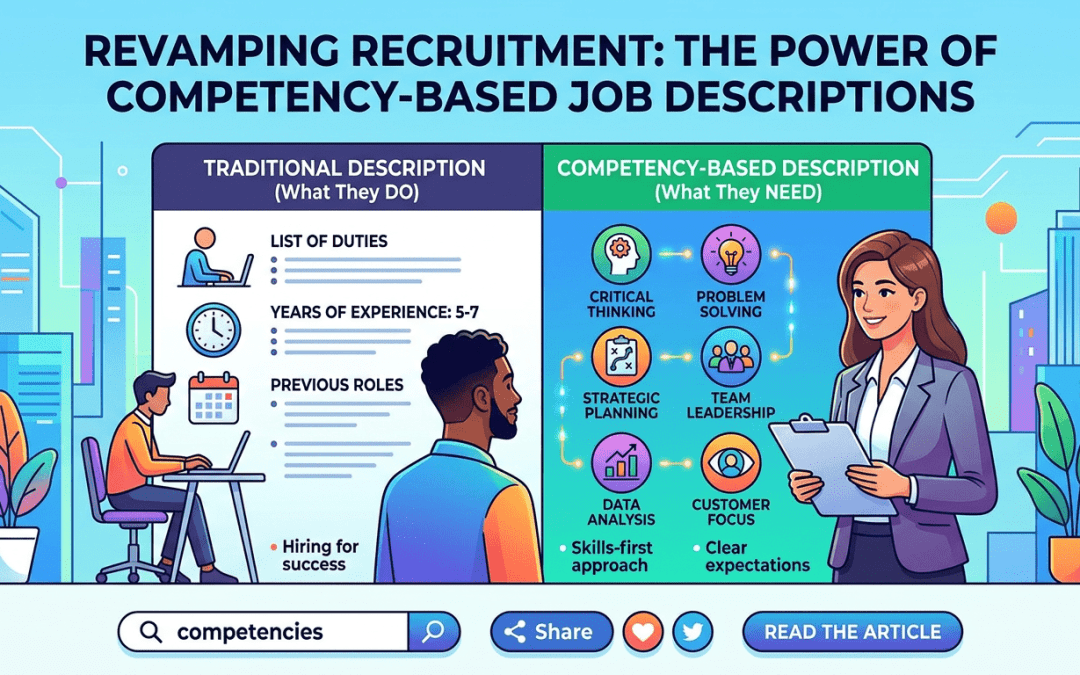
Traditional job descriptions typically list a title, a summary paragraph, a set of duties, and a qualification section requiring specific degrees and experience levels. The problem with this format is that it tells candidates what they need to have entered the workforce with, not what they need to demonstrate on the job. Competency-based descriptions flip this model by prioritizing what candidates can do and how they behave in work-relevant situations.
This distinction has measurable business impact. Organizations that hire based on demonstrated competencies rather than credentials alone see stronger retention rates, faster ramp-up times for new hires, and better alignment between individual performance and strategic goals. When job descriptions clearly articulate the competencies needed, hiring managers can design interviews, assessments, and onboarding programs that directly evaluate and develop those specific capabilities.
How Does a Competency-Based Job Description Differ from a Traditional One?
The core difference lies in focus: traditional descriptions emphasize inputs (degrees, certifications, years of experience), while competency-based descriptions emphasize outputs (demonstrable skills, behavioral indicators, and performance standards).
Consider a marketing manager position. A traditional description might require a “Bachelor’s degree in Marketing and 5+ years of experience.” A competency-based version would instead specify competencies such as “demonstrated ability to plan and execute multi-channel campaigns that achieve measurable ROI targets” and “proficiency in interpreting analytics data to optimize campaign performance.” The second version tells candidates — and hiring managers — exactly what successful performance looks like.
This shift also affects diversity and inclusion outcomes. When organizations remove unnecessary degree requirements and focus on demonstrable competencies, they open positions to candidates from non-traditional backgrounds — career changers, self-taught professionals, and those with vocational training — who may be highly qualified but excluded by credential-based filters.
What Are the Core Components of a Competency-Based Job Description?
A well-structured competency-based job description contains six essential components that together create a complete picture of the role, its requirements, and its success criteria.
What Should the Job Summary Section Include?
The job summary provides a concise overview of the role’s purpose, its position within the organization, and the primary impact area. It should connect the role to the company’s mission and explain how the position contributes to strategic objectives in two to three sentences.
Avoid generic summaries like “responsible for managing a team.” Instead, write outcome-oriented summaries: “Leads a cross-functional product team to deliver customer-facing features that drive user engagement and revenue growth.” This immediately signals to candidates what kind of impact the organization expects.
How Should Core Competencies Be Defined?
Core competencies are the knowledge, skills, abilities, and behaviors (KSABs) essential for the role. Each competency should include a clear definition and specific behavioral indicators that describe what the competency looks like in practice at the required proficiency level.
Competencies generally fall into three categories. First, technical competencies cover domain-specific knowledge and skills such as financial modeling, software development, or regulatory compliance expertise. Second, behavioral competencies address interpersonal and cognitive abilities like communication, analytical thinking, and collaboration. Third, leadership competencies apply to roles involving people management and include strategic planning, decision-making, and team development capabilities.
For each competency, include proficiency levels. A junior analyst role might require “foundational” proficiency in data analysis, while a senior role might require “advanced” or “expert” proficiency. This granularity helps candidates self-assess their fit and helps hiring managers calibrate interview questions.
How Do You Write Effective Key Responsibilities?
Key responsibilities in a competency-based description differ from traditional duty lists because each responsibility is linked to specific competencies and includes performance criteria that define what success looks like.
Use this three-part structure for each responsibility: the action (what the person does), the competency (what capability enables it), and the performance indicator (how success is measured). For example: “Develops and implements employee engagement programs (competencies: project management, organizational development) that achieve a measurable improvement in annual employee satisfaction scores.” This structure ensures that every task in the job description connects to a demonstrable competency and a business outcome.
What Performance Indicators Should Be Included?
Performance indicators define the measurable benchmarks that determine whether the role holder is meeting expectations. These indicators transform vague expectations into concrete targets and give both the employee and manager a shared understanding of success from day one.
Effective performance indicators follow the SMART framework: they are specific to the role, measurable through data or observation, achievable within the role’s scope, relevant to organizational goals, and time-bound with clear review periods. Including these indicators in the job description — rather than introducing them only after hiring — creates transparency in the recruitment process and sets realistic expectations for candidates.
How Do You Build a Competency Framework for Any Role?
Building a competency framework requires a systematic process of data collection, analysis, and validation that identifies the specific competencies distinguishing high performers from average performers in a given role.
What Is the Best Method for Identifying Role-Specific Competencies?
The most effective method for identifying role-specific competencies combines job analysis with behavioral event interviews of top performers. This approach, originally developed through the McClelland/McBer methodology, collects data about how the best people in a role actually work rather than relying on assumptions or generic industry standards.
Start by conducting structured interviews with three to five top performers in the role (or in comparable roles if the position is new). Ask them to describe specific situations where they achieved outstanding results. Identify the patterns in their responses — the skills, knowledge, and behaviors that repeatedly appear across multiple high performers are your core competencies. Supplement these interviews with input from direct supervisors, cross-functional stakeholders, and analysis of performance data to validate your findings.
How Should Competencies Be Organized into a Usable Model?
Organize identified competencies into clusters that align with the major functional areas of the role. A typical competency model contains eight to twelve competencies grouped into three or four clusters such as technical expertise, interpersonal effectiveness, results orientation, and leadership impact.
For each competency, document four elements: a concise definition (one to two sentences), behavioral indicators at each proficiency level (foundational, intermediate, advanced, expert), the link to specific job responsibilities, and the assessment method that will be used to evaluate the competency during hiring and performance reviews. This structured approach ensures that competencies are not just aspirational labels but actionable criteria embedded in every stage of the talent management lifecycle.
What Is the Step-by-Step Process for Writing a Competency-Based Job Description?
Writing a competency-based job description follows a structured seven-step process that moves from data gathering through drafting to validation and implementation.
Step 1 — Conduct a Job Analysis. Gather information about the role through interviews with current incumbents, supervisors, and stakeholders. Document the key responsibilities, working conditions, reporting relationships, and critical success factors. This step provides the raw material for competency identification.
Step 2 — Identify Core Competencies. Using the job analysis data plus behavioral event interviews with top performers, determine the eight to twelve competencies that most strongly predict success in the role. Distinguish between must-have competencies (required on day one) and developmental competencies (that can be built over time).
Step 3 — Define Proficiency Levels. For each competency, write behavioral descriptions at the proficiency level required for the role. A junior position might need “foundational” conflict resolution skills (recognizes and escalates conflicts appropriately), while a senior role might need “advanced” skills (mediates complex multi-party disputes and reaches mutually acceptable outcomes).
Step 4 — Write the Job Summary. Craft a two-to-three sentence overview that connects the role to organizational strategy and communicates the primary impact area. Avoid generic language and internal jargon.
Step 5 — Draft Responsibility Statements. Write each key responsibility using the action-competency-performance indicator structure. Limit the list to eight to ten critical responsibilities, ranked by importance and frequency. Establish in the description that the duties list is not exhaustive.
Step 6 — Remove Unnecessary Barriers. Review the draft for credential requirements that do not directly correlate with job performance. Unless a specific degree or certification is legally required (medical, legal, engineering licensure), replace credential requirements with competency requirements. Change “Bachelor’s degree in Finance required” to “Demonstrated proficiency in financial analysis, budgeting, and forecasting.”
Step 7 — Validate and Finalize. Share the draft with current role holders, hiring managers, and an HR compliance reviewer. Validate that the competencies accurately reflect the role, the proficiency levels are calibrated correctly, and the description complies with employment law requirements. Schedule a review cycle — competency-based job descriptions should be updated whenever there are significant changes in role scope, technology, or organizational structure.
What Are Common Mistakes to Avoid When Writing Competency-Based Job Descriptions?
Several common pitfalls undermine the effectiveness of competency-based job descriptions, turning a powerful hiring tool into just another administrative document that fails to differentiate the organization’s recruitment approach.
Mixing competencies with credentials. The most frequent error is bolting competency language onto a traditional credential-based structure. If the description still requires a specific degree as a hard filter, the competency section becomes decorative rather than functional. Ensure that competencies are the primary selection criteria.
Using vague behavioral descriptions. Competencies like “strong communication skills” or “team player” are meaningless without behavioral indicators. Always specify what the competency looks like in practice. Instead of “strong communication,” write “presents complex technical findings to non-technical stakeholders in clear, actionable terms and confirms understanding through active questioning.”
Overloading the competency list. Listing twenty or more competencies signals that the organization has not done the analytical work to prioritize what truly matters. This overwhelms candidates and dilutes the focus of hiring assessments. Keep the list between eight and twelve competencies, clearly distinguishing essential from preferred.
Neglecting to update descriptions. Job descriptions that remain static for years drift out of alignment with actual role requirements. Technology changes, organizational restructuring, and evolving business strategies all affect what competencies a role demands. Build a scheduled review process — at minimum annually or whenever a key role change occurs.
Ignoring stakeholder input. Writing competency-based descriptions in isolation — without input from current role holders, supervisors, and cross-functional partners — produces descriptions that reflect HR’s assumptions rather than operational reality. Always validate competencies through multiple data sources.
How Can Competency-Based Job Descriptions Improve Organizational Performance?
Competency-based job descriptions generate value far beyond the hiring process by creating a shared language that connects recruitment, onboarding, performance management, learning and development, and succession planning into a unified talent management system.
Better hiring decisions. When interviewers evaluate candidates against defined competencies with behavioral indicators, the assessment becomes more objective and consistent. Structured competency-based interviews reduce the influence of unconscious bias and produce hiring decisions based on evidence rather than intuition.
Faster onboarding. New hires who receive a competency-based job description on day one understand exactly what is expected of them and at what proficiency level. This clarity accelerates the onboarding process by giving new employees a clear roadmap for where to focus their learning and development efforts.
Aligned performance reviews. Competency-based descriptions create the evaluation criteria for performance management. Managers can assess employees against the same competencies and behavioral indicators used in hiring, ensuring consistency between what was promised in the recruitment process and what is measured during employment.
Strategic workforce planning. When every role in the organization has a competency profile, HR leaders can identify skill gaps across the workforce, plan targeted development programs, and build succession pipelines based on competency readiness rather than tenure or title.
What Does a Competency-Based Job Description Template Look Like?
A practical template provides HR teams with a reusable structure that standardizes how competency-based job descriptions are created across the organization while allowing flexibility for role-specific customization.
The template above provides the structural framework. Each section should be populated through the seven-step process described earlier in this guide. The most critical section is the core competencies block, which serves as the foundation for all downstream talent management activities.
How Do Leading Organizations Implement Competency-Based Hiring?
Several major organizations have publicly documented their transition from credential-based to competency-based hiring, providing practical models that HR teams can study and adapt.
IBM’s “New Collar” initiative removed degree requirements from many technology positions and replaced them with competency assessments validated through apprenticeship programs and technical evaluations. The program demonstrated that candidates hired through competency-based methods performed comparably to traditionally hired candidates while significantly expanding the diversity of the talent pipeline.
Google systematically analyzed the correlation between educational credentials and job performance across its workforce and found that degrees were not a reliable predictor of success. The company subsequently removed degree requirements from many positions and shifted to structured interviews designed to assess specific competencies like cognitive ability, role-related knowledge, leadership, and cultural contribution.
Unilever restructured its entire talent framework around a skills-based organization model. Rather than defining employees by job titles, Unilever views each role as a collection of competencies that can be deployed flexibly across projects and functions. This approach improved internal mobility, reduced time-to-fill for open positions, and aligned workforce capabilities with the company’s future-ready skills agenda.
What Tools and Frameworks Support Competency-Based Job Description Development?
HR teams can accelerate competency-based job description development by leveraging established frameworks and tools rather than building everything from scratch.
Competency dictionaries provide standardized definitions and behavioral indicators for common competencies across industries. Organizations can license an established dictionary — such as those offered by Workitect, SHL, or Korn Ferry — and customize entries for their specific context. A typical dictionary contains 30 to 50 competencies organized by cluster, each with definitions and behavioral indicators at multiple proficiency levels.
Job analysis methodologies including the Critical Incident Technique, Functional Job Analysis, and the Position Analysis Questionnaire provide structured approaches to collecting the data needed for competency identification. Each methodology has strengths suited to different organizational contexts — critical incident analysis works well for roles where performance variation is high, while functional analysis is effective for standardized operational roles.
HRIS and ATS integration is essential for scaling competency-based descriptions across the organization. Modern HR information systems allow competency frameworks to be embedded in job requisitions, interview scorecards, performance review templates, and learning management systems, creating a connected talent ecosystem where competencies flow seamlessly from hiring through development to succession planning.
Frequently Asked Questions About Competency-Based Job Descriptions
How many competencies should a job description include?
A well-designed competency-based job description includes eight to twelve competencies. Research indicates that models exceeding fifteen competencies lose practical utility because they dilute assessment focus and overwhelm both candidates and hiring managers.
Can competency-based job descriptions be used for all types of roles?
Yes, the competency-based approach applies to every role type — from entry-level operational positions to senior executive roles. The competencies and proficiency levels change, but the structural framework remains consistent. Roles requiring legally mandated credentials (medical, legal, engineering) include those credentials alongside competency requirements rather than replacing them.
How often should competency-based job descriptions be updated?
At minimum, review and update competency-based descriptions annually. Additional reviews should occur when there are significant changes in role scope, organizational restructuring, technology adoption, or when the current incumbent or supervisor requests a review due to persistent performance alignment issues.
What is the relationship between competency-based job descriptions and performance management?
Competency-based job descriptions provide the foundation for performance management by establishing clear, measurable criteria at the point of hire. Performance reviews then evaluate the employee against the same competencies and behavioral indicators defined in the job description, ensuring continuity between recruitment promises and workplace expectations.
How do competency-based job descriptions reduce hiring bias?
By replacing subjective criteria (university prestige, employer brand names on résumés) with objective competency assessments, this approach levels the playing field for candidates from non-traditional backgrounds. Structured competency-based interviews further reduce bias by ensuring every candidate is evaluated on the same criteria using the same behavioral questions.
What is the difference between skills-based and competency-based job descriptions?
Skills-based descriptions focus primarily on technical abilities and knowledge areas. Competency-based descriptions are broader — they include skills but also encompass behaviors, attitudes, and cognitive abilities that predict success. A competency-based approach captures the full profile of what makes someone effective in a role, not just the technical tasks they can perform.
Competency-based job descriptions are a cornerstone of modern talent management strategy. By shifting the focus from credentials to capabilities, organizations can attract stronger candidates, make better hiring decisions, and build a workforce that is directly aligned with business objectives. The framework outlined in this guide provides HR professionals with a practical, repeatable process for transforming their organization’s approach to defining and filling every role.
Discover more from Kurums | Business Intelligence
Subscribe to get the latest posts sent to your email.