
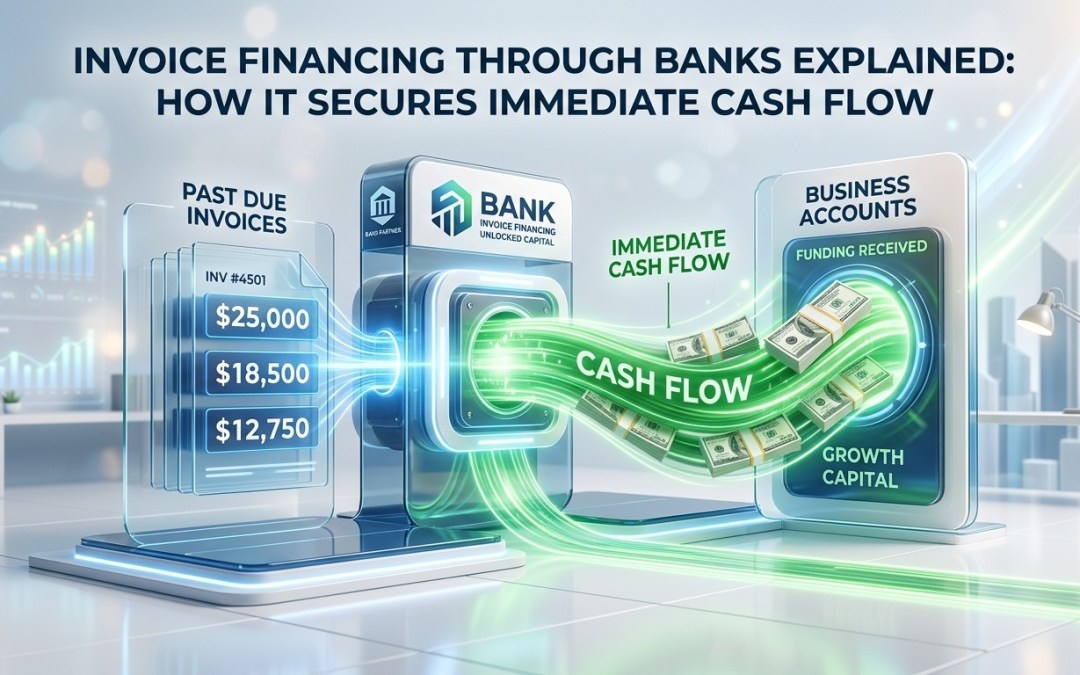
In an increasingly volatile macroeconomic environment, liquidity is the lifeblood of any corporate enterprise. Invoice financing through banks represents a sophisticated, highly regulated financial mechanism that allows businesses to unlock trapped working capital from their accounts receivable. By leveraging institutional capital, corporations can optimize their Cash Conversion Cycle (CCC), mitigate counterparty credit risk, and fuel sustainable growth without diluting equity or taking on traditional long-term debt. This comprehensive analysis explores the historical evolution, mechanical underwriting processes, strategic advantages, failure-case analyses, and the future technological trajectory of bank-led invoice financing.
Introduction to Bank-Led Liquidity Solutions
For modern corporate entities, the temporal disconnect between delivering goods or services and receiving payment often creates critical liquidity bottlenecks. The standard commercial terms of trade—spanning 30, 60, 90, or even 120 days—trap millions of dollars in accounts receivable, rendering that capital inaccessible for payroll, operational expenditure, or strategic investments. To bridge this gap, treasury departments increasingly rely on structured working capital solutions. Chief among these is invoice financing through banks.
Unlike alternative lending platforms or shadow banking entities, traditional commercial and investment banks offer a unique blend of massive balance sheet capacity, rigorous regulatory compliance, and highly competitive capital costs. Invoice financing through banks is not merely a lifeline for distressed companies; it is a strategic treasury tool utilized by Fortune 500 companies and robust mid-market enterprises to optimize their balance sheets, manage days sales outstanding (DSO), and accelerate liquidity velocity. This article provides an exhaustive, highly technical examination of how these bank-led facilities operate, the intricate risk management protocols involved, and the strategic foresight required by Chief Financial Officers (CFOs) to leverage them effectively.
The Historical Context and Evolution of Invoice Financing
To fully appreciate the sophistication of modern invoice financing through banks, one must first understand its extensive historical lineage. The practice of advancing capital against outstanding invoices is not a contemporary financial innovation, but rather an evolution of trade finance that dates back thousands of years, evolving alongside global commerce.
Antiquity to the Renaissance: The Birth of Trade Credit
The conceptual framework of advancing funds against future payments can be traced back to ancient Mesopotamia, where merchants operating under the Code of Hammurabi utilized rudimentary forms of trade credit to finance agricultural exports. However, the formalization of this practice began in earnest during the European Renaissance. Prominent banking families, such as the Medici in Italy, essentially operated as early factors. They provided immediate capital to merchants shipping textiles and spices across the Mediterranean, taking on the risk of the buyer’s default in exchange for a discount on the final payment.
The Industrial Revolution and the Rise of Institutional Factoring
The Industrial Revolution marked a paradigm shift in global manufacturing and distribution. As production scaled, particularly in the textile industries of the United Kingdom and the United States, manufacturers faced severe cash flow constraints. The time required to harvest raw materials, process them into textiles, ship them across the Atlantic, and await payment was untenable. This gave rise to dedicated factoring houses. These institutions did more than just provide capital; they provided credit underwriting, assumed the risk of non-payment (non-recourse factoring), and handled the physical collection of funds. By the late 19th and early 20th centuries, commercial banks began to recognize the profitability of these operations, leading to the gradual integration of invoice discounting into traditional banking services.
The Modern Era: Digitization and Regulatory Frameworks
The late 20th and early 21st centuries saw traditional banks fully operationalize invoice financing as a core commercial banking product. The implementation of the Uniform Commercial Code (UCC) in the United States, specifically Article 9 governing secured transactions, provided a robust legal framework for banks to secure their interest in accounts receivable. Following the 2008 Global Financial Crisis, regulatory frameworks such as Basel III fundamentally altered the capital adequacy requirements for banks. Because invoice financing is typically short-term and backed by tangible corporate assets (receivables), it became an highly attractive, capital-efficient deployment of bank funds. Today, invoice financing through banks is a highly digitized, API-driven ecosystem, deeply embedded in corporate Enterprise Resource Planning (ERP) systems.
What Is Invoice Financing Through Banks? Core Mechanics
At its core, invoice financing through banks is an umbrella term encompassing various financial structures where a corporate entity utilizes its outstanding customer invoices (accounts receivable) as collateral to secure an immediate injection of cash from a banking institution. Instead of waiting for the debtor to settle the invoice according to the net terms, the bank advances a significant percentage of the invoice value immediately.
Dissecting the Financial Instrument
From a technical standpoint, this is an asset-based lending facility or a specialized form of corporate asset sale, depending on the exact legal structure. The bank evaluates the creditworthiness of the corporation’s customer portfolio (the debtors) rather than solely relying on the credit rating of the corporation itself (the seller). This asymmetric risk assessment is what makes invoice financing uniquely advantageous; a mid-market company with BBB credit can access capital at highly favorable rates if its primary debtors are AA-rated multinational conglomerates.
Invoice Factoring vs. Invoice Discounting
It is imperative for corporate treasurers to distinguish between the two primary mechanisms offered by banks under the invoice financing umbrella: Factoring and Discounting.
- Invoice Factoring: The corporation sells its entire ledger (or a specific tranche) of invoices to the bank. The bank takes over the credit control and collection process. In a “non-recourse” factoring arrangement, the bank absorbs the loss if the debtor defaults due to insolvency. Because the bank assumes more operational control and risk, the fees are typically higher.
- Invoice Discounting: A more sophisticated facility typically reserved for established corporations with robust internal credit control departments. The bank provides a revolving line of credit secured against the total value of the accounts receivable ledger. The corporation retains control over its sales ledger and collections, meaning the arrangement remains strictly confidential from the end customers. This is almost exclusively done on a “recourse” basis, meaning the corporation must replace the collateral or repay the advance if the debtor fails to pay.
How Does It Work? A Granular Operational Framework
Executing an invoice financing facility through a tier-one commercial bank is a multi-layered process requiring rigorous underwriting, technological integration, and continuous monitoring. Here is the technical workflow.
Step 1: Corporate Onboarding and Portfolio Underwriting
The process initiates with an exhaustive due diligence phase. The bank’s credit risk committee evaluates the historical performance of the corporation’s receivables. Key metrics analyzed include the average Days Sales Outstanding (DSO), historical bad debt ratios, dilution rates (the percentage of invoices reduced by returns, discounts, or disputes), and concentration risk (the percentage of the total ledger tied to a single debtor). Banks generally require that no single debtor accounts for more than 15% to 20% of the total collateral pool.
Step 2: Verification and Security Perfection
Once the credit parameters are established, the bank must “perfect” its security interest. In the US, this involves filing a UCC-1 financing statement, establishing the bank’s first-priority lien on the specified accounts receivable. In the UK, this may involve a debenture establishing a fixed or floating charge. The bank will also verify the authenticity of the invoices. For large facilities, banks utilize automated systems to ping the debtor’s accounts payable portals to ensure the invoice is approved and scheduled for payment.
Step 3: Fund Disbursement and the Advance Rate Matrix
Upon verification, the bank disburses the initial capital. This is dictated by the Advance Rate, which typically ranges from 70% to 90% of the gross invoice value. The advance rate is not arbitrary; it is a meticulously calculated metric designed to buffer the bank against dilution, currency fluctuations (in cross-border trade), and potential disputes. The remaining 10% to 30% is held in a reserve account.
Step 4: Collection, Settlement, and Reconciliation
When the invoice matures, the debtor remits payment directly into a bank-controlled lockbox or designated trust account (in discounting) or directly to the bank (in factoring). The bank deducts its advance, its discount fee (essentially the interest calculated over the days the funds were deployed), and any ancillary transaction fees. The remaining balance from the reserve account is then rebated to the corporation, completing the cycle.
Strategic Imperatives: Why Corporations Choose Banks
While the fintech landscape has exploded with alternative lenders offering rapid capital deployment, established corporate entities overwhelmingly prefer invoice financing through banks. The reasons are rooted in macroeconomic strategy, capital costs, and holistic treasury management.
Maximizing Working Capital Velocity
Corporate growth is fundamentally limited by the velocity at which capital cycles through the business. By converting a 90-day receivable into Day-1 cash, corporations can immediately reinvest in raw materials, fund research and development, or execute aggressive M&A strategies. This accelerated cash conversion cycle dramatically improves the Internal Rate of Return (IRR) on corporate projects.
Balance Sheet Optimization and Debt Covenants
Traditional term loans add liabilities to the balance sheet, negatively impacting the debt-to-equity ratio and potentially breaching existing loan covenants. Structuring an invoice financing facility as an off-balance-sheet true sale allows corporations to generate immense liquidity without triggering debt covenant defaults, preserving the company’s overall borrowing capacity.
Mitigating Supply Chain Disruptions
In globalized operations, supply chains are highly sensitive to liquidity shocks. If a tier-one manufacturer lacks cash, it cannot pay its tier-two suppliers, leading to a cascading failure of production. Bank-led invoice financing ensures that the anchor corporation maintains a highly liquid treasury, allowing it to offer early payment programs (Supply Chain Finance or Reverse Factoring) to its own suppliers, thereby stabilizing the entire supply ecosystem.
Quantitative Cost Analysis and Financial Modeling
Evaluating the true cost of invoice financing requires robust financial modeling. Corporate CFOs must look beyond headline rates to understand the Annualized Percentage Rate (APR) and the impact of ancillary fees.
The Discount Rate and Annualized Percentage Rate (APR)
Banks typically quote a discount rate as a margin over a benchmark rate, such as SOFR (Secured Overnight Financing Rate) or SONIA. For example, a bank might offer SOFR + 2.5%. If the facility is utilized, the interest is calculated daily on the outstanding advanced amount. However, if a flat discount fee is applied (e.g., 1.5% for 30 days), the annualized cost is significantly higher. A 1.5% fee every 30 days equates to an APR of over 18%. Because tier-one banks access capital at wholesale rates, their invoice financing facilities are historically much cheaper, often resulting in effective APRs in the single digits for prime corporate clients.
Hidden Costs: Service Fees, Audit Fees, and Drawdown Charges
The Total Cost of Facility (TCF) includes operational fees. Banks require rigorous oversight. Treasury departments must model for:
- Facility / Arrangement Fees: A flat annual fee (e.g., 0.5% of the total facility limit) to keep the credit line open.
- Field Examination / Audit Fees: Banks will send auditors quarterly to inspect the ledger and verify invoice validity.
- Non-Utilization Fees: If a corporation negotiates a $50 million facility but only draws down $10 million, the bank may charge a fee on the unutilized $40 million to compensate for committed regulatory capital.
Comparative Analysis: Bank-Led vs. Alternative Financiers
To provide a clear perspective on market offerings, the following table details the strategic differences between securing invoice financing through a traditional commercial bank versus utilizing modern alternative Fintech platforms.
| Strategic Criterion | Commercial Banks | Alternative Lenders (Fintechs) |
|---|---|---|
| Cost of Capital (APR) | Low (Usually SOFR + 1.5% to 3.5%) due to massive, cheap deposit bases. | Moderate to High (Often 10% to 30%+ APR) due to reliance on institutional debt. |
| Facility Size Capacity | Virtually limitless. Capable of handling hundreds of millions in A/R. | Typically capped at lower thresholds ($5M – $20M). |
| Underwriting Speed | Slower (4 to 8 weeks). Requires deep auditing, KYC, and AML compliance checks. | Extremely Fast (24 to 72 hours). Utilizes algorithmic API-based underwriting. |
| Regulatory Stability | Extremely High. Governed by central banks and Basel III/IV frameworks. | Variable. More susceptible to liquidity crunches during macro downturns. |
| Ancillary Services | FX hedging, global treasury management, L/Cs, and syndication. | Highly specialized; generally limited to the core financing product. |
Real-World Application Scenarios and Case Studies
Theoretical mechanics only tell part of the story. Analyzing real-world applications highlights the transformative potential—and the inherent risks—of invoice financing through banks.
Success Scenario: Global Manufacturing and Supply Chain Stabilization
Consider a mid-cap automotive parts manufacturer based in Germany, supplying OEM components to major automotive giants like Volkswagen and Ford. The manufacturer operates on net-90 day payment terms, creating immense strain when purchasing raw steel and aluminum, which suppliers demand payment for in 30 days. By establishing a €50 million confidential invoice discounting facility with a tier-one European bank, the manufacturer bridged the 60-day gap. The bank advanced 85% of the invoice value upon shipment. The manufacturer utilized this immediate cash to negotiate early payment discounts (2/10 Net 30) with its own raw material suppliers. The savings generated from these raw material discounts entirely offset the interest expense of the bank facility, effectively providing the manufacturer with “free” liquidity and protecting the automotive supply chain from disruption.
Success Scenario: High-Growth SaaS and B2B Technology
A rapidly expanding Software-as-a-Service (SaaS) enterprise specializing in enterprise cybersecurity signs massive three-year contracts with Fortune 100 companies, billed annually in arrears. While the recognized revenue is high, the cash flow is lumpy. The company needed capital for massive R&D expansion but wished to avoid venture debt or dilutive equity rounds. By utilizing bank-led invoice financing, they monetized their highly rated accounts receivable. Because the debtors were blue-chip corporations with near-zero default risk, the bank offered an exceptional advance rate of 90% at SOFR + 1.75%. This provided the SaaS company with millions in non-dilutive growth capital instantly.
Failure Case Analysis: The Perils of Concentration Risk and Fictitious Receivables
Invoice financing is not without catastrophic risks if poorly managed. A notable failure scenario occurred with a UK-based commercial logistics provider. The company relied on a £20 million recourse factoring facility provided by a major commercial bank. However, over 60% of the logistics firm’s revenue was tied to a single anchor retail client (a severe concentration risk). When the retail client suddenly declared bankruptcy and entered administration, the outstanding invoices became uncollectible. Because the facility was strictly “recourse,” the bank demanded that the logistics provider immediately repurchase the £12 million in defaulted invoices. The logistics firm lacked the cash reserves to cover this clawback, triggering a rapid liquidity crisis that ultimately forced the logistics provider into liquidation.
Furthermore, macro-level failures, such as the collapse of Greensill Capital, highlight the systemic risks of financing “future receivables” or fictitious invoices. When banks lose sight of the physical verification of goods and services, invoice financing can mutate into dangerous unsecured lending.
Risk Management and Regulatory Compliance (Basel III & IV)
For a bank, deploying capital against invoices requires a fortress of risk management protocols, heavily influenced by international regulatory accords.
KYC, AML, and Fraud Detection
Banks are subjected to stringent Know Your Customer (KYC) and Anti-Money Laundering (AML) regulations. In invoice financing, banks must not only KYC the borrower but must also have transparency into the underlying debtors to ensure funds are not originating from sanctioned entities. Advanced data analytics and AI are deployed to detect anomalies in invoice generation, mitigating risks such as “fresh air invoicing” (creating fake invoices to draw down funds) or related-party transactions designed to artificially inflate the borrowing base.
Credit Insurance and Recourse Structures
To reduce risk weighting under Basel III capital adequacy rules, banks frequently mandate the inclusion of Trade Credit Insurance. By insuring the receivables portfolio against debtor insolvency, the bank essentially transfers the default risk to an A-rated insurance conglomerate (like Euler Hermes or Atradius). This structural enhancement allows the bank to classify the facility as a lower-risk asset, freeing up regulatory capital and allowing the bank to pass on lower interest rates to the corporate borrower.
Future Trends: The Technological Renaissance of Invoice Financing
The operational landscape of invoice financing through banks is undergoing a profound digital transformation. Legacy paper-based processes are being eradicated by cutting-edge financial technology.
Artificial Intelligence and Predictive Underwriting
Banks are moving away from retrospective auditing toward predictive AI models. By analyzing historical payment behaviors, macroeconomic indicators, and sector-specific trends, AI algorithms can predict the exact probability of an invoice being paid late or defaulting. This allows banks to dynamically adjust advance rates and discount fees on an invoice-by-invoice basis in real time, optimizing risk-adjusted returns.
Blockchain, Smart Contracts, and Distributed Ledger Technology (DLT)
One of the greatest inefficiencies in invoice financing is reconciliation and the risk of double financing. Consortiums of global banks are adopting Distributed Ledger Technology (DLT) to tokenize invoices. When an invoice is created, it is hashed onto a blockchain. If a corporation attempts to finance that identical invoice with another bank on the network, the smart contract instantly rejects the transaction. Furthermore, smart contracts facilitate instantaneous, automated settlements. When the debtor pays, the smart contract automatically splits the funds—routing the principal and fee to the bank, and the remaining reserve to the corporate borrower—eliminating days of manual reconciliation.
API-Led ERP Integration and Open Banking
The future of bank-led invoice financing is frictionless integration. Through secure APIs and Open Banking protocols, a corporation’s ERP system communicates directly with the bank’s underwriting engine. When a sales order is fulfilled and an invoice is generated in the ERP, it is immediately visible to the bank. The bank’s algorithm scores the invoice, and funds are automatically deposited into the corporate treasury account overnight. This seamless flow of data transforms invoice financing from a reactive funding request into an invisible, automated working capital optimization engine.
Actionable Framework for Corporate CFOs
For corporate treasurers and CFOs preparing to secure or renegotiate an invoice financing facility with a commercial bank, meticulous preparation is critical. The following checklist ensures readiness for institutional underwriting.
- Ledger Cleansing: Identify and write off uncollectible debt. Banks penalize portfolios with high volumes of invoices past 90 days due.
- Analyze Concentration Limits: Ensure no single customer exceeds 20% of your total A/R ledger. If they do, prepare to negotiate specific carve-outs or secure standalone credit insurance for that debtor.
- Dilution Assessment: Calculate your historical dilution rate (returns, credits, early payment discounts). A high dilution rate will severely lower your bank advance rate.
- Contractual Review: Review your commercial contracts with key buyers to ensure there are no “Ban on Assignment” clauses, which legally prevent you from pledging their invoices to a bank.
- Technological Audit: Confirm that your ERP can easily export high-fidelity, standardized A/R aging reports, or better yet, supports direct API linkage with tier-one bank treasury systems.
Conclusion
In the complex theater of corporate finance, liquidity reigns supreme. Invoice financing through banks stands as one of the most resilient, scalable, and sophisticated tools available for managing the cash conversion cycle. By transitioning from traditional debt to asset-backed liquidity solutions, corporations not only shield their balance sheets but also unlock trapped capital to fuel strategic expansion. As regulatory frameworks stabilize and technological innovations like AI and blockchain eradicate operational friction, bank-led invoice financing will continue to cement its role as an indispensable pillar of modern treasury management. For the astute CFO, mastering the nuances of these facilities—from the granular mechanics of the advance rate to the systemic implications of recourse structures—is no longer optional; it is a fundamental prerequisite for competitive corporate survival and growth.
Discover more from Kurums | Business Intelligence
Subscribe to get the latest posts sent to your email.