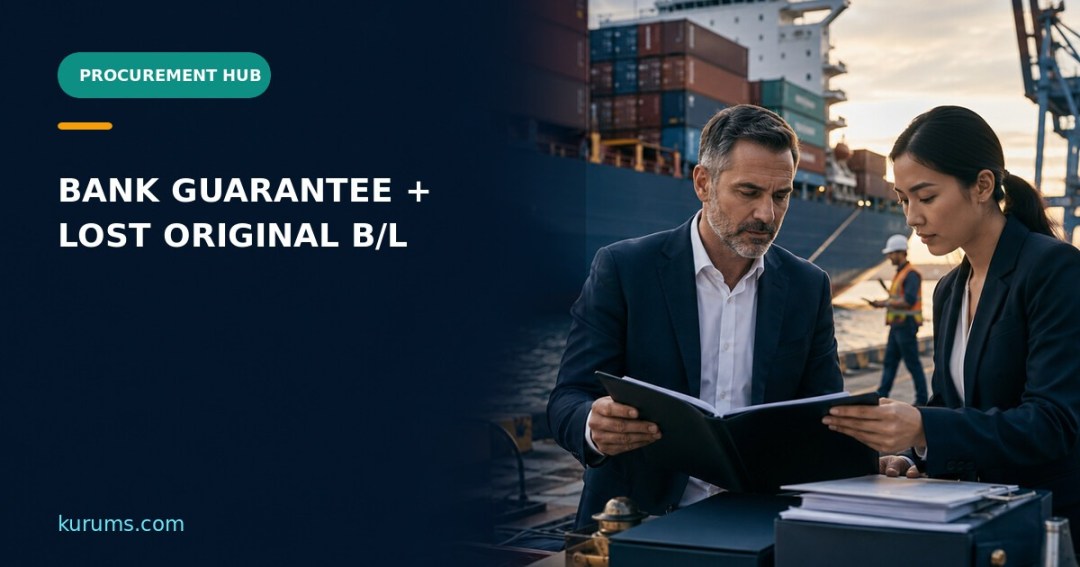
A bank guarantee or letter of indemnity can support a carrier’s decision when an original bill of lading is unavailable, but it does not make an unauthorised release safe by itself. Procurement should define who may request release, what evidence is accepted, the guarantee’s issuer and wording, expiry, counterparty risk and recovery plan.
- Treat a missing original bill of lading as a title, fraud, payment and operational exception.
- Separate a bank guarantee, a carrier indemnity and a commercial promise; they provide different protection.
- Use approved wording, issuer checks, amount, governing law, expiry, signatory authority and document retention.
- Record release, surrender, sea-waybill or replacement-document decisions against one shipment case.
The Missing Original Is a Release-Control Failure
The SSDER glossary describes a bank guarantee as a guarantee to a carrier when an original bill of lading is lost or misdirected. The operational pressure is understandable: cargo is at the port, storage is accruing and production needs the goods. The risk is that a carrier releases to the wrong party or loses the ability to defend a claim by a lawful document holder.
Procurement should open a document exception case that identifies the shipment, bill type, shipper, consignee, notify party, title holder, bank, carrier, insurer, cargo value, location and immediate business impact. No one should treat a scanned copy or an email instruction as an automatic substitute.
Choose the Correct Security Instrument
A bank guarantee is issued or supported by a bank under defined terms. A letter of indemnity is a contractual undertaking by the requesting party, sometimes supported by a bank. A sea waybill or electronic bill may be a different transport-document choice agreed before shipment. The parties, liability, enforceability and operational process are not the same.
Ask the carrier and bank to use reviewed wording that states the release, shipment, amount, currency, claims, jurisdiction, duration, demand process, counter-guarantee and return or cancellation conditions. Legal and treasury should approve the instrument before the buyer asks operations to release cargo.
Verify Authority, Issuer and Exposure
The carrier should confirm whether it will accept a guarantee, who must issue it, whether the original or authenticated electronic message is required, and what other documents are needed. Treasury verifies the bank, facility, signatories, collateral and expiry. Legal checks the governing law and recovery route.
BIMCO contract materials illustrate why bills of lading, delivery and indemnity obligations need to be read together. Procurement should not copy a sample clause into a purchase order without checking the carrier’s contract, local law, bank rules and insurance position.
Close the Case and Recover the Original
The exception record should include the search log, carrier acknowledgement, bank guarantee, indemnity, release instruction, delivery receipt, replacement document, original recovery and cancellation evidence. Set reminders before the guarantee expires and require a named owner to return or discharge it.
Measure missing-document frequency, release cycle time, guarantee value and duration, storage avoided, disputed releases and documents recovered. A recurring loss pattern may indicate supplier dispatch, bank courier, forwarder or internal document-control failure.
Worked Example: Release Before the Bank Authenticates
A supplier reports that the original bill of lading was lost and sends a PDF of a bank guarantee. The forwarder releases the cargo after receiving an email from a junior buyer, but the carrier had required an authenticated bank message and a specific wording. The buyer later faces a demand for additional security and cannot prove who authorised release.
The corrected workflow blocks release until the carrier confirms the approved instrument, treasury verifies the issuer and legal approves the wording. A document owner tracks the original search, release, receipt and guarantee cancellation.
Metrics and Governance
For bank guarantee and original bill of lading controls, measure both service and evidence quality. Useful indicators include first-pass acceptance, exception rate, response time, unplanned cost, document completeness, damage or discrepancy rate, and the percentage of shipments that follow the approved process. A dashboard should distinguish a supplier failure from a carrier, terminal, broker or internal master-data failure.
Review the metric trend with procurement, logistics, finance, quality and the responsible specialist. Use a monthly exception sample to test whether the control worked in a real transaction, not just whether a field was filled. Repeated exceptions should change the sourcing strategy, contract, lane design or supplier development plan.
Keep the control proportionate to risk. High-value, regulated, time-critical or safety-sensitive cargo needs stronger evidence and faster escalation than a routine shipment. Record the decision owner, approval date, source documents and follow-up action so the next buyer can understand the operating history.
Supplier and Carrier Questions
- Which BANK GUARANTIEE or related glossary condition is assumed in your quotation, procedure or service description?
- Which party owns each data field, physical handoff, inspection, document and exception?
- What evidence will be available before release, loading, movement, receipt, invoice approval or claim?
- What changes require advance notice, requalification, a revised price or a new risk decision?
- How will the supplier report incidents, delays, mismatches and corrective actions, and within what response time?
Implementation Sequence
Implement the control in a small, representative lane first. Capture the baseline process, test the required data and evidence, run a real transaction, and review every exception with the people who performed the work. Do not declare the control effective only because a supplier signed a procedure.
After the first three shipments or operating cycles, update the purchase-order clause, work instruction, scorecard and training. Scale the control to other suppliers only when the evidence is repeatable and the owner can explain what happens when the normal path fails.
Common Mistakes to Avoid
- Treating a scan, email or supplier promise as an original bill of lading.
- Confusing a bank guarantee, letter of indemnity and sea waybill.
- Accepting an issuer, wording, amount or expiry that treasury and legal have not approved.
- Releasing cargo before the carrier confirms authenticated receipt and conditions.
- Failing to recover the original or cancel the guarantee after delivery.
Procurement Implementation Checklist
- Open a missing-document case with title, parties, value and cargo location.
- Confirm the bill type and carrier's accepted release alternatives.
- Obtain approved bank, legal, wording, amount, expiry and authentication checks.
- Record release authority, delivery proof, replacement document and search log.
- Set expiry, cancellation and original-recovery reminders.
- Trend missing originals and fix supplier, bank, forwarder or internal controls.
Frequently Asked Questions
What is a bank guarantee for a lost bill of lading?
It is a bank-backed undertaking that may support a carrier’s agreed release process when the original document is unavailable. Acceptance depends on the carrier, bank, wording and applicable law.
Is a letter of indemnity the same as a bank guarantee?
No. An indemnity is a contractual promise; a bank guarantee is a bank’s undertaking under its own terms. They create different recovery and credit profiles.
Can a carrier release cargo against a PDF?
Only if its documented process accepts that form and the required authentication, wording and authority have been completed.
Who should approve the guarantee?
Treasury, legal, the carrier or forwarder, the document owner and the authorised commercial signatory should approve the parts within their remit.
When is the case closed?
After authorised delivery, receipt of the replacement or original document, cancellation or discharge of the guarantee and retention of the evidence.
Related Kurums Guides
- Freight Contracts and Parties
- Shipping Documents for Procurement
- Customs EDI and Entry Data
- Freight Network Design for Procurement
- Cargo Abandonment and Acquittance
- Advanced Charges and Pass-Through Freight
Standards and Authoritative Sources
- BIMCO — Contracts and charter-party resources
- BIMCO — Standard clauses
- BIMCO — Sample charter-party document with bill-of-lading indemnity language
- ICC — Banking and documentary credits
Glossary terms covered: BANK GUARANTIEE, original bill of lading, letter of indemnity, cargo release, title, carrier, document control
Kurums.com · Procurement, sourcing and business operations
Discover more from Kurums | Business Intelligence
Subscribe to get the latest posts sent to your email.