
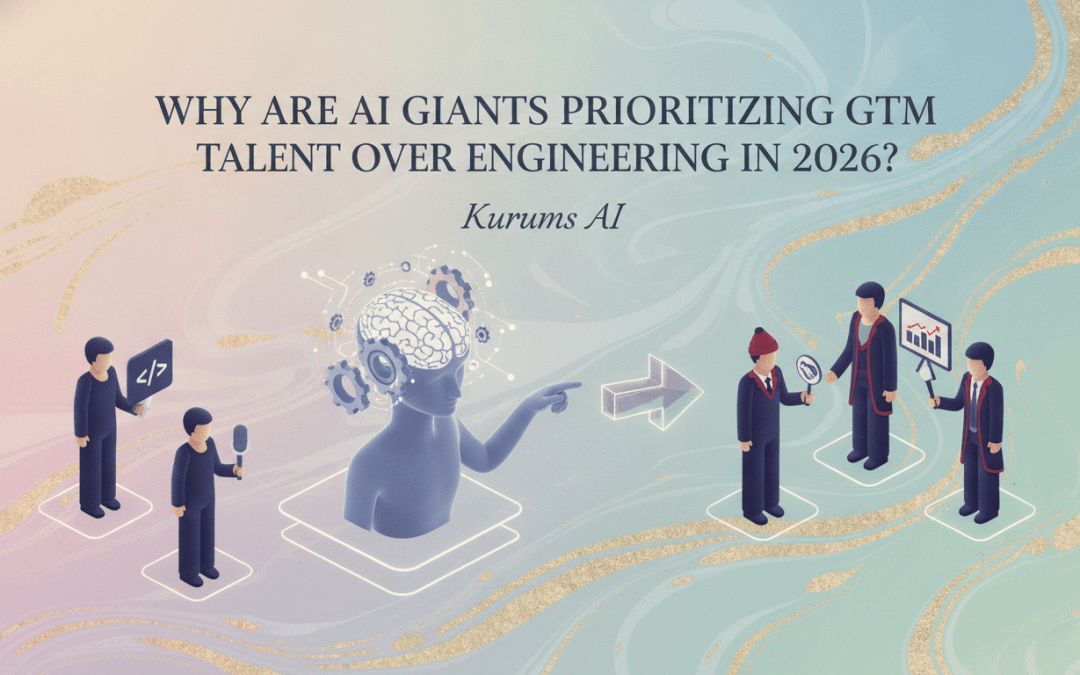
Q: Why is 2026 seeing a shift from engineering to GTM talent in AI labs?
A: The core technology (LLMs) has reached a level of parity and maturity where the primary obstacle is no longer model performance, but enterprise integration, security compliance, and demonstrable ROI. Labs are hiring GTM teams to bridge the gap between “cool tech” and “essential business infrastructure.”
Q: What is the current hiring ratio for giants like OpenAI and Anthropic?
A: Current market data indicates a 3:1 hiring ratio favoring commercial roles (Sales, Solutions Architects, Customer Success) over pure R&D and Model Engineering.
Q: What does this mean for the enterprise?
A: It means the “Wild West” of AI experimentation is over. Enterprises now demand localized deployments, customized workflows, and white-glove support—services that only a robust GTM team can provide.
The AI revolution has reached a critical inflection point. For the past three years, the narrative was dominated by compute power, parameter counts, and the race toward AGI. But here is the real catch: having the world’s most powerful Large Language Model (LLM) means nothing if enterprises cannot integrate it into their legacy workflows. As of mid-2026, the battleground has shifted from the research laboratory to the corporate boardroom. The “Scaling Laws” that once applied only to GPUs are now being applied to human capital—specifically, the commercial teams tasked with selling “intelligence” as a utility.
The Great Recalibration: Why the AI Bottleneck Shifted
For years, the bottleneck was the “Model.” Can it reason? Can it code? Does it hallucinate? While these questions haven’t disappeared, the delta between the top three models (GPT-5, Claude 4, and Gemini 2) has shrunk to a margin that is negligible for most business applications. We have entered the era of Model Parity. In this environment, technical superiority is no longer a sustainable moat.
Think about it this way. In the early days of the internet, the breakthrough was the TCP/IP protocol. But the wealth wasn’t created by the people who wrote the protocol; it was created by the companies that built the Go-To-Market (GTM) engines to put that protocol into every home and office. In 2026, AI labs have realized they are no longer just research institutes; they are the new Oracle, the new Salesforce, and the new Microsoft. And to compete with those giants, they need an army of commercial experts.
But that’s not all. The enterprise world is notoriously slow to change. While an AI lab can update its weights in a weekend, a Fortune 500 company might take 18 months to approve a new vendor. This friction is the new frontier. AI giants are prioritizing GTM talent because they need people who speak the language of “Risk Mitigation,” “Compliance,” and “Change Management”—languages that traditional software engineers rarely master.
Mapping the Shift: Engineering vs. GTM Allocation
To understand the scale of this shift, we must look at the resource allocation within the industry’s leaders. In 2023, 80% of venture capital and revenue was funneled directly into H100 clusters and Ph.D. researchers. Fast forward to 2026, and the payroll of OpenAI, Anthropic, and Cohere reflects a vastly different priority list.
| Resource Category | 2023 Allocation (%) | 2026 Projection (%) | Primary Driver |
|---|---|---|---|
| R&D / Model Training | 70% | 25% | Efficiency in inference & data saturation. |
| Enterprise GTM & Sales | 15% | 50% | Market capture and revenue sustainability. |
| Solutions Architecture | 5% | 15% | Customized integration & legacy migration. |
| Legal, Trust & Safety | 10% | 10% | Regulatory compliance (EU AI Act, etc.). |
The numbers speak for themselves. The “Engineering-Heavy” era was the “Build Phase.” The “GTM-Heavy” era is the “Harvest Phase.” If these companies do not start generating massive enterprise revenue soon, the astronomical valuations they currently hold will face a brutal correction. Therefore, hiring a former Salesforce VP of Sales is currently more valuable than hiring another Stanford CS Ph.D.
The Anatomy of the 2026 GTM Team
What does an AI Go-To-Market team actually look like? It’s not just “cold callers” and “account executives.” It’s a sophisticated blend of technical knowledge and commercial strategy. We are seeing the rise of a new role: the AI Solutions Strategist.
- Sovereign Solutions Architects: These individuals don’t just sell an API; they design on-premise or VPC (Virtual Private Cloud) deployments that satisfy strict data residency laws.
- Vertical-Specific Leads: Experts in Healthcare, FinTech, or Manufacturing who understand the specific regulatory “tripwires” of their industry.
- AI Transformation Consultants: Professionals who focus on “Human-in-the-Loop” workflow design, ensuring that employees actually use the tools provided.
- Value Engineers: Specialists who calculate the exact dollar value of tokens saved versus labor hours reduced.
You see, the product isn’t the model anymore; the product is the outcome. Enterprises are tired of paying for “tokens.” They want to pay for “completed tax audits,” “resolved customer tickets,” or “optimized supply chains.” Scaling a GTM team is the only way to package models into these outcome-based products.
Why “Code is Cheap” and “Context is King”
In the current landscape, the ability to generate Python code or summarize a document is a commodity. You can get that from an open-source Llama model or a proprietary giant. What isn’t a commodity is Enterprise Context.
Enterprise context is the “moat” that GTM teams build. When an Anthropic sales engineer spends six months deeply integrating Claude into the legal department of a global bank, that bank becomes “locked in”—not because the model is magically better, but because the integration is so deep that the cost of switching is prohibitive. This is the classic SaaS playbook, and AI labs are executing it with surgical precision.
The Rise of the “White-Glove” AI Service
We are witnessing the “consultant-ification” of AI labs. OpenAI’s recent hiring sprees have targeted veterans from McKinsey, BCG, and Deloitte. Why? Because the biggest hurdle to AI adoption is Organizational Psychology.
Middle managers are afraid of being replaced. IT departments are afraid of security leaks. Legal teams are afraid of copyright infringement. A software engineer cannot solve these problems with a better loss function. Only a sophisticated GTM professional can navigate these “human” bottlenecks through high-touch engagement and strategic partnership.
Comparison of AI Business Models: 2023 vs. 2026
The shift in talent is a direct result of the shift in how these companies make money. Let’s look at the evolution of the AI business model through this comparative table.
| Feature | 2023 “Research Lab” Model | 2026 “Enterprise Giant” Model |
|---|---|---|
| Sales Motion | Product-Led Growth (PLG) / Self-Serve | Top-Down Enterprise Sales (Field Sales) |
| Pricing | Usage-based (per 1k tokens) | Platform fees + Seat-based + Outcome-based |
| Integration | Public API / Playground | Hybrid Cloud / On-Prem / Fine-tuned Adapters |
| Success Metric | MMLU Scores / Benchmark Wins | Net Revenue Retention (NRR) / ACV |
| Support | Discord / Community Forums | Dedicated Customer Success Managers (CSM) |
It’s clear: the AI industry has “grown up.” It is no longer a playground for developers; it is the central nervous system of global commerce. And you don’t run a central nervous system with just “devs.” You run it with a world-class commercial organization.
The Psychology of the Boardroom: Overcoming the “AI Fatigue”
By 2026, many CEOs have grown skeptical. They’ve heard the hype, they’ve bought the “Plus” subscriptions, but they haven’t seen the radical productivity gains promised in 2023. This is what we call AI Fatigue.
Engineering cannot fix AI Fatigue. Only GTM talent can. Here is how they are doing it:
- Proof of Value (PoV) Frameworks: Instead of vague “pilots,” GTM teams are running structured 30-day PoVs with predefined KPIs like “reduction in average handle time (AHT)” or “code refactoring speed.”
- Executive Briefing Centers: Labs are opening physical and virtual centers to educate C-suite executives on the 5-year roadmap, moving the conversation from “tools” to “infrastructure.”
- Co-Innovation Agreements: Rather than just selling a license, labs are entering “Co-Innovation” deals where they build custom models alongside the client, sharing the risk and the reward.
Here is the crazy part: many of these “commercial” roles actually require a deep understanding of the tech. We are seeing a merger of roles. The salesperson of 2026 can explain the difference between RAG (Retrieval-Augmented Generation) and Fine-tuning just as well as they can explain a contract’s indemnification clause.
The Enterprise Adoption Bottleneck: Security and Sovereignty
The real reason engineering is taking a backseat to GTM in hiring is the Security Wall. High-end labs have realized that if they can’t get past a Chief Information Security Officer (CISO), their model is useless.
In 2026, “Data Sovereignty” is the buzzword of the year. Companies in the EU, Singapore, and the US are demanding that their data never leaves their jurisdiction—and sometimes never leaves their own servers. Building the technology to allow “federated learning” or “private inference” is one thing; selling the trust that it works is another. GTM teams are the “trust ambassadors” of the AI world.
The “Salesforce-ification” of OpenAI and Anthropic
Wait, is AI just becoming another SaaS category? Not exactly, but the GTM strategies are converging. OpenAI’s hiring of former Sarah Friar (ex-Salesforce, ex-Square) as CFO and other commercial heavyweights signals a move toward a pre-IPO structure that looks remarkably like a traditional software giant.
However, the difference lies in Velocity. Traditional SaaS has a sales cycle of 6-12 months. AI GTM teams are trying to compress this into 3 months because the technology moves so fast that a 12-month sales cycle would render the product obsolete by the time it’s signed. This requires “Hyper-GTM”—a blend of rapid prototyping (Engineering) and aggressive closing (Sales).
Why 2026 is the Year of “Customer Success” in AI
In the SaaS world, Customer Success (CS) was often the “forgotten” department. In AI, CS is the Engine of Growth. Why? Because the hardest part of AI isn’t buying it; it’s prompting it and integrating it.
If a company buys 10,000 licenses of Claude but the employees don’t know how to write effective prompts or integrate them into their Slack/Teams workflows, they will churn. AI labs are hiring “AI Success Managers” to ensure that the adoption curve is steep and permanent. These roles are 50% teacher, 25% psychologist, and 25% technical architect.
- Prompt Engineering Workshops: Training staff to move beyond “Help me write an email” to “Analyze this dataset for seasonal anomalies.”
- Internal AI Champions: Identifying and empowering “super-users” within the client organization.
- Iterative Feedback Loops: Feeding user frustrations directly back to the product team to refine the UI/UX, making the AI “invisible.”
Technical Debt: The Silent Killer of AI Sales
One of the biggest reasons for the GTM surge is the massive “Technical Debt” found in most enterprises. Most Fortune 500 companies are still running on fragmented, messy data architectures that were built in the 1990s and 2000s.
You cannot run a state-of-the-art AI on “dirty data.” AI labs are finding that their GTM teams need to include Data Strategists who can help clients clean their data before the AI can even function. This is a massive “pre-sales” effort that requires human talent, not just automated scripts.
The Future: Will Engineering Ever Reclaim the Throne?
Does this mean AI engineering is a dead end? Absolutely not. But it means that engineering has entered its “Optimization Phase.” The goal is now to make models smaller, faster, and cheaper (SFC). While a small team of elite researchers works on the “next big leap” (like AGI or radical new architectures), the majority of the workforce will be focused on Applied AI.
By 2027, we expect the GTM roles to evolve even further into “AI Orchestrators”—people who don’t just sell one model, but sell a system of agents that work across multiple models. The complexity of these systems will make the sales process even more consultative and even more human-centric.
Strategic Action Plan for Enterprise Leaders
If you are a leader in this new landscape, your strategy must reflect the shift from “Building” to “Buying and Implementing.” The bottleneck is human, and your solution must be human too.
- Audit Your GTM Ratio: If you are an AI startup, check if your engineering-to-sales ratio is still stuck in 2023. You likely need more “bridge builders” (Solutions Architects).
- Invest in “AI Literacy” as a Commercial Tool: Your sales team must be your most technical assets. They should be able to demo live, troubleshoot basic API errors, and discuss tokenomics fluently.
- Focus on the Last Mile: Don’t just deliver an API key. Deliver a workflow. The company that solves the “Last Mile” of integration wins the market.
Final Thoughts: The Commerce of Intelligence
The transition we are seeing in 2026 is the natural maturation of a foundational technology. We have moved from the “Magic” phase to the “Utility” phase. In the utility phase, the winner isn’t the one with the best laboratory, but the one who can plug the power into every house in the city.
OpenAI, Anthropic, and their peers have realized that to change the world, they have to sell to the world. And selling “Intelligence” is the hardest GTM challenge in history. It requires more than code; it requires a deep understanding of how humans work, how businesses grow, and how trust is built. The “Engineers of Growth” are now just as important as the “Engineers of Code.”
Are you ready for the era of Commercial AI? The laboratories are full—it’s time to hit the streets.
Discover more from Kurums | Business Intelligence
Subscribe to get the latest posts sent to your email.