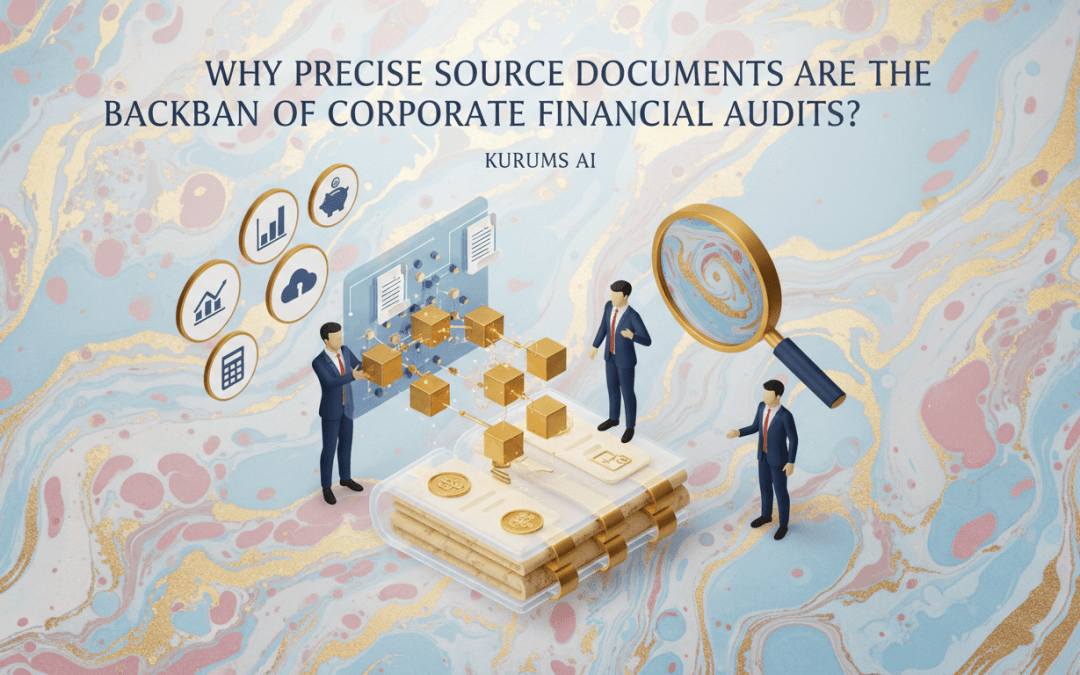
What are source documents in a corporate context? They are the original records (invoices, receipts, contracts, bank statements) that serve as objective evidence for every financial transaction recorded in the general ledger.
Why are they called the “backbone” of audits? Without them, an audit trail is broken. Auditors use these documents to verify the “existence,” “occurrence,” and “accuracy” of financial claims. In short: if it isn’t documented, it didn’t happen.
What is the 2026 Compliance Standard? It refers to the global shift toward real-time reporting and digital immutability, requiring corporations to maintain instantly accessible, cryptographically secure digital twins of all source documents.
Every financial movement within a corporation must be anchored to a verifiable reality. In the high-stakes world of international finance, a transaction without a source document is merely an unsubstantiated entry in a ledger—a ghost in the machine. For tax authorities, external auditors, and regulatory bodies, an entry lacking a source document effectively does not exist. This lack of substantiation is the primary catalyst for severe penalties, disallowed tax deductions, and legal liabilities that can jeopardize a corporation’s future.
But here is the kicker: managing source documents is no longer just about filing paperwork in a cabinet. It has evolved into a sophisticated discipline of data integrity and risk management. As we approach 2026, the demand for “precise” documentation has skyrocketed, driven by the rise of AI-driven auditing and real-time tax reporting requirements. To survive an audit today, a firm must provide more than just a receipt; it must provide a narrative of legitimacy.
1. The Definitive Definition: Beyond Paper and Ink
To understand the gravity of source documents, we must first define what they represent in the modern era. Historically, source documents were physical papers—signed, stamped, and filed. Today, they are digital assets, often existing as EDI (Electronic Data Interchange) files, blockchain hashes, or cloud-stored PDFs. However, their fundamental purpose remains unchanged: they provide the evidentiary support necessary to validate the four pillars of accounting: Existence, Rights/Obligations, Completeness, and Valuation.
Think about it this way: if the general ledger is the “story” of a company’s financial year, the source documents are the “witnesses.” Without witnesses, the story is just fiction. Precise source documents include, but are not limited to:
- Supplier Invoices: Validating the cost, tax breakdown, and vendor identity.
- Purchase Orders (PO): Confirming that the expenditure was authorized prior to the transaction.
- Executed Contracts: Establishing the legal terms, performance obligations, and payment milestones.
- Bank Statements: Providing the ultimate “truth” by showing the actual movement of cash.
- Expense Receipts: Verifying employee-level spending and tax-deductible business costs.
- Payroll Records: Documenting the largest recurring expense for most service-based corporations.
2. The Evolution of Audit Readiness: Preparing for 2026
Why is 2026 a turning point? Regulatory bodies worldwide, including the OECD with its Pillar Two initiatives and various national tax authorities (like the UK’s Making Tax Digital or the EU’s ViDA), are moving toward real-time or near-real-time digital reporting. This means the traditional “post-mortem” audit—where you gather documents months after the fiscal year ends—is becoming obsolete.
By 2026, the expectation will be continuous compliance. Corporations will need to maintain an “immutable audit trail.” This means that once a document is recorded, it cannot be altered without a logged adjustment entry. The precision of the initial capture becomes paramount. If a digital invoice is captured with incorrect metadata today, it becomes a systemic risk tomorrow.
3. The Anatomy of an Audit Trail: Connecting the Dots
An audit trail is a step-by-step record by which financial data can be traced to its source. It is the nervous system of corporate transparency. Imagine an auditor selecting a random $50,000 “Consulting Fee” entry in your ledger. The audit trail must allow them to work backward with ease.
First, they look for the invoice. Then, they look for the contract that authorized the consulting rate. Next, they look for the “deliverable” (proof that work was done). Finally, they look for the bank confirmation showing the $50,000 leaving the company account. If any link in this chain is missing or imprecise—such as a contract that isn’t signed by both parties—the entire transaction is flagged as a “significant deficiency” or a “material weakness.”
Comparison of Documentation Weights in an Audit
Not all documents carry the same evidentiary weight. Auditors use a hierarchy of evidence to determine how much they can trust an entry. The following table outlines how different document types are perceived during a corporate audit.
| Document Type | Source Origin | Audit Weight | Risk of Manipulation |
|---|---|---|---|
| External Bank Statement | Third-Party (Bank) | Highest | Very Low |
| Supplier Invoice | External Vendor | High | Low (if verified) |
| Internal Purchase Requisition | Internal Dept. | Medium | Moderate |
| Employee Expense Memo | Internal Employee | Low | High |
4. Mitigating Fraud through Documentation Precision
Fraud thrives in ambiguity. When source documents are vague, incomplete, or missing, it creates “shadows” where occupational fraud can hide. One of the most common corporate fraud schemes involves “ghost vendors”—fake companies created by employees to bill the corporation for services never rendered.
Precise source documents are the ultimate deterrent. A robust system requires every invoice to be matched to a verified Tax ID and a physical address. Furthermore, the use of timestamped digital signatures on contracts makes it nearly impossible for an internal actor to backdate an agreement to cover their tracks. In the eyes of an auditor, the precision of the metadata (who created the document, when, and from what IP address) is often as important as the document’s content itself.
5. The Legal and Tax Implications of Substantiation
Let’s talk about the legal burden of proof. In most jurisdictions, the “burden of proof” in a tax audit rests solely on the taxpayer, not the government. If the tax authority (like the IRS or HMRC) challenges a $1 million deduction, the corporation must prove it is entitled to that deduction through source documents.
But wait, there’s more. Beyond just “having” the document, you must ensure it meets statutory requirements. For example, a VAT/GST invoice must contain specific information: the seller’s tax ID, a unique invoice number, a detailed description of goods, and the specific tax rate applied. If a document is “imprecise”—for instance, it’s missing the buyer’s corporate name—the tax authority can legally disallow the entire tax credit, leading to massive unexpected liabilities.
6. Digital Transformation: From Filing Cabinets to OCR and AI
The sheer volume of transactions in a modern corporation makes manual document management impossible. This is where Optical Character Recognition (OCR) and Artificial Intelligence (AI) step in. Leading-edge corporate accounting departments are now using “Intelligent Document Processing” (IDP) to scan and categorize source documents automatically.
The goal is to achieve 100% capture with zero human touch. When an invoice arrives in an AP (Accounts Payable) inbox, the AI extracts the vendor name, the line items, the tax amount, and the total. It then cross-references this with the Purchase Order and the shipping manifest. This level of precision ensures that by the time an auditor arrives, the “verification” work has already been done by the system in real-time.
Operational Efficiency: Manual vs. Automated Documentation
The following table illustrates why corporations are investing millions in document precision technology. The ROI isn’t just in “saving paper”—it’s in risk reduction and speed.
| Metric | Manual Process | AI-Automated Process |
|---|---|---|
| Processing Time per Invoice | 12 – 15 Minutes | < 30 Seconds |
| Error Rate (Data Entry) | 4% – 8% | < 0.5% |
| Audit Retrieval Time | Days/Weeks | Instant (Searchable) |
| Storage Cost | High (Physical Space) | Minimal (Cloud) |
7. Internal Controls and the COSO Framework
Corporate financial audits are fundamentally an evaluation of “Internal Controls.” Auditors use the COSO (Committee of Sponsoring Organizations) framework to assess risk. At the heart of this framework is Information and Communication.
Precise source documents are the primary evidence that internal controls are functioning. For instance, if a company policy states that all expenses over $10,000 require CFO approval, the source document (the invoice) must be accompanied by an approval stamp or a digital authorization log. If an auditor finds an invoice for $15,000 without that secondary document, it’s a “Control Failure.” Even if the money was spent legitimately, the failure to document the process of the spend is a major audit hit.
8. Best Practices for Maintaining an Immutable Audit Trail
So, how does a modern corporation ensure its source documents are truly “the backbone” of its financial health? It requires a proactive strategy rather than a reactive one. You cannot wait for “audit season” to start organizing your records.
- Centralize Everything: Eliminate “siloed” documentation. Whether it’s a marketing expense or a manufacturing cost, every source document should flow into a single, searchable ERP or Document Management System (DMS).
- Standardize Naming Conventions: Use a rigorous metadata strategy (e.g., YYYY-MM-DD_VendorName_InvoiceNumber). This ensures that documents are never “lost” in the digital void.
- Implement Write-Once-Read-Many (WORM) Storage: For high-compliance industries, use storage solutions that prevent a file from being edited or deleted once it has been uploaded.
- Regular Internal Spot-Checks: Conduct “mini-audits” every quarter. Randomly select 20 transactions and see if you can find all supporting source documents within 5 minutes.
- Digitize at the Source: Encourage vendors to send e-invoices directly into your system rather than mailing paper copies that must be scanned.
9. Global Compliance: GAAP, IFRS, and Beyond
For multinational corporations, the challenge is multiplied. You are dealing with different accounting standards—Generally Accepted Accounting Principles (GAAP) in the US and International Financial Reporting Standards (IFRS) elsewhere. While their specific rules differ, both frameworks agree on one thing: Substance over Form.
This means that the reality of a transaction (documented by the source document) is more important than its appearance. For example, if you lease a piece of equipment, the source document (the lease agreement) will determine whether that is treated as an “Operating Lease” or a “Finance Lease” on your balance sheet. An imprecise or poorly worded contract can lead to a multi-million dollar misclassification error, resulting in a restatement of earnings—a nightmare scenario for any CFO.
10. The Impact of Remote Work on Documentation Integrity
The post-pandemic world has introduced a new risk: decentralized documentation. With employees working from home, “source documents” are often sitting on personal laptops or in home office drawers. This decentralization is an auditor’s worst nightmare.
Corporations must implement mobile-first document capture tools. If an executive has a business lunch, they should be required to photograph the receipt and upload it to the corporate system before they even leave the restaurant. The longer the gap between the transaction and the documentation, the higher the “Precision Decay Rate.”
11. The Role of Source Documents in Business Valuation and M&A
Beyond audits, precise source documents are critical for Due Diligence. If your corporation is ever looking for investment, a merger, or an acquisition, the buyer’s team will perform a “deep dive” into your records. They aren’t just looking at your profit and loss statement; they are looking at the contracts and invoices that support those numbers.
A company with “messy” source documents is viewed as a high-risk asset. This can lead to a “valuation haircut”—where the buyer offers less money because they cannot verify the recurring nature of your revenue or the validity of your IP (Intellectual Property) ownership. In this context, precise documentation isn’t just a compliance task; it’s a value-driver.
12. Building a “Compliance First” Corporate Culture
The technical systems are only as good as the people using them. To truly maintain a backbone of precise source documents, a corporation must foster a culture of accountability. This starts at the top (Tone at the Top).
- Mandatory Training: Ensure every employee knows what a “valid” source document looks like.
- Strict Deadlines: Implement a “No Receipt, No Reimbursement” policy that is strictly enforced, even for top executives.
- Feedback Loops: If the accounting team receives an imprecise invoice from a vendor, they should immediately send it back for correction rather than trying to “fix” it internally.
Conclusion: The Path to Audit-Proof Success
As we look toward 2026, the complexity of corporate financial audits will only increase. The move toward digital transparency and real-time reporting leaves no room for error. Source documents—the humble invoices, contracts, and receipts—remain the only defense against regulatory scrutiny, financial fraud, and operational inefficiency.
By treating these documents as strategic assets rather than administrative burdens, corporations can build an immutable audit trail that serves as a foundation for growth. Precision in documentation is not just about staying out of trouble; it’s about providing the clarity and integrity that shareholders, regulators, and partners demand in the modern age.
Final Call to Action
Is your organization ready for a 2026-standard audit? Begin by auditing your own audit trail. Transition from manual filing to an automated, AI-driven Document Management System today. Remember: In the world of corporate finance, if you can’t prove it with a precise source document, it didn’t happen. Don’t leave your fiscal integrity to chance—anchor it in evidence.
Discover more from Kurums | Business Intelligence
Subscribe to get the latest posts sent to your email.