- What is Meta’s 2026 strategy? Meta is implementing a “Surgical Efficiency” model, aiming for a 10% headcount reduction to reallocate capital toward autonomous AI agents and core infrastructure.
- How does Microsoft’s approach differ? Microsoft is utilizing Voluntary Severance Packages (VSPs) and “Golden Handshakes” to encourage a demographic shift, allowing senior staff to exit gracefully while making room for AI-native talent.
- What is the primary goal? Beyond cost-cutting, both giants are pursuing “High-Performance Workforce Optimization,” ensuring every remaining employee is a multiplier for the company’s 2026-2030 roadmap.
- Who is most affected? Middle management and non-technical roles that have not integrated AI into their workflows are at the highest risk.
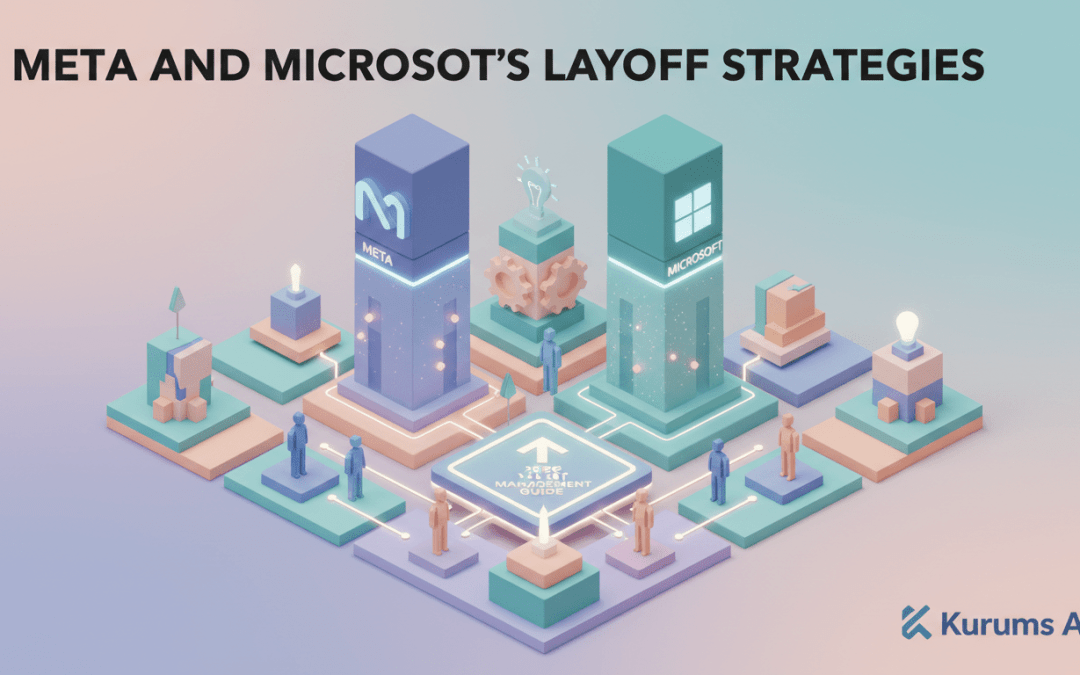
Meta and Microsoft’s Layoff Strategies: The 2026 Talent Management Guide
Last Updated: April 23, 2026 – Written by kurums.com Editorial Team
The tech landscape of 2026 is no longer defined by the frantic “hiring wars” of the early 2020s. Today, we witness a more calculated, cold, and data-driven evolution. As technology titans Meta and Microsoft enter the 2026 fiscal year, their radical workforce structural changes offer a masterclass in modern corporate survival. Meta’s aggressive 10% downsizing and Microsoft’s elegant voluntary retirement strategy represent two distinct schools of modern HR management.
But here is the real question: Is this just about saving money, or is it a fundamental redesign of what a “corporation” looks like in the age of mature artificial intelligence? Consider this: labor, traditionally the largest expense for any corporation, is no longer just a cost center to be managed—it is a variable to be optimized with algorithmic precision. In this guide, we will deep-dive into the “Why” and “How” behind these trillion-dollar decisions.
1. Meta’s “Surgical Efficiency”: The 10% Downsizing Blueprint
Meta, under Mark Zuckerberg’s intensified “Year of Efficiency” mantra (now in its 4.0 iteration in 2026), has moved beyond general layoffs. The current 10% reduction is not a reaction to a bad quarter; it is a proactive re-engineering of the organizational chart. Meta’s goal is to reach a 1:15 manager-to-employee ratio, a drastic leap from the 1:8 industry standard of the past decade.
This 10% cut specifically targets “Coordination Layers.” In the 2026 corporate environment, AI-driven project management tools have rendered many middle-management roles obsolete. By removing these layers, Meta isn’t just saving on salaries; they are increasing the “velocity of decision-making.” When there are fewer people to say “no,” the speed of “yes” accelerates. This is critical for Meta’s survival in the hyper-competitive AR/VR and generative social media space.
But it doesn’t stop there. Meta is leveraging its own Llama-5 internal agents to automate routine HR, legal, and compliance tasks. The 10% being phased out are largely those whose functions have been successfully mapped into these internal AI ecosystems. The message is clear: If your job can be described in a 5-step prompt, your seat is at risk.
2. Microsoft’s “Golden Handshake”: The Power of Voluntary Severance
Contrast Meta’s surgical strikes with Microsoft’s “Soft Transition” model. Microsoft has introduced a massive Voluntary Severance Package (VSP) targeting employees with 15+ years of tenure. Instead of the negative PR associated with mass layoffs, Microsoft is framing this as an opportunity for “Demographic Rejuvenation.”
The voluntary retirement package includes up to 24 months of salary, extended healthcare, and specialized “Second Act” career coaching. Why would Microsoft be so generous? The answer lies in the Total Cost of Talent. Senior employees often carry high salaries, legacy benefits, and—most importantly—legacy mindsets. By encouraging voluntary exits, Microsoft avoids the “survivor guilt” that often cripples morale after forced layoffs.
This strategy allows Satya Nadella’s team to refill these vacant slots with “AI-Native” graduates at a 40% lower cost basis, while simultaneously clearing the path for cultural transformation. It is a demographic shift disguised as a benefit package. Microsoft is effectively “buying back” its organizational agility.
3. Comparative Analysis: Meta vs. Microsoft (2026)
To understand which strategy fits your organization, we must look at the data side-by-side. The following table breaks down the core metrics of these two approaches.
| Metric | Meta (Forced Downsizing) | Microsoft (Voluntary VSP) |
|---|---|---|
| Primary Objective | Operational Velocity & OPEX Reduction | Demographic Shift & Cultural Refresh |
| Target Group | Middle Management / Redundant Roles | Tenured Staff (15+ Years) |
| Impact on Morale | High Tension / Performance-Driven | Neutral to Positive / Gradual Transition |
| Estimated Cost Savings | Immediate (within 1-2 quarters) | Long-term (realized over 18-24 months) |
| Public Perception | Aggressive & “Lean” | Compassionate & “Strategic” |
4. The Financial Mechanics: Impact on OPEX and EBITDA
In 2026, the stock market no longer rewards growth at all costs; it rewards EBITDA-per-Employee. This metric has become the North Star for Silicon Valley. Meta’s 10% cut is projected to improve its operating margin by 450 basis points by the end of FY2026. For a company of Meta’s scale, that translates into billions of dollars that can be diverted into “Compute Capital”—the purchasing of next-gen GPU clusters.
Microsoft’s VSP, while expensive in the short term due to the massive severance payouts, is a maneuver to lower the “Terminal Cost of Labor.” By replacing a $350k/year legacy architect with a $160k/year AI-specialized engineer, the long-term compounding effect on the bottom line is staggering. Furthermore, Microsoft avoids the litigation risks often associated with age-discrimination lawsuits during forced layoffs.
5. Talent Management in 2026: High-Performance Workforce Optimization
The term “Human Resources” is being replaced in boardrooms by “Workforce Optimization (WO).” This isn’t just a semantic change. WO treats talent as a dynamic portfolio. In 2026, companies are using “Skill-to-Value” mapping to determine who stays and who goes.
High-performance workforce optimization involves three key pillars:
- Predictive Churn Modeling: Using AI to predict which employees are likely to disengage or leave, allowing for proactive intervention or planned replacement.
- Role Deconstruction: Breaking jobs down into “Tasks.” If 60% of a role’s tasks are now automated, the role is flagged for “Consolidation” (the polite term for layoffs).
- Internal Talent Marketplaces: Meta, for instance, allows employees whose departments are being cut to “bid” for roles in high-growth areas like Meta-Reality Labs, but only if they pass a rigorous “AI-Literacy Test.”
6. The Psychology of the 2026 Workplace: Managing the “Survivor”
One of the biggest mistakes a kurumsal (corporate) leader can make is ignoring those who remain. “Survivor Guilt” in 2026 is coupled with “Automation Anxiety.” Employees see 10% of their colleagues leave and think, “Am I the next 10%?”
Meta handles this through radical transparency and “Performance-Based Security.” They tell their employees: “You are safe as long as your output-to-cost ratio remains in the top 75th percentile.” It’s brutal, but it eliminates the ambiguity that kills productivity.
Microsoft, conversely, uses its VSP to create a “Legacy Celebration” culture. By treating those who leave as heroes who helped build the company, they maintain a positive brand image for those who stay. It creates a sense of “passing the torch” rather than “getting the axe.”
7. The Role of Generative AI in the Org Chart
Wait, there’s a catch. You cannot talk about Meta and Microsoft in 2026 without talking about “Digital Twins” and “Agentic Workforces.” In many of the departments where Meta is cutting 10%, they are simultaneously deploying “Digital Staff.”
These are not just chatbots. They are autonomous agents capable of handling supply chain logistics, basic coding, and initial customer success queries. The 2026 layoff strategy is essentially a Resource Swap: swapping expensive, slow human labor for scalable, 24/7 digital labor. This is the “Inconvenient Truth” of the 2026 labor market.
8. Checklist: How to Conduct a 2026-Style Optimization
If your organization is looking at Meta or Microsoft as a benchmark, use the following checklist to ensure your workforce optimization is strategic, not just reactive.
- Define the Objective: Is your goal immediate cash flow (Meta style) or long-term cultural transformation (Microsoft style)?
- Audit AI-Replaceable Tasks: Before cutting heads, audit the workflows. Can 30% of the work be automated? If so, the layoff is a structural necessity.
- Identify “Lynchpin” Talent: Use network analysis to find the “quiet influencers”—the people who hold teams together. These people must be protected at all costs.
- Draft a “Dignity-First” Exit Strategy: Whether it’s a VSP or a forced layoff, the package must include upskilling credits. In 2026, a “good” layoff includes a path to the employee’s next job.
- Communicate the “Why”: Modern employees see through corporate jargon. Be honest about the 10% or the VSP. Explain the fiscal reality and the future vision.
9. Market Reaction: Why Investors Love the Pruning
Wall Street’s reaction to these moves has been tellingly positive. In the 2026 fiscal environment, a “hiring freeze” is seen as a sign of stagnation, while “strategic downsizing” is seen as a sign of management strength.
Microsoft’s stock (MSFT) saw a 4.2% jump following the VSP announcement because analysts calculated the “Average Age of Talent” would drop by 6 years, signaling a more aggressive stance on AI innovation. Meta (META) saw a similar surge, as the 10% cut proved Zuckerberg’s commitment to the “Lean Metaverse” model. Investors are looking for companies that can produce more with less. In 2026, Efficiency is the new Growth.
10. Future Projections: Is the 10% Cut the New Normal?
Looking toward 2027 and 2028, we expect this “Cycle of Pruning” to become an annual event in the tech sector. Much like a gardener prunes a rose bush to encourage more blooms, tech companies will adopt “Continuous Workforce Rightsizing.”
We are moving away from “The Great Resignation” and “The Great Layoffs” toward “The Great Calibration.” In this era, the relationship between employer and employee is becoming more transactional and more specialized. The traditional 40-year career at one company is a relic of the past; the 2026 model is a series of high-impact “stints” optimized for both parties.
11. Implementation Roadmap: Choosing Your Path
To help HR directors and C-suite executives decide, here is a roadmap based on organizational maturity and market position.
| Scenario | Recommended Strategy | Key Risk to Manage |
|---|---|---|
| High Debt / Slow Growth | Meta’s 10% Surgical Cut | Losing top-tier talent to competitors during the chaos. |
| Cash Rich / Legacy Culture | Microsoft’s Voluntary VSP | Over-subscription (losing too many people at once). |
| Hyper-Growth / Scaling AI | Internal “Reskill or Exit” Program | Drop in short-term productivity during training. |
| Stable / Dividend-Focused | Natural Attrition (No Backfilling) | Slow “rot” of technical skills over time. |
12. The Human Element: Don’t Forget the Brand
In the age of social media and Glassdoor-integrated AI, how you fire is just as important as who you fire. An aggressive 10% cut can ruin your “Employer Value Proposition” (EVP) for years if handled coldly. Meta has mitigated this by offering robust “Alumni Networks” and allowlisting former employees for future contract work.
Microsoft’s VSP is the gold standard for brand protection. It turns former employees into brand ambassadors. When a retired Microsoft engineer speaks well of the company, it helps Microsoft recruit the next generation of genius-level talent. In 2026, your Exit Experience is your best recruiting tool.
13. Conclusion: The Strategic Pivot of 2026
The strategies of Meta and Microsoft are not just HR updates; they are a fundamental shift in the social contract between capital and labor. Meta proves that in the AI age, speed is the ultimate currency, and a 10% reduction is sometimes the only way to shed the weight of the past. Microsoft proves that empathy and strategy can coexist, using the VSP to reshape its future without breaking its spirit.
As a leader in 2026, you must ask yourself: Is my workforce built for the challenges of 2020, or the opportunities of 2030? Optimization is no longer optional. It is the price of entry into the future of business.
Ready to optimize your workforce? The era of “High-Performance Workforce Optimization” is here. Whether you follow the path of Meta or Microsoft, the time to act is now, before the 2027 fiscal cycle begins. Efficiency waits for no one.
Discover more from Kurums | Business Intelligence
Subscribe to get the latest posts sent to your email.